

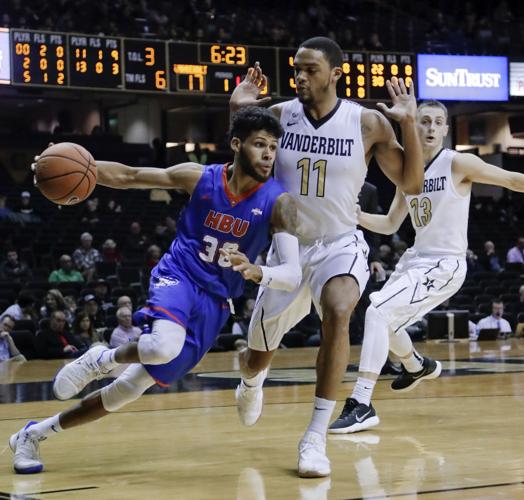

By appearing at McKale Center for Arizona’s season opener Wednesday, Houston Baptist will set two records.
Not only will the Huskies bring in the lowest-ever RPI from the previous season of any UA opponent, but Arizona will also pay them as much as any previous opponent, a tidy $100,000.
How is that possible?
Let’s take a dive into the dynamics of college basketball scheduling, with a little sidebar on good old supply and demand.
It’s all basically tied to Arizona’s appearance in this season’s Maui Invitational and the proliferation of “multiteam” events that have flooded college basketball’s early-season calendar.
Since NCAA rules allow “MTEs” to have up to four games but count for only three against the NCAA scheduling maximum, the Maui Invitational has normally offered add-on mainland games so participants play an unbracketed fourth game on top of the three-game Lahaina bracket.
In the past, four mid- or low-major teams have been recruited as opponents, with three of them playing two of the Maui participants on their home courts, and one team playing only one game (since traditional Maui host Chaminade did not play mainland games).
The four mainland-only teams would then meet for their own two-game bracket, usually at the site of the team that played only one game.
This worked out well the last time Arizona played in the Maui Invitational during the 2014-15 season. Eventual Maui championship game participants Arizona and San Diego State both hosted Cal State Northridge for early season wins at home, and then the Matadors went to Little Rock, Arkansas, and beat Samford while losing to Arkansas Little-Rock.
In the old format, everybody was happy. Almost everyone got to play four games, and while the mainland-only teams didn’t get to go to Maui, they cashed guarantee checks for road games and had a chance to win a couple of neutral-site games.
But this year, things began to fall apart.
Ryan Reynolds, who coordinates UA’s schedules as the Wildcats’ director of basketball operations, said the Maui Invitational went into May without four add-on opponents lined up — and everyone was getting a little anxious.
“Maui was having a hard time filling it,” Reynolds said. “There’s so many MTE events that exist now that it’s hard to get some smaller schools that at some point in time would have been excited to play in a big MTE event even if they didn’t get to go to Maui, because it worked out for them financially.
“That’s what broke down. And as we hit May or June, it was like, ‘OK, there’s not four teams signed up to do this.’”
Wisconsin also was having trouble getting an add-on game for its participation in the Battle 4 Atlantis, so the Badgers applied to the NCAA for a waiver that would allow them to schedule their own add-on game.
Arizona and most of the Maui teams decided to also apply.
The NCAA granted their waivers in July. By then, however, there weren’t a whole lot of teams left on the scheduling market with an open date — and a lot of hungry high-major programs were suddenly trying to sign them.
That’s where the supply and demand thing comes in.
Worse, Arizona had only a few possible dates with which to find a match: The Wildcats couldn’t play any earlier than the first allowable regular-season date (Tuesday) but not too close to its Sunday game with Cal Poly.
“After we got the waiver, I was calling and emailing a bunch of people to see what was out there,” Reynolds said. “If you’re doing it in late July, you just have to get it done.”
Houston Baptist had the date open. Reynolds offered the Huskies $100,000.
“We usually pay between 85 and 95 (thousand) but at that time of year, it was like, ‘Let’s just get it done,’” Reynolds said. “It just kind of helped get it done.”
The figure is actually still less than what some power-conference teams will offer for game guarantees, which are a flat amount paid to visitors in lieu of sharing television and attendance revenue.
But the $100,000 is more than Arizona is paying any other opponent this season and matches the previous high that UA has ever paid. Ball State collected $100,000 in the 2011-12 season.
The $100,000, of course, is also a pretty nice chunk of revenue for the Houston Baptist athletic department. The Huskies annually seek four or five guarantee games to help their program stay afloat.
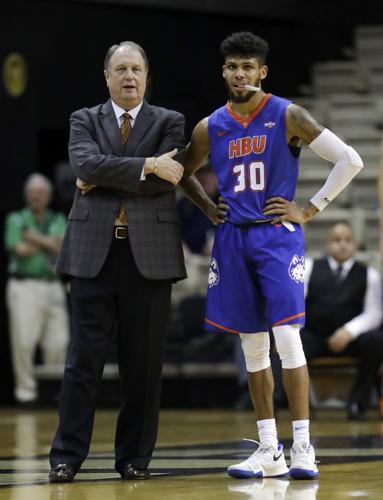
“Anytime you’re at our level, there’s a budget,” Houston Baptist coach Ron Cottrell said. “But this is also an exposure thing and it’s a chance for the guys to go play in some great arenas.”
And if the Huskies can find a little leverage along the way, even better.
“We just had a date open that was an attractive date,” Cottrell said. “It just worked out. We try to get everything filled earlier as much as we can, but usually you end up with one game left to schedule. If it’s a good date, you can put yourself in a good position.”

