




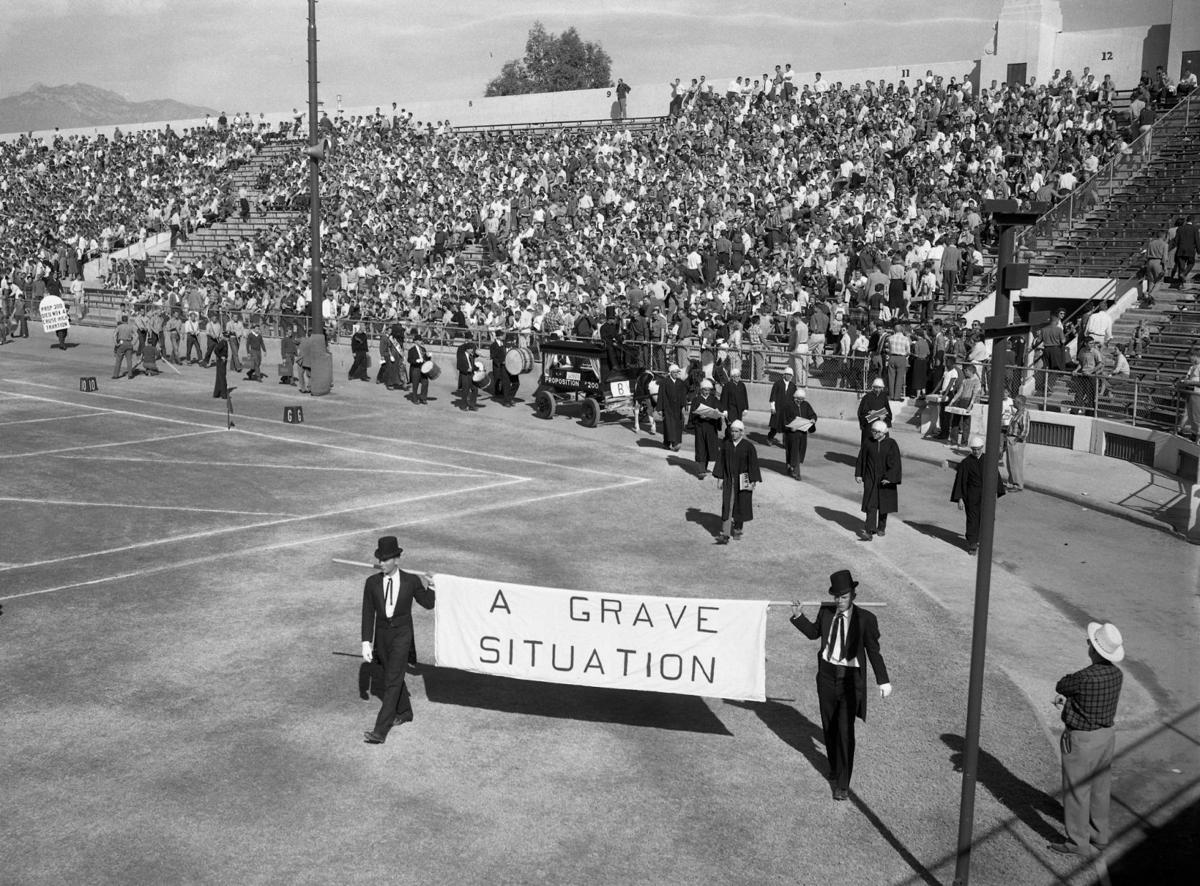
On Election Day 60 years ago this week, 51,471 Arizonans voted to kill a measure that would add “University” to the title of Arizona State College.
Considering that Pima County had just 82,249 registered voters in 1958 — and that politicians estimated most of the 51,471 “no” votes came from Tucson — it turned out to be one of the Sun Devils’ greatest victories over the Wildcats.
Proposition 200 drew 101,811 Maricopa County-heavy “yes” votes. Tucsonans who feared ASU to be a sleeping giant, in sports and otherwise, had no chance. The Sun Devils gained equal footing for the first time in history.
First-year Sun Devil football coach Frank Kush was so motivated to strike back at the haughty UA athletic constituency that decades later he told “Maroon and Gold: A History of Sun Devil Athletics” author Bob Eger: “It’s easy to develop an aggressive attitude toward them when you experience something like that.”
“Aggressive” didn’t do justice to the bad feelings between the schools.
When newly-named ASU arrived in Tucson for the Territorial Cup 60 years ago this month, Arizona coach Ed Doherty was pictured on Page A1 of the Arizona Daily Star wearing a “Beat Tempe” necktie.
ASU won in Tucson that day, 47-7, launching a Territorial Cup dominance that lasted until 1982.
Touché.
Thus began a profound and unimaginable 60-year change in the culture of college sports, both in Tucson and Tempe.
The schools are still “aggressive” rivals, so much so that as the Sun Devils upset Utah last week, giving the UA a slight opening in the Pac-12 South race, Arizona starting defensive lineman PJ Johnson tweeted, “First time I’ll ever root for asu.’
At this time a year ago, Johnson was playing for Sacramento City College and probably didn’t know if it was ASU or ASC, nor did he care. Now he’s all in. Who isn’t?
In recent years, ASU and Arizona have combined to spend an estimated $600 million on athletic facilities. The football and basketball coaches at both schools are millionaires many times over.
After Kush won in Tucson in 1958, the Sun Devils gave him a new one-year contract for $10,000.
Construction of the original Sun Devil Stadium was estimated at $875,000.
That 1958 Election Day showdown, Arizona vs. ASC, is crazily modest by today’s college sports standards.
Do you realize Arizona is paying Houston Baptist $100,000 to agree to play basketball at McKale Center on Wednesday?
The ’58 Territorial Cup wasn’t even televised. UA officials canceled those plans when ticket sales to the game were slow, even though a record crowd of 25,247 attended. Ticket sales were always No. 1 until monstrous media-rights contracts of the 21st century changed the game’s finances — and kickoff times — forever.
The ’58 game was played at 2:30 p.m., instead of Arizona’s routine 8 p.m. home kickoffs. Why the change?
Star columnist Abe Chanin reported that Arizona played afternoon home games against Idaho, West Texas State and ASU “to gain more national publicity; the scores of Arizona’s night football games fail to make Midwest and Eastern newspapers.”
It worked, too. “After Arizona beat West Texas,” Chanin wrote, “the Cedar Rapids (Iowa) Gazette reported the story on its front sports page and the New York Times listed the final score.”
Progress: From the Pony Express to the sports page to streaming on ESPN3.
Over the last 60 years, the culture in and around UA and ASU sports changed from professorial to professional.
On the week ASC became ASU, Arizona’s flight to play Texas Tech in Lubbock included just 36 football players. Now: 70 players make up a traveling squad.
Instead of 10 full-time assistant coaches and four full-time analysts with an annual payroll of close to $3 million, the 1958 UA traveling party to Texas Tech included just two assistant coaches, Gene Fetter and John Ford. A third assistant, Carl Cooper, who was also the school’s head track coach, drove to El Paso to scout UTEP, the next opponent.
The manifest for Arizona’s flight to Lubbock included a who’s who of campus giants:
- Ralph Kaufman, assistant dean of liberal arts.
- Donald Schutt, assistant dean of men.
- Albert Geggenheiner, faculty chairman.
- William Pistor, faculty athletic chairman.
- Robert Crowell, faculty athletic committeeman.
- Tom McIntosh, UA student body president.
- Billy Joe Varney, president, Student Union.
- Robert L. Houston, superintendent of buildings and grounds.
Those who now occupy similar positions at Arizona would have to buy a ticket and pay their own way to Lubbock, or any football game.
Thankfully, not all changes during the 60 years of ASC-becoming-ASU have been predicated on big-bigger-biggest scale.
When Arizona arrived in Lubbock this week 60 years ago, it bunked in two motels on the outskirts of town: the Park View Lodge and the Colonial Motel.
Wrote Chanin: “The team will not be staying at a downtown hotel because several Negroes are in the traveling party.”
Now, after 60 years of change, both ASU and Arizona have black head football coaches.
It’s one of the few times the Territorial Cup rivals have won at the same game.

