



If Arizona wasn't also undefeated in a brand new category so far this season, there's a chance the Wildcats might not be 8-0 and ranked No. 1.
After winning a second "coach's challenge" Saturday against Auburn, the Wildcats are now 2-0 in the new NCAA procedure in which coaches can ask officials to review certain types of calls up to twice a game — in exchange for agreeing to lose a timeout if a challenge fails.

Arizona head coach Tommy Lloyd talks to the referee during the game against Auburn at McKale Center, Dec. 6, 2025.
Coaches can have officials review out-of-bounds calls, basket interference and/or goaltending situations or whether a secondary defender is outside the restricted-area (where the defender can pick up a charge call).
Both of Arizona men's basketball coach Tommy Lloyd's challenges have been out-of-bounds calls. The Wildcats hardly needed the one against Auburn, leading by 26 points at the time, but their challenge at UConn on Nov. 19 was much more critical.
With Arizona holding a 58-52 lead with 6:39 left in that game at Gampel Pavilion, Lloyd challenged a call saying freshman forward Koa Peat last touched the ball on a rebound attempt as the ball dropped out of bounds.
Offiicals reviewed the call and determined that UConn’s Solo Ball actually tipped it on his finger, with replays showing the ball changed direction again after falling off Peat's hands.
While Arizona failed to score on its ensuing possession, it is possible a loss to the challenge might have set up UConn to hit a 3-pointer that could have cut the Wildcats’ lead to a single possession and potentially change the momentum of the game Arizona eventually won by four, 71-67.
A loss to the challenge would have also eaten up another timeout that Lloyd might have needed had the game been even tighter than it was.
“I think everyone's trying to figure out how to utilize it,” Lloyd said. “For me, there has to be certainty, and it has to be at a certain part of the game. I'm probably not going to do it early in the game because timeouts are too valuable.
“To win the game, sometimes you’ve got to lose a possession, and I'm not afraid to do that early in the game because I think there's enough game to make up for it."
Data so far indicates coaches everywhere are being careful with the new opportunity, and for good reason. While many official play-by-play accounts are not recording coach's challenges — including both of Lloyd’s — college basketball data guru Ken Pomeroy found coaches won only 54.3% of the 494 recorded challenges over 1,928 games through Monday.
Within that, Pomeroy said, out-of-bounds challenges were by far the most common, with coaches winning on 54.9% of them. Coaches also won 60.4% of the 53 goaltending challenges they asked for, a particularly consequential ask since it can directly change the scoreboard as Pomeroy noted.
But coaches have been particularly careful with the equally consequential charge-call challenge — and that also has proven wise, since coaches have won just six of the 22 times they tried to pull off that trick.
“It’s not surprising that charge-circle calls are the rarest,” Pomeroy wrote. “Players routinely trigger out-of-bounds challenges, but they’ll never trigger a challenge for fouls since they never know if they were in the charge circle with any confidence. And replays are usually not conclusive enough for a coaching staff to want to challenge that call.”
Under the new system, which was ultimately designed to result in fewer trips to the monitor for officials, coaches must initiate the challenge, not players, and officials are no longer able to routinely review out-of-bounds calls on their own.
While coaches can attempt a challenge twice a game, Pomeroy said it’s rare for a team to use both challenges and “unheard of” for both teams to use them.
In line with Lloyd’s philsosphy, the data indicates most coaches stay away from them early on in games, too, unless they are certain. Pomeroy said only 39 recorded challenges were made in the first 10 minutes, but were won at a 78.1% rate.
Predicatably, challenges rise as the games go on, with 232 of the 494 made within the final 10 minutes — but the success rate also falls, possibly since some of them may be desperation attempts by trailing teams who find the risk/reward equation changes.
“Challenging calls early in the game is risky,” Pomeroy wrote. “If you lose, you forfeit your second challenge. … And there’s potentially less leverage on a call early in a game than late in a game. So the standard for challenging a call early in the game is higher. You better be sure you’ll win.”
Even then, Pomeroy argues that even a 72% success rate in the first 10 minutes doesn’t justify making a coach's challenge that early because, as Lloyd says, there is so much time left to make up for whatever happens.
“Never challenge out-of-bounds calls in the first half would be my advice,” Pomeroy wrote.
Both of Arizona's challenges have been made with less than seven minutes remaining in the game. While the Wildcats might not have needed to make one when they held a 85-59 lead over Auburn in the second half last Saturday, Lloyd found an extra incentive to do so.

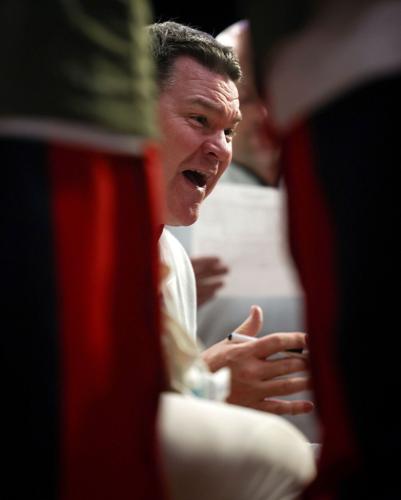
Arizona head coach Tommy Lloyd speaks to his team during a media timeout at McKale Center, Nov. 11, 2025, during a game against NAU.
“It's a perfect time to give your team an extra rest,” Lloyd said. “You call the time out no matter what happens. You get a full time out, you rest and then you have another time out after the media timeout. To me, that’s kind of the sweet spot.”
So when officials ruled the ball went out of bounds on Wildcat forward Tobe Awaka with 5:17 left against Auburn — and UA staffers who were monitoring the game on video disagreed — Lloyd pulled the trigger.
“I didn't even see the play. I was kind of blocked a little bit," Lloyd said. "But our guys behind the bench were adamant that we should do it."

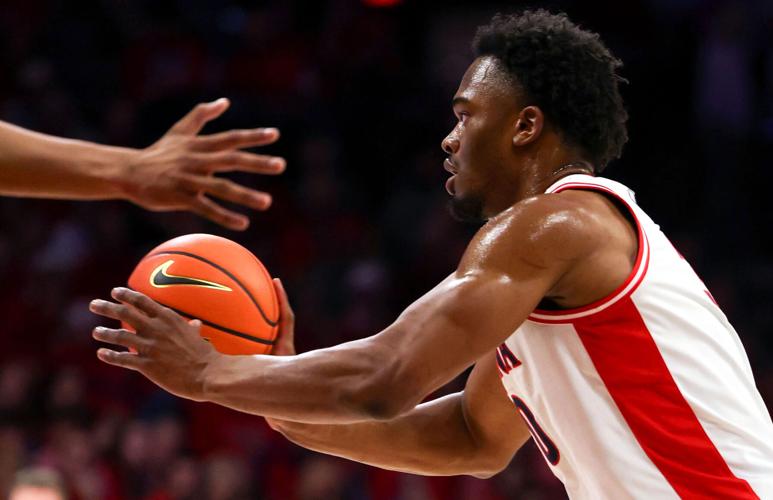
Arizona forward Tobe Awaka (30) passes the ball during the game against Auburn at McKale Center, Dec. 6, 2025.
Ultimately, the Wildcats received possession of the ball and some extra rest. Upon review, officials determined the ball actually bounced off the foot of Auburn's KeShawn Murphy, giving the Wildcats the ball to go with their 26-point lead.
After the final four minutes of games, though, the equation can get a little trickier. Losing teams get more incentivized to call challenges, tension escalates and, in the final two minutes, officials are allowed to go to the monitor at their discretion to review basket interference issues or restricted-arc plays — but still not for out-of-bounds plays.
That means coaches probably don't need challenges as much in the final two minutes ... but still might want to be able to. Just in case.
“I think it's judicious to probably keep that challenge in your back pocket down the stretch of the game," Lloyd said. "Because even under two minutes, you still have to challenge an out-of-bounds call. So we're all learning the intricacies of it.”

