



Nobody in college basketball picks or publishes an All-Senior team. But every league and every website with a URL address chooses an All-Freshman team.
As with most schools, Arizona keeps a list of its freshman records, but never one of its senior records.
College basketball has changed so thoroughly in the last 25 years, with diminishing contributions from seniors, that the formula to get to the Final Four has changed with it. Age isn’t a factor.
It’s more difficult to make the Pac-12’s All-Freshman team than it is the All-Conference team.
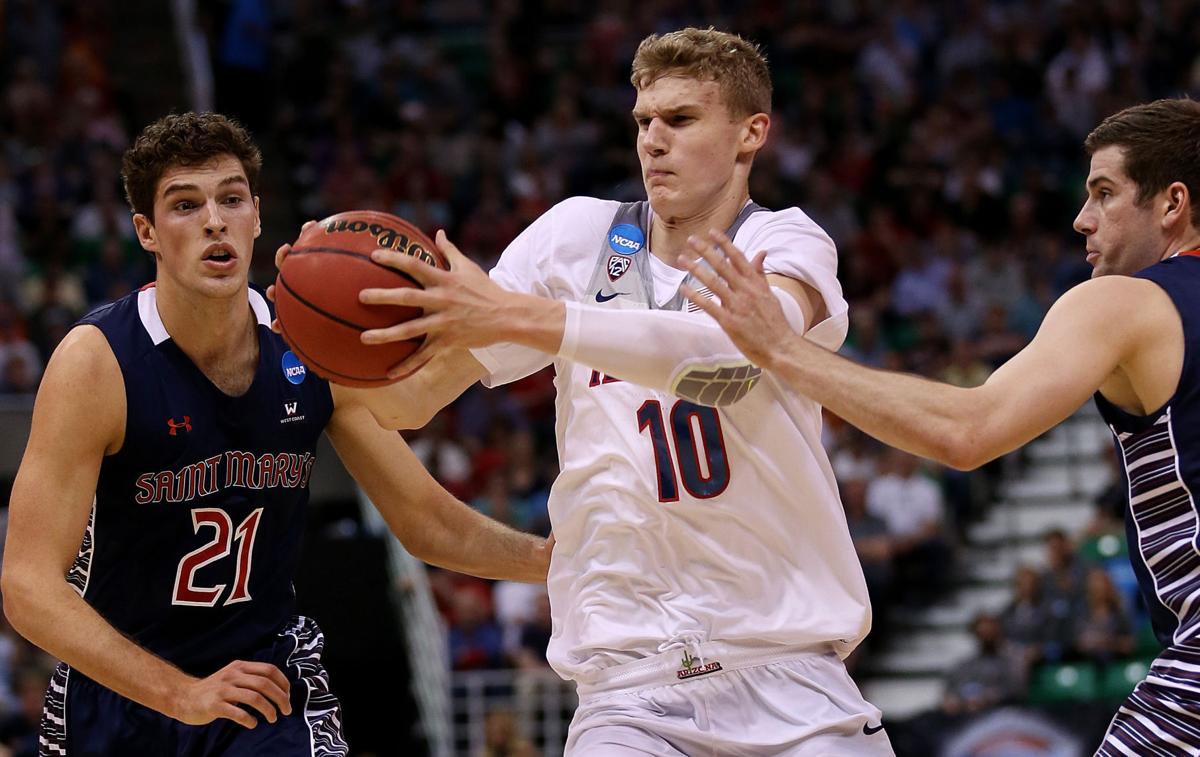
Take a look at the Pac-12’s all-freshman team: Lauri Markkanen, Arizona; Rawle Alkins, Arizona; Markelle Fultz, Washington; Lonzo Ball, UCLA; T.J. Leaf, UCLA.
The best of the rest: junior Dillon Brooks, Oregon; junior Reid Travis, Stanford; sophomore Chimezie Metu, USC; junior Jordan Bell, Oregon; sophomore Allonzo Trier, Arizona.
I’ll take the freshmen.
This applies not just to the conference season, but to the NCAA Tournament.
When Arizona, Xavier, West Virginia and Gonzaga hit the floor at the San Jose Sweet 16 Thursday, those teams will deploy a total of six seniors among each team’s six leading scorers.
Ten of the teams’ 24 leading scorers are freshmen and sophomores.
Arizona, UCLA and Oregon have combined for 94 victories entering the Sweet 16, which is a Pac-12 record. No other threesome in league history has won more than 89.
How did the Ducks, Wildcats and Bruins do it?
Only four of the 18 leading scorers for those teams — UCLA’s Bryce Alford and Isaac Hamilton; Arizona’s Kadeem Allen and Oregon’s Dylan Ennis — are seniors.
Oregon freshman point guard Payton Pritchard beat out junior Casey Benson this season. A year ago, Benson led the nation in assist-to-turnover ratio and helped the Ducks to the Elite Eight.
He lost his job anyway. That’s college basketball in 2017.
While researching Arizona’s history in Sweet 16 games, I read about Lute Olson’s reaction after losing to Seton Hall in a fiercely contested 1991 game in Seattle. The Pirates beat the Wildcats 81-77 that day to advance to the Elite Eight.
After 30 minutes of media interviews, Olson and his wife, Bobbi, entered the UA locker room and noticed junior guard Matt Othick in tears.
Bobbi embraced Othick and said “Oh, Matt, we’ve got so much to look forward to next year.”
Indeed, the Wildcats of ’92 were loaded, built with size and experience the way college basketball teams of that generation planned.
Chris Mills would be a fourth-year senior, perhaps the top player in the Pac-10. Future All-American Khalid Reeves would be a sophomore. The Tucson Skyline — future NBA draft picks Sean Rooks and Ed Stokes — would clog the middle. Othick would return to join future All-American Damon Stoudamire at guard.
The Wildcats opened the season ranked No. 5 in the AP poll and climbed to No. 2 in March.
Then the NCAA goofed up the seedings the way it always seems to mis-rank Wichita State. It matched Arizona, a pound-it-inside team, against the best team in East Tennessee State history, a speed machine that finished the previous season No. 17 in the AP poll and beat North Carolina State, Tennessee and BYU — and barely lost to Arizona at McKale Center.
The Buccaneers won 87-80, and two nights later played Michigan’s Fab Five to the wire, losing 100-92 to an all-freshman team that reached the national championship game.
After that game, Othick was randomly pre-designated by the NCAA drug-testing people to provide a urine sample. Othick sat isolated in a corridor of the Atlanta’s old Omni Coliseum, his career over, unable to quickly provide that urine sample.
When Othick finally completed his duties, he walked slowly to the locker room and said “I wish I could be back another year, we’ve got all those seniors and all that experience; we’re really going to be good.”
With all of those old guys, Arizona lost in the first round a year later to a Santa Clara team breaking in future all-NBA freshman guard Steve Nash.
That’s when the game began to change.
In 1997, Arizona won the national championship behind freshman point guard Mike Bibby and sophomore guard Jason Terry, the nation’s top sixth man. The Wildcats had no scholarship seniors.
The game has never been the same. Sean Miller has started 14 freshmen (for most of the season) in his Arizona years. Some were busts (point guard Josiah Turner), some were short-term solutions (point guard MoMo Jones) and some (forward Aaron Gordon) were quickly on their way to the NBA.
In San Jose, he’ll start Markkanen and Alkins, and if the Wildcats manage to play twice at the SAP Center, it’s likely Markkanen will pass Jerryd Bayless as the leading freshman scorer in school history.
Between 1974-2008, Sean Elliott was the only freshman to lead Arizona in scoring. Since then freshmen Jerryd Bayless, Derrick Williams, Stanley Johnson and now Markkanen have led Arizona in scoring.
Markkanen is a Big Story, and not just because he is 7 feet tall. He is an instant sensation in a game of instant sensations.
A long time ago, Arizona produced a collector’s item video “Memories ’88,” the heart-grabbing story of the UA’s run to the nation’s No. 1 spot and the Final Four. That team started fifth-year senior Tom Tolbert, fifth-year guard Steve Kerr and senior guard Craig McMillan. The other starters, Elliott and Anthony Cook, were juniors, with more than 90 games of college basketball experience.
Now, bent on reaching their first Final Four since 2001, the Wildcats of the 21st century will start two freshmen, a sophomore, a junior and senior Kadeem Allen.
It’s possible that none of them, or maybe only one of them, will be back when practice begins in the fall.
Yet any time you discuss the Wildcats of 2017-18, it’s not much different than Bobbi Olson in 1991 saying, “Oh, Matt, we’ve got so much to look forward to next year.”

