

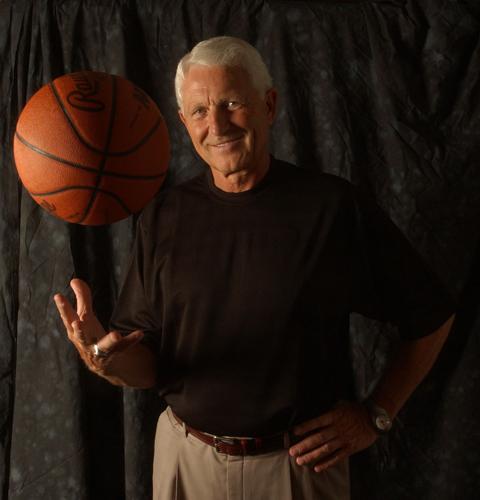
Lute Olson rarely said no.
CBS or another television network would call McKale Center looking to set up a made-for-TV game between the Arizona Wildcats and another national power. UA assistant athletic director Mark Harlan would politely listen and then walk to Olson’s office, thinking he might decline.
“But,” Harlan said last week, “he’d just get a big smile on his face and say, ‘Let’s do it.’”
Plenty has been said and written about Olson, who died Aug. 27 at age 85, and the teams he led to greatness. Arizona won its first Pac-10 title in 1986, Olson’s third season in Tucson. The 1988 Wildcats made the Final Four for the first time in program history, and the 1994 team followed suit. The UA won it all in 1997, then returned to the Final Four in 2001.
But Olson’s most impressive work, if we’re talking degree of difficulty, might have come in a year which the UA went no further than the Sweet 16.
During the 2001-02 regular season, the Wildcats played 19 games against teams that would make the NCAA Tournament. Nine of their 10 nonconference opponents advanced to the Big Dance, with Maryland — the team that Arizona beat in the season opener — winning it all. The UA played three of that season’s four Final Four teams.
How tough was the schedule? The Wildcats lost 10 games, their most since 1986-87, and still finished the season ranked No. 7 nationally.
Rick Anderson, who averaged nearly 13 points and more than seven rebounds per game for the Wildcats that season, said it might have been the best coaching job of Olson’s career.
“Oh, absolutely,” said Anderson, who’s now a teacher and junior college basketball coach in Southern California. “I wish we would have gone to a Final Four that year, of course. But it was more than that. It was, by far, I think, Coach’s best year.”
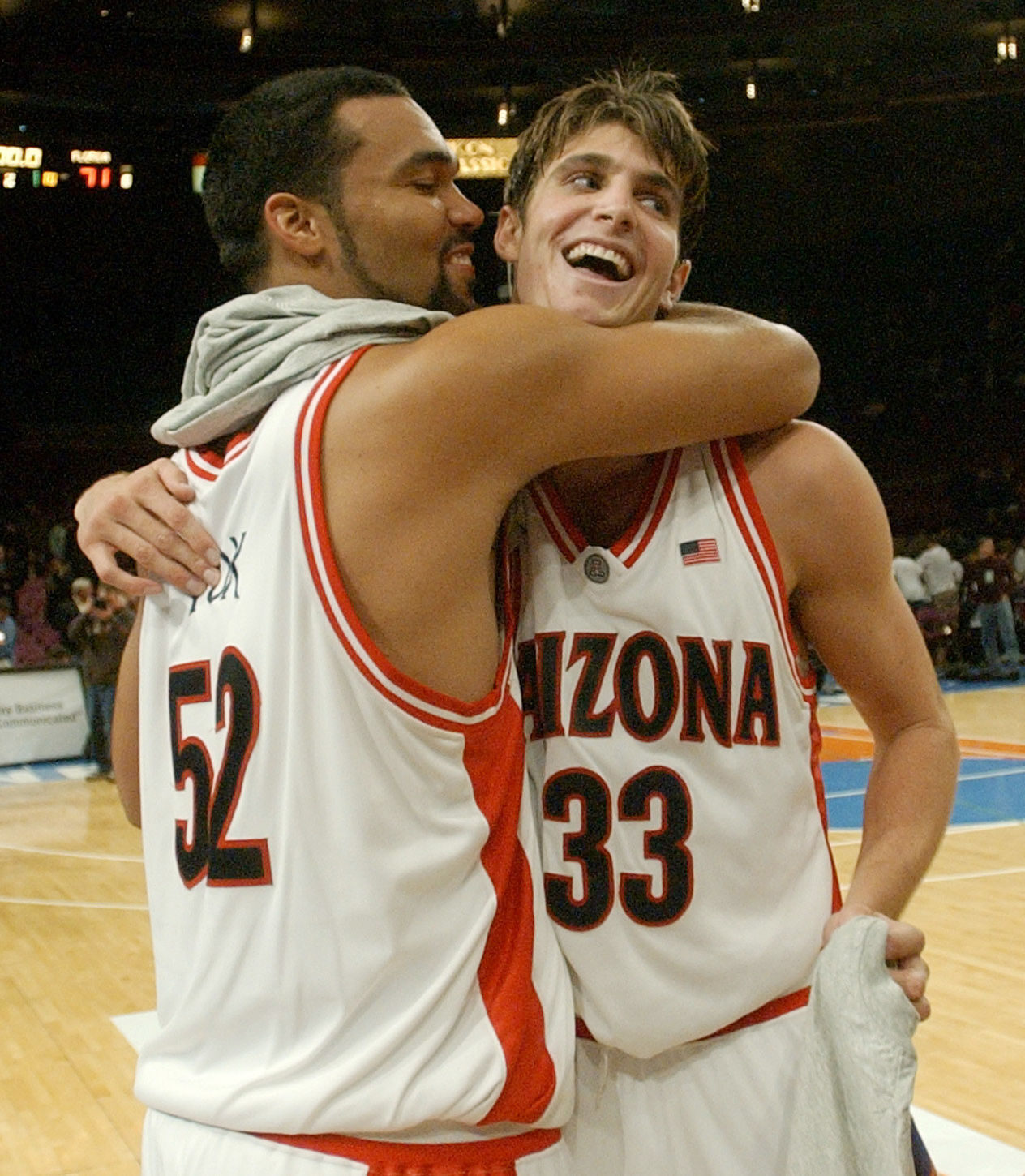
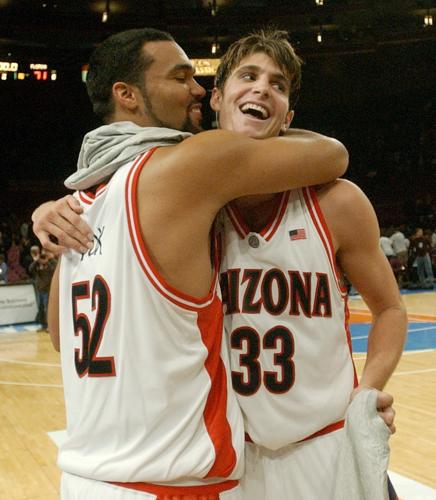
Rick Anderson, right, gets congratulated by Isaiah Fox after Anderson scored the winning basket to beat Florida during a 2001 nonconference game.
The 2001-02 club, which featured Anderson, fellow forward Luke Walton and point guard Jason Gardner, faced an uphill battle from the start.
A Final Four hangover loomed, and Olson’s staff didn’t expect to lose four starters to the NBA draft that summer. Gone were Michael Wright, Richard Jefferson, Loren Woods and Gilbert Arenas, who collectively accounted for nearly 78% of Arizona’s offense in its run to the 2001 national title game.
Olson, Harlan and other UA athletic department officials built the 2001-02 schedule with the expectation that Wright, Jefferson and Arenas would still be on the roster.
“I specifically remember before our first game. We’re at Madison Square Garden (about to play) Maryland,” Anderson said.
“Coach O is in the locker room like, “Nobody knows about you. Nobody thinks you’re going to be good this year.’ But I remember him saying — I clearly remember it — ‘You guys can be better than our Final Four team last year.’
“And Luke and I looked at each other and go, ‘OK, we’ve got this.’”
A repeat Final Four trip didn’t happen. But Arizona finished with a Pac-10 tournament trophy and a top-10 final ranking while navigating one of the most daunting nonconference schedules in program history.
It began with that showdown against that year’s eventual national champion.
“We just lost four guys to the NBA. We weren’t even ranked going into that season,” Anderson added. “But we go into the Garden and play our first game against Maryland.
“They had Juan Dixon and all these studs. And we go in and beat them by six or eight.”
It was a four-point victory (71-67), to be precise, but the point remains: Arizona beat No. 2 Maryland, then followed it up the next day with a win over No. 6 Florida, also in New York.
A week later, the Wildcats logged a true road win against No. 23 Texas in Austin.
In roughly a week, the Wildcats went from unranked to No. 4 in the country.
Arizona’s 2001-02 schedule included a who’s who of college hoops royalty. Maryland, Florida, Texas, Kansas, Illinois, Michigan State, UConn, Oklahoma and UCLA would reach the Final Four a combined 20 times between 2000-09. Maryland, Michigan State, UConn, Florida and Kansas all won national championships in that decade.
The Wildcats also faced ranked Pac-12 opponents in Stanford, USC and Cal, and Oregon ended the season ranked 11th in the nation.
Arizona also defeated the only two mid-majors on its schedule: Pepperdine and Valparaiso. Both teams would go on to win at least 20 games and capture their conference’s titles.
Arizona played 10 nonconference opponents in the 2001-02 regular season. Nine went on to make the NCAA Tournament, with Purdue — a traditionally competitive Big Ten program coached at the time by legendary Gene Keady — the only one to miss.
Harlan, now the athletic director at Utah, said his goal was to follow Olson’s lead, play tough opponents and give broadcast networks no choice but to put Arizona in front of a national audience.

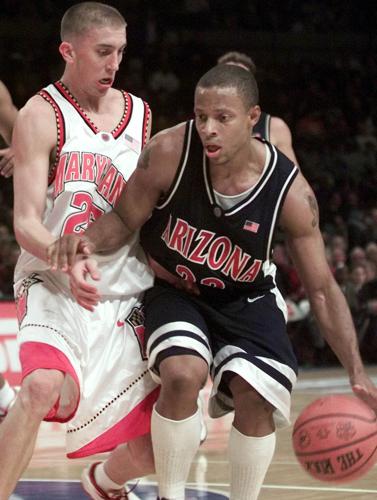
Arizona's Jason Gardner drives past Maryland's Steve Blake in the first half of Arizona's 71-67 win at Madison Square Garden in November 2001. The Terrapins would go on to win the national championship that March.
“There was that assumption we’d have a different team back,” Harlan said. “But, of course, Coach (Olson) never complained about that. It was just the way it worked out.
“(Olson) made it real clear to me that everybody was on the table — with the exception of a few that will remain between me and him forever,” Harlan added.
“He would always mention that players loved to play in those environments. I also remember that he really felt compelled to give the fans those kinds of games because they were such an instrumental part of the program’s success. Those are the two main factors, I believe, that drove, the schedule.”
Ryan Hansen worked with Harlan on the schedule that season, and took the reins in the years that followed. In 2001-02, Arizona hosted a Top 25 UConn program in mid-January — a nonconference game played during the heart of conference play — with an 11 a.m. local tipoff on CBS. The Huskies won 100-98 in overtime, but the eyes of college basketball were on the Wildcats.
“Every year, I would talk (to CBS),” Hansen said. “It was a known thing: ‘OK, Arizona, who are you going to play in January the week you guys play Arizona State?’
“We’d talk it through and it would be LSU one year, Kansas another year, UConn another year. CBS essentially had a dedicated window for an Arizona nonconference clash. But no one else in the conference was doing that.
“Lute had this philosophy long before I took the scheduling on, or even Mark Harlan. This was part of his process of preparing (Arizona) for the NCAA Tournament, playing all different styles; playing very difficult road games; the home-and-home series, which are much more challenging to come by today.”


