

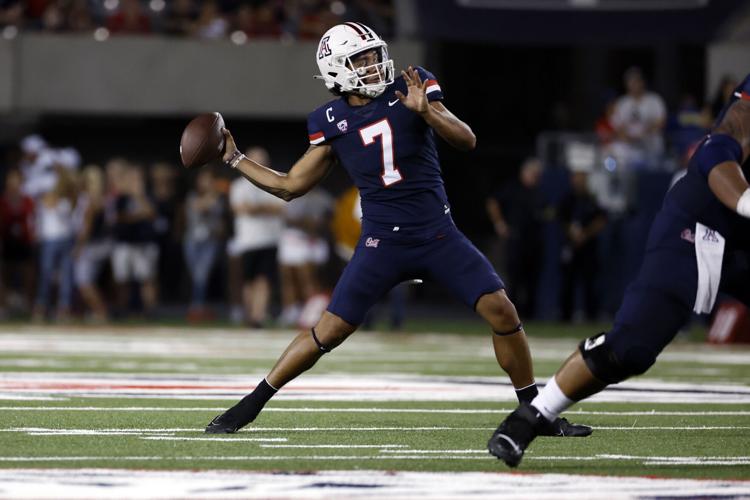

Jedd Fisch and Jayden de Laura have been Arizona’s coach-quarterback combo for two games. They’re still learning about each other.
Fisch and de Laura had plenty to talk about during and after the Wildcats’ 39-17 loss to Mississippi State on Saturday. After a stellar opening week, de Laura threw three interceptions. Some of the decisions he made were questionable.
“He scrambles around so often and makes plays,” Fisch said Monday. “There’s some times that it’s OK to know when to say when — and also know when to use your feet to your advantage.”
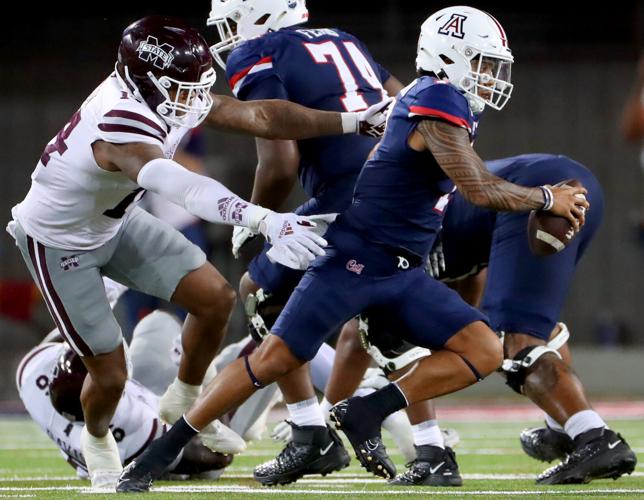
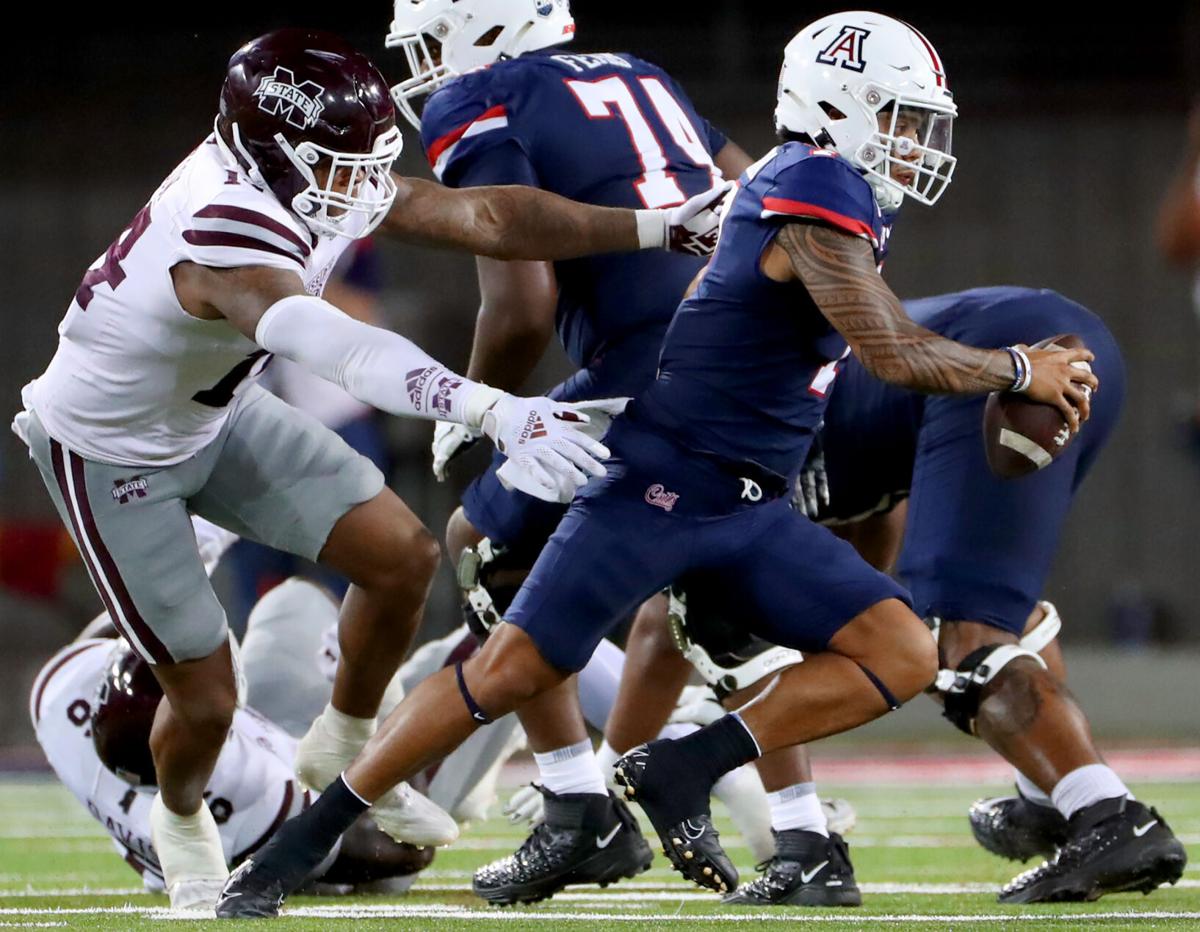
De Laura is a slippery and superb improviser — but that tendency can get him into trouble at times. Case in point: the first interception against the Bulldogs.
It happened on Arizona’s second possession. De Laura faced immediate pressure from MSU’s Nathan Pickering. De Laura rolled to his left, pump-faked, turned back to his right, sprinted across the field, eluded two defenders, came back to his left, then threw the ball downfield for Jacob Cowing. It deflected off the leaping receiver’s fingertips for the interception.
Fisch called that wild scramble “the longest play of all time.” In retrospect, Fisch said, de Laura should have thrown the ball away.
Fisch was asked what goes through his head on a play like that.
“Sometimes it’s a no-no-yes. Sometimes it’s a yes-yes-no. And it’s everything in between,” said Fisch, whose team hosts North Dakota State on Saturday. “There’s times when ... he’s in the middle of the end zone, they bring the corner cat (blitz) and he spins around, makes a play and converts a 16-yard gain. You live with those plays because of the fact that he’s so gifted as an athlete.

Arizona's Jayden de Laura threw some passes in Saturday's loss that coach Jedd Fisch thought should have been quarterback runs.
“It’s our job to continue to help him play within the parameters of the system and help him understand there’s times you don’t have to do that. There’s times you can just hit a guy in rhythm. And then there’s also times that you can use your legs to your advantage.”
Fisch said that de Laura had “three or four opportunities” where he could have run instead of trying to throw the ball downfield. His second interception appeared to be one such example. Another came in the fourth quarter. Arizona trailed 32-17 and faced third-and-10 at the MSU 31-yard line. De Laura rolled to his right and appeared to have a clear path ahead of him. He instead fired an incomplete pass into the end zone toward Tetairoa McMillan, who was well-covered. The Wildcats ended up turning the ball over on downs.
“There were a couple of third downs that we could have scrambled forward and we didn’t,” Fisch said. “We talked about it, and we’ll get better there.”
De Laura has yet to run past the line of scrimmage as a Wildcat. He had 73 rushing attempts — 50 if you exclude sacks — in 16 games at Washington State. Those played produced 111 net yards and five touchdowns.
Another instance where de Laura’s instincts worked against him happened at the end of the first half. Arizona had first-and-10 at the MSU 32 with nine seconds left and one timeout. De Laura felt pressure, tried to spin out of it and ended up going down for a 15-yard loss that took the Wildcats out of field-goal range.
“The end of the half is a great example of ‘know when to say when.’ Just throw it away,” Fisch said. “You’ve got a shot at the end zone, you’ve got a shot at two guys in the flats, you’ve got nine seconds and a timeout. You’ve got plenty of time to do whatever you want — other than take a sack.”
As they continue to work together, Fisch and de Laura keep an open dialogue. During games, the conversation is usually about strategy. Sometimes, it’s psychology.
“Between every series I’m going to talk to Jayden about what he likes, what he doesn’t like, where he’s comfortable,” Fisch said. “And there’s times you get frustrated. It’s 25-17. You have a 65-yard drive, you’re on the 30-yard line going in and the ball gets tipped up in the air and picked. How do you handle that? How do you come back?”
De Laura never had a three-interception outing at WSU. He threw two picks three times. He threw a total of two interceptions in the succeeding three games.
What could have been
Fisch and his staff planned to use Jamarye Joiner a handful of times as a “Wildcat” quarterback against MSU. He ended up taking two snaps. Joiner gained 2 yards rushing on the first play and threw the ball out of bounds on the second.
Fisch said the first play could have resulted in a touchdown if not for an error by the offensive line.
“Had a great shot of hitting Jamarye right up the A-gap,” Fisch said. “Wound up having a mental mistake up front and leaving the 3-technique (defensive tackle). Should never have left the 3-technique. I think Jamarye probably would have had a great chance to hit his head on the goalpost there.”
Game-time decision
Fisch said defensive tackle Tiaoalii Savea, who got injured late in the first quarter vs. MSU, will be a game-time decision against North Dakota State.
Savea suffered an injury to his right lower leg after a cut block by Bulldogs left tackle Kwatrivous Johnson. The play was going to the offense’s right. Johnson and Savea were nowhere near the ball. But cut-blocking is legal under those circumstances.
“As long as you get cut within the tackle box, you can do that,” Fisch said. “I’ve certainly coached that for a lot of years. So I’m not going to comment on that.”
Extra points
Pro Football Focus charged Cowing with three dropped passes vs. MSU. He had six drops all of last season. “I don’t worry about Jacob dropping the ball,” Fisch said. “So we just have to move past it and chalk it up as an anomaly.”
NDSU (2-0) has never faced a Pac-12 opponent. The Bison have won six consecutive times against FBS foes. They are the top-ranked team in FCS after winning their 17th national championship last season.
Arizona’s Pac-12 opener at Cal on Sept. 24 will kick off at 2:30 p.m. It will be televised by Pac-12 Networks. The start time and TV assignment for the conference home opener vs. Colorado on Oct. 1 should be announced next Monday.


