

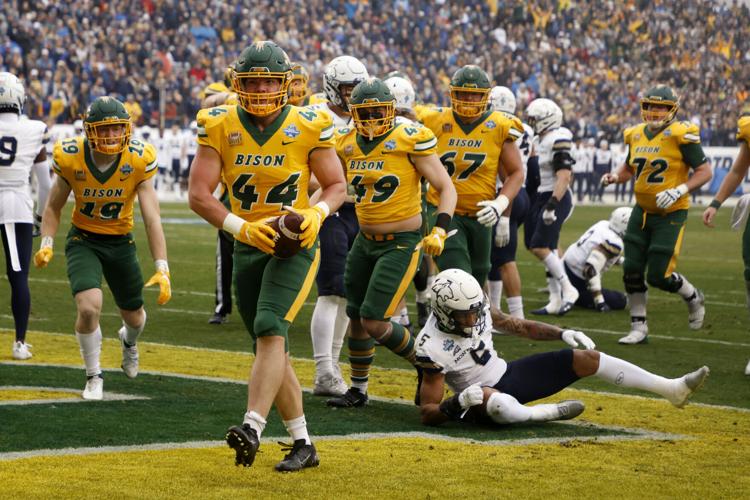

Don’t expect North Dakota State to throw the ball 50 times like Mississippi State did when it visited Arizona Stadium last week. In fact, the Bison have thrown the ball 43 total times in two games this season.
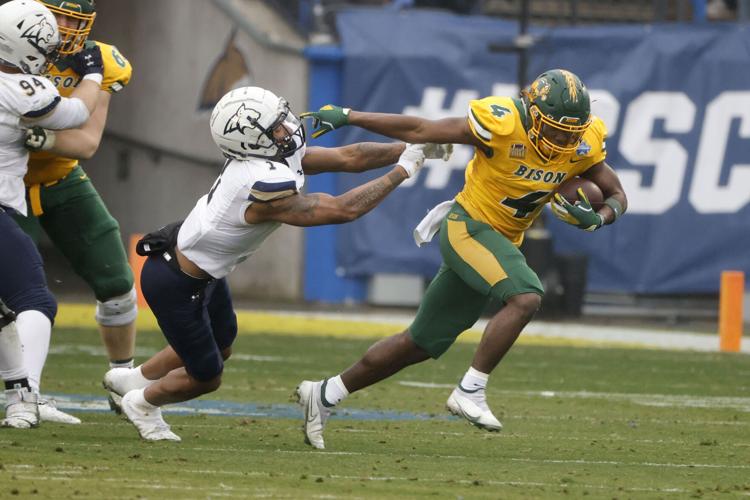
North Dakota State, like many small-school powers, specializes in running the football. NDSU is averaging 211.5 rushing yards per game heading into Saturday night’s game against the Wildcats, a statistic that ranks 18th in Division I FCS. The Bison’s 6.22 yards per carry rank ninth in FCS.
NDSU attempted just 13 passes in its 56-14, season-opening win over Drake. It threw 17 times in last week’s 43-3 win over North Carolina A&T.
UA coach Jedd Fisch called North Dakota State a “two-back, I-back, power team” with a reputation for a ground-and-pound attack. Consider: The Bison averaged 280.6 rushing yards per game last season, and put up 287 rushing yards per game in 2019; 286 in 2018; and 272 in 2017. The only outlier: 2020, when NDSU averaged just 218 rushing yards and went 7-3, losing in the FCS quarterfinals.

North Dakota State running back Kobe Johnson has rushed eight times for 55 yards in the Bison’s first two games.
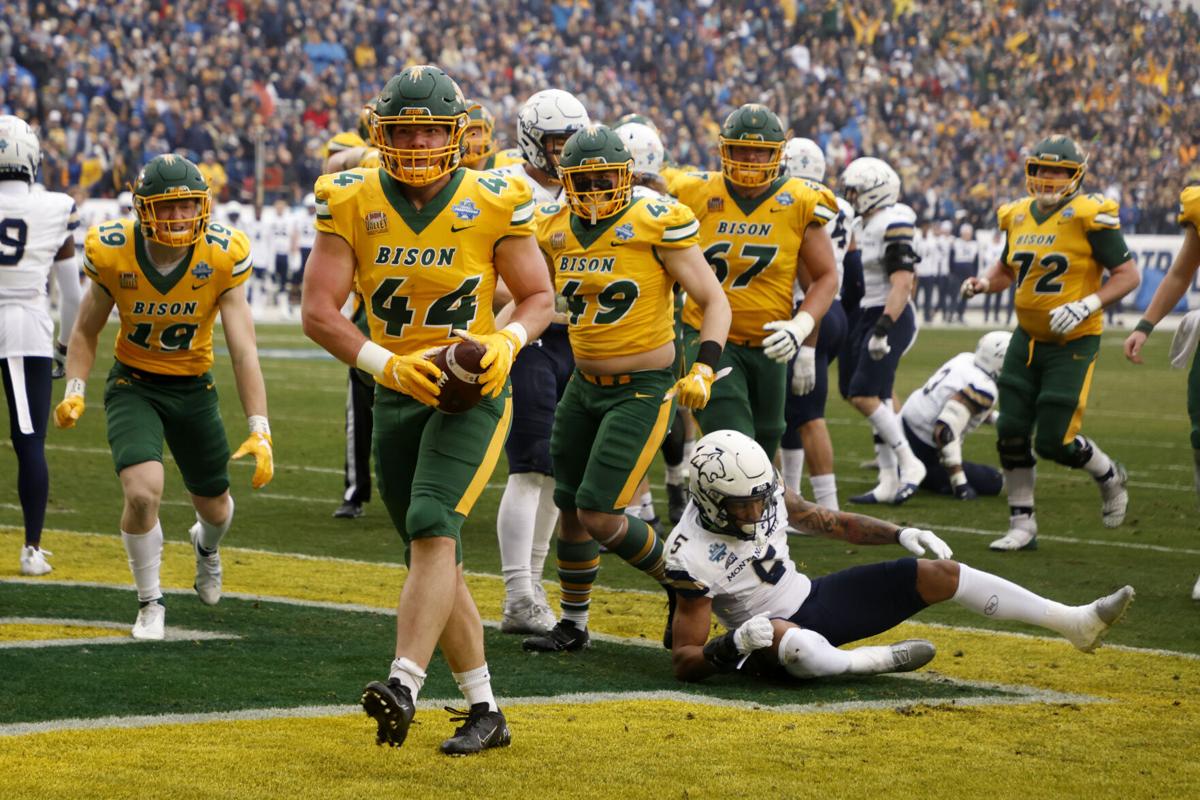
Hunter Luepke, last year’s Division I FCS title game’s most valuable player, has rushed seven times for 68 yards and two scores. He is one of eight different players to have at least six carries through the Bison’s first two games. Nobody has more than nine.
“I wouldn’t even say (it’s a) pro-style (offense); I’d say they’re an old-school, pro-style (offense),” Fisch said during his news conference on Thursday. “Pro-style nowadays, what is that? They’re truly playing with a fullback, multiple tight ends and going downhill at you.
“The thing that makes them unique is that they’ve been doing it for so long and doing it the same way for so long. There’s a lot of plug-and-play, so to speak. … They’ve been recruiting for this system, so they’re able to get rolling with this system.”
Nowhere to run
Fisch likes to think of himself as a D&D fan. And no, not Dungeons & Dragons.
In Arizona’s case, it stands for down and distance — one of the underlying factors in the Wildcats’ home-opening loss to Mississippi State.
The Wildcats had 40 net rushing yards against the Bulldogs, the program’s lowest single-game total since 2011.
Fisch cited lack of opportunity and playing behind the chains for the Wildcats’ inability to run the football efficiently. The UA was 4 of 14 on third-down conversions, with four of those plays netting five or fewer yards. For the most part, Arizona found itself in too many third-and-long situations, which — more often than not — led to a pass play.
“It’s always important to run the football. The key is to be down and distant to call the runs,” Fisch said. “I never lost any patience in the running game, it was just not being in position to call runs. … For us last week, we got into bad D&Ds that caused us to get away from runs, or we would run on first-and-10 and not really go anywhere.
“Now you’re thinking, ‘OK, it’s second-and-10, what’s the best situation here to be able to get two downs to get a first — is it to throw it or run it?’ I’m hopeful we’re not going to be in that situation too often and stay balanced. That’s certainly our goal.”
Or, as Arizona running back Michael Wiley said on Saturday: “Being behind the chains makes it hard.”
“Our goal on offense is to stay on schedule and think about the next play,” he added.

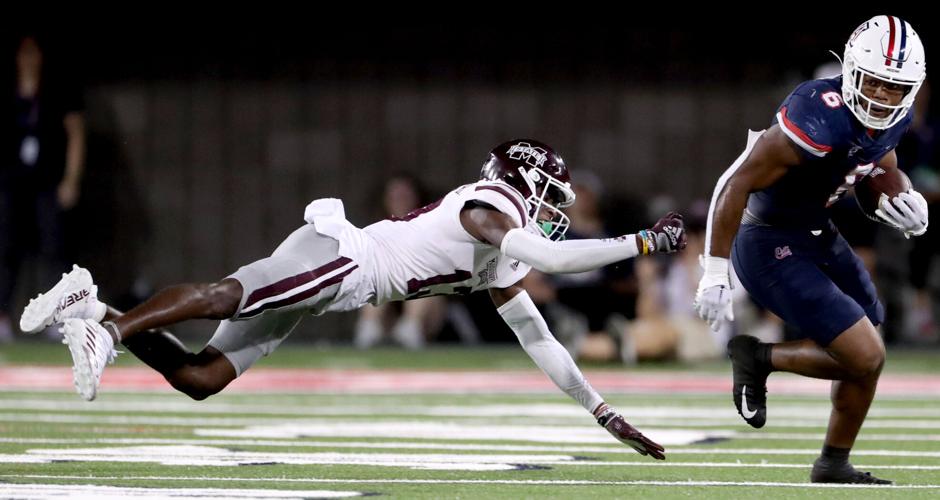
Arizona running back Michael Wiley outruns Mississippi State cornerback Emmanuel Forbe after making a catch during the third quarter of last week’s game.
Michael’s wily
Wiley finished with 49 rushing yards against MSU, but 34 of them came on a touchdown run in the opening minutes. Wiley also had four receptions for 54 yards and utilized a stiff-arm to shield off defenders.
“He’s certainly running more powerfully,” Fisch said of Wiley. “He’s able to stick his foot in the ground, stay in bounds like his first run, that 34-yard run, as well as that screen (pass) — they were both great balance, and he’s worked really hard at that. Credit to (Arizona running backs coach Scottie Graham) and (strength and conditioning coach Tyler Owens) for making sure he gets stronger every day.”
Wiley has 12 carries this season, trailing Florida State transfer D.J. Williams (21) and true freshman Jonah Coleman (18). Star freshman Rayshon “Speedy” Luke has just four carries, but Fisch said the Wildcats are not rushing to overload the first-year player.
“Speedy just got here, and our running backs have been running the ball pretty good. Who are you going to take out to put in?” Fisch said. “He’s a back, he’s not a receiver, so he’s not someone you’re going to put in the game and not expect to be the runner. He’s got a great skill set to run the football, but so does Michael, so does D.J. and so does Jonah.”
Arizona adds defensive lineman
The Wildcats have added graduate transfer defensive lineman Traemaine Savea, brother of current Wildcat and UCLA transfer Tiaoalii Savea. Traemaine, a 6-foot-2-inch, 290-pound defensive tackle, played for Northern Arizona last season and was on the roster when the Lumberjacks upset the Wildcats in Tucson.
The Las Vegas native played two seasons at East Los Angeles College following a standout career at Desert Pines High School.
“We just needed to add some depth on the D-line. … More than anything, we had 109 spots on our roster, and we wanted to take it to a 110 number,” Fisch said. “We always feel like D-line is a great position of depth — also good for Tia to have his brother.”
Tia Savea suffered a leg injury as a result of a cut block during last week’s loss to Mississippi State but is expected to play on Saturday.
Sumlin joins The Field of 12
Former Arizona head coach Kevin Sumlin has joined The Field of 12 media network as an analyst for its digital shows and live streams. Field of 12 is a part of the same media company as “Field of 68,” a college basketball multimedia outlet formerly employed ex-Arizona basketball coach Sean Miller as an analyst.
Sumlin has recorded two episodes of Field of 12 with host Michael Felder.
Don’t stop
The Wildcats’ now play “Don’t Stop Believin’” by Journey at the start of the fourth quarter. Last week’s debut seemed to work: Arizona Stadium fans hoisted their phone flashlights during the song.
“Seemed pretty cool. I noticed the lights looked pretty awesome. It sounded like the fans got into it,” Fisch said. “The best tradition I saw was that they were all still there. … You could see how the energy was turning. When it was 25-17 and we got that defensive stop, that place was loud, and I thank our fans for that.
“If they can do that for six more weeks in a row, we can have a pretty awesome gameday experience and build Arizona Stadium into a place that nobody wants to play.”
The Journey song replaces Kenny Chesney’s “Happy Does.” The country tune, which mentions Tucson in the lyrics, lasted one year.

