

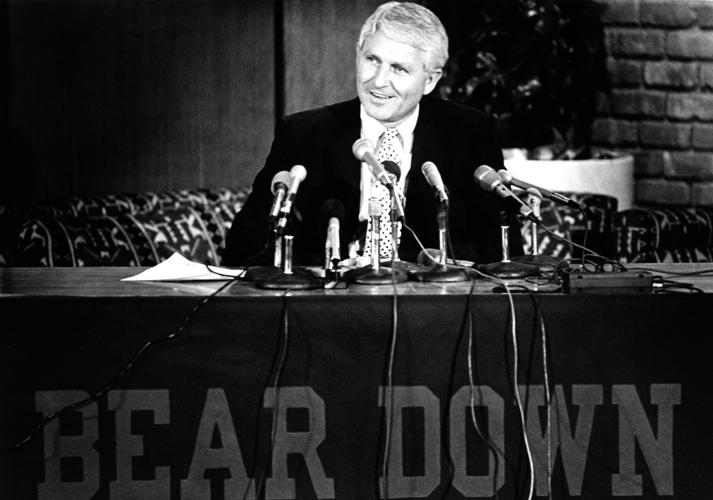
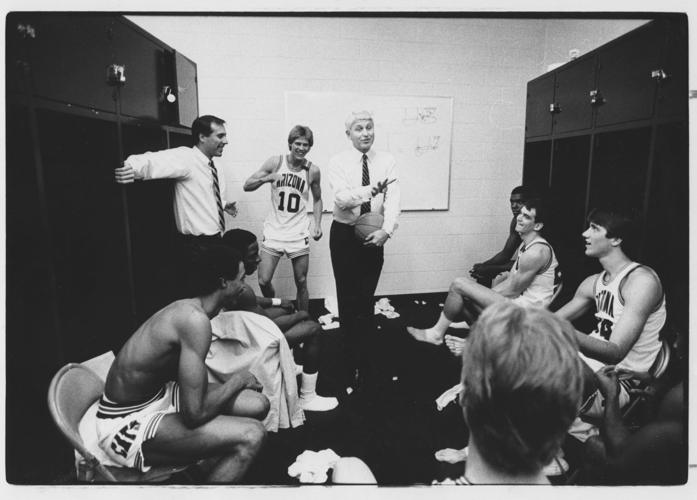

Of all places, Lute Olson’s journey to Tucson began at the antiquated Pacific Pavilion in Stockton, California, on Jan. 10, 1974.
The route he followed almost defies belief. Here’s how it got started according to Cedric Dempsey, the man who “discovered” the 39-year-old Olson in one of the improbable settings on the college basketball map.
Two days before No. 9 Long Beach State was to play at the oft-intimidating Pacific Pavilion in 1974, the NCAA ruled two of first-year coach Olson’s future NBA draft picks, Glenn McDonald and Roscoe Pondexter, academically ineligible.
Pacific’s 3,000-seat arena was an imposing venue for coaches in the PCAA; in recent years the Tigers had gone 43-3 at home and Dempsey, UOP’s young athletic director, felt that his team could beat the short-handed 49ers.
Good luck with that.
“They beat us something like 72-52,” Dempsey remembers, an uncannily accurate recall of Long Beach State’s 72-53 win. “I remember telling myself, ‘that guy’s got some tools.’”
That guy? Lute Olson.
It was Dempsey’s first exposure to Olson, who had coached at Long Beach City College the two previous seasons. As with many athletic directors, Dempsey kept a mental list of potential coaching replacements.
“I put Lute at No. 1,” he says now.
Eight years later, Dempsey was the athletic director at Houston when the core of the Cougars’ famed Phi Slama Jama team — led by future NBA All-Stars Clyde Drexler and Hakeem Olajuwon — played Olson’s Iowa Hawkeyes at Houston’s Hofheinz Pavilion. By then Olson was a coaching celebrity, having led Iowa to the 1980 Final Four.
“Even though we were at home, we struggled to beat Iowa (62-52) that night,” Dempsey says. “I thought, ‘he’s still at the top of my list.’”
Six months later, after declining an offer to be the commissioner of the Texas Longhorns-led Southwest Conference, Dempsey was in Tucson, interviewing for the vacant athletic directorship at Arizona. There wasn’t much mystery to the interview; new UA president Henry Koffler, acting on a tip from his athletic director at UMass, had made hiring Dempsey a priority.
Before taking office on July 1, 1982, Koffler had fully researched Dempsey’s background and his success both as an assistant AD at Arizona in the late 1960s, and as the AD at Pacific and Houston. Koffler desperately needed someone to navigate Arizona through what turned out to be the most turbulent period in the history of its athletic department.
The football program was serving a two-year NCAA probation for employing a player-benefitting slush fund; the basketball program had just forced the resignation of coach Fred Snowden and athletic director Dave Strack, whose last act was hiring an unimpressive fall-back basketball coaching candidate, Ben Lindsey of Grand Canyon University.
With Koffler’s support, Dempsey fired Lindsey eight months later — even though the Arizona state senate vigorously opposed the move.

By coming to UA, Lute Olson was able to live a more relaxed lifestyle with pleasant winters and a Pac-10 conference ripe for the taking.
Given the school’s low athletic profile of 1983, there couldn’t have been a soul in Tucson who believed the new athletic director could successfully execute the coaching coup of a lifetime by stealing Olson away from the high-flying Iowa Hawkeyes, who had for a decade been No. 1 on Dempsey’s must-hire-someday list.
Dempsey flew to Kansas City and, about 15 minutes after the Hawkeyes were eliminated 55-54 in a Sweet 16 NCAA Tournament game to Villanova, introduced himself to Olson while still in the arena.
Would he be interested in talking about the coaching vacancy at Arizona?
“Lute invited me to his hotel room for breakfast the next morning,” Dempsey recalls. “I talked with him and his wife, Bobbi, for about two hours. Then they invited their five children into the room, put some chairs together around me in a semi-circle and let them ask me questions. I was like ‘who’s interviewing who here?’ “
After spending about five hours in Olson’s hotel suite, Dempsey asked the big question. Would Lute and Bobbi be interested in flying to Tucson that night to further discuss the job?
Dempsey left the room while the Olsons talked about it. A few hours later they were on a private jet to Tucson. Olson essentially accepted the job the next day, although he insisted he first fly back to Iowa to tell his players, coaches and athletic director he was leaving.
“I was worried when he went back to Iowa, sure,” says Dempsey. “It’s difficult to tell someone you’re leaving, especially in the winning situation he had created. I had a back-up candidate (UAB coach Gene Bartow) staying at the Arizona Inn, just in case.”

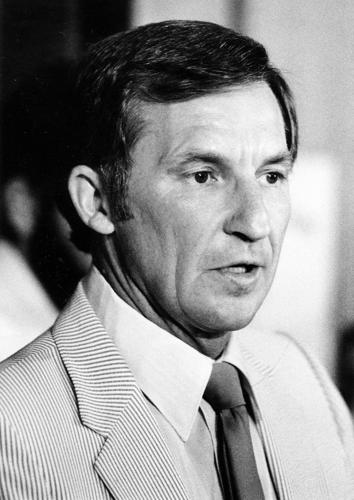
Cedric Dempsey, former athletic director for the University of Arizona.
Olson had been so successful at Iowa that the school built the $60 million (in today’s dollars) Carver-Hawkeye Arena, a long-awaited project that three years earlier led him to decline an offer to be the basketball coach at USC.
But in March, 1983, Olson had come to realize two important factors about his career: (1) it would be easier to recruit to Tucson than to Iowa City in a basketball-strong Big Ten Conference; (2) the Pac-10 was ripe for the taking; Cal and Stanford were little more than community college basketball operations, UCLA was in decline from the John Wooden years, Oregon’s basketball program was in shambles and Arizona State was at the beginning of a 10-year decline.
More? “Lute did not enjoy the fishbowl-type atmosphere of Iowa,” Dempsey says. “He had lived in the Los Angeles area for about 12 years before going to Iowa, and he and his family identified with the West. He told me, ‘Do you know what it’s like to spend a winter in Iowa?’”
Dempsey said he initially struggled with the concept of matching Olson’s compensation at Iowa — roughly $150,000 per year — and did not want to fracture the salary structure of the financially-struggling UA athletic department, then fighting its way out of a historic $419,000 debt.
“But when I thought of the growth potential for our basketball program, I knew it was the right thing to do,” says Dempsey. “Plus, I knew Lute was a man of integrity. We needed that during that period. I never had to worry about him.”
Dempsey left Arizona in the winter of 1993-94 to become executive director of the NCAA. He helped to create a legacy that will endure for decades.
Today, retired and living in La Jolla, California, Dempsey says, simply, “I was proud to be a part of it.”



