


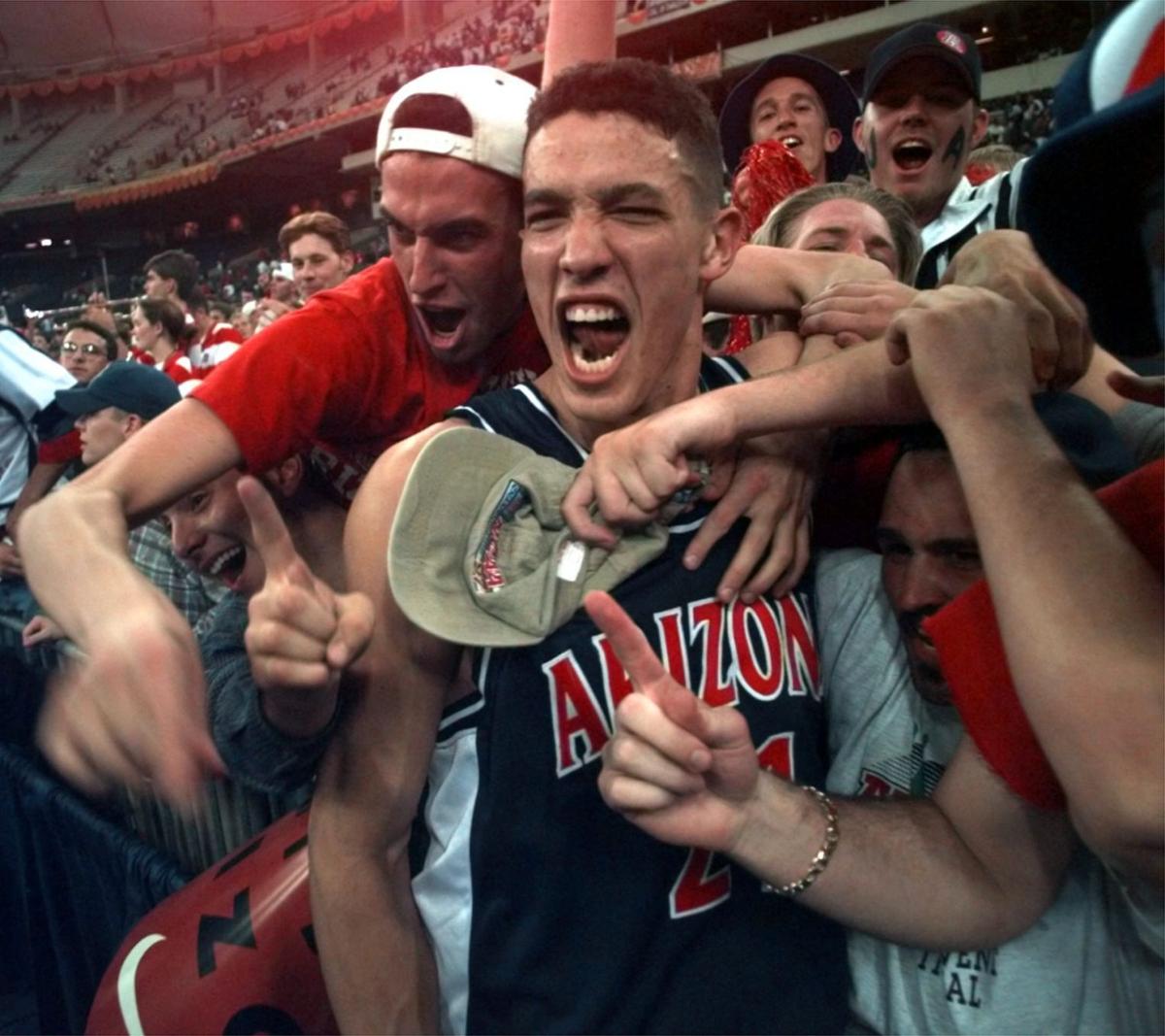
When some of Lute Olson’s former Arizona players were asked about him Friday, one topic often came up first.
Not just about Olson’s character, his skills, his relationship-building, his love for the University of Arizona — all that stuff is well-documented around Tucson — but a somewhat more practical matter.
Like, how much time do we have?
How many words?
And where to start?
“There are so many things,” said Matt Muehlebach, a Tucson attorney and Pac-12 Networks analyst who played for Olson in the late 1980s and an early 1990s. “It’s not easy.”
Muehlebach said UA coach Sean Miller probably summed it up best when he said Olson had “no weaknesses” as a coach. Then, as did everyone else, Muehlebach made it clear he was not just talking about what Olson did on the floor.
“I think at his core, he was an incredibly passionate, hardworking, fierce competitor, and someone who was a fundamental teacher,” Muehlebach said. “That was the foundation of our teams.
“But he was also a guy who taught a lot of other things, about class and respect and just playing the right way. So many life lessons that I think all of us took with us.”

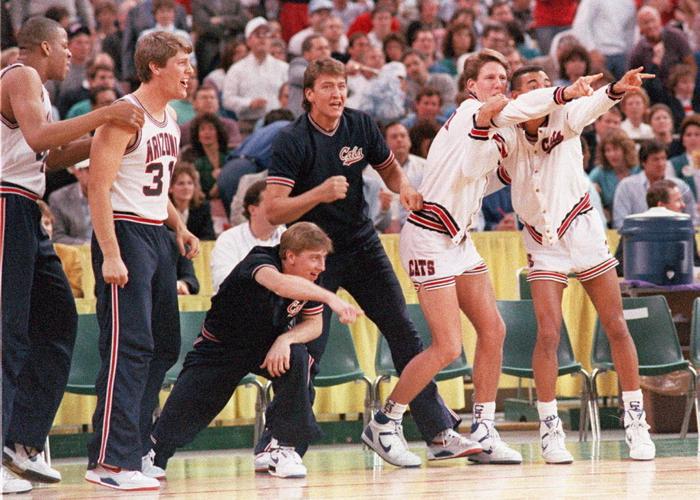
Matt Muehlebach, third from left, was one of the many talented players who were part of the “Gumbies” when Arizona reached the Final Four in 1988.
Muehlebach and several other players said Olson formed it all with a group of players he hand-picked not only for their talent but for their emotional makeup, guys he knew he could mold into successful players and successful people.
Sometimes, Olson would even informally poll his current players to see if a recruit fit into the family.
“Everyone talked about him being a (great) evaluator but what went into that was much more than about basketball,” Muehlebach said. “He loved to recruit winners and guys like him who were hard-nosed, tough, fierce competitors. He liked guys who were smart — you look at the guys who came through here — Steve Kerr, Andre Igudoala, Mike Bibby, Miles Simon — guys with high basketball IQs. And just good guys who really shaped the culture that he was trying to build. He built great teams and great culture.”
Olson did it in part by extending his family to theirs, by building a personal bridge that led to on-court success.
It was not strictly a transactional relationship. Not even close.

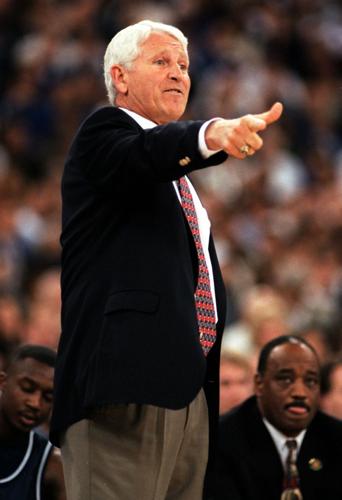
UA coach Lute Olson, shown directing his team in the 1997 Final Four, had a way of motivating his players and adapting to the talents of his roster.
“Sometimes, colleges can turn into a puppy farm,” said Bennett Davison, a starter for UA’s 1997 national champions. “But Coach Olson really cared about his players. He always said he would recruit good people instead of great athletes, guys who weren’t going to cause problems.”
That culture lasted long after Olson retired from Arizona in 2008. Players came back routinely for Lute Olson All-Star games at McKale Center, for the Lute Olson Fantasy Camp or just, well, whenever.
“The last four or five years, when I was in town, I’d just go right to his house,” said Pacific coach Damon Stoudamire, who led UA to the 1994 Final Four. “I loved those moments. I could just stay there the whole day. It was so crazy. I would laugh to myself that he might not remember something from a couple of minutes ago, but he remembers what happened during that practice in 1993.”
What happened in those practices, many players say, was the essence of Olson’s coaching: Fundamentals, drilled over and over and over, with not a minute wasted in preparation, allowing his teams to play games with a particular freedom because there was always a solid foundation to improvise from.
“All we did was read and react,” said Stoudamire, who teamed with Khalid Reeves to led teams that ushered in Olson’s transition from coaching big-man-oriented “Tucson Skyline” teams to uptempo guard-oriented schemes.
“One of the important things is to be able to adapt and he was able to do that,” said Georgia Tech coach Josh Pastner, a former UA walkon and longtime staffer under Olson.
“He was able to adapt even after he had been to a Final Four (in 1988). A lot of guys who have success get stuck in their ways. But he had a great ability to adapt and change with the times.”
Olson famously had a way of implementing change, developing buy-in, motivating his players without using a single swear word.
A crossed arms and a blunt, if sometimes corny, phrase could stop even the more free-spirited players such as Davison from going outside the lines.
“He always told me to ‘Stop chasing butterflies,’” Davison said. “He’d always tell me to tone it down.”

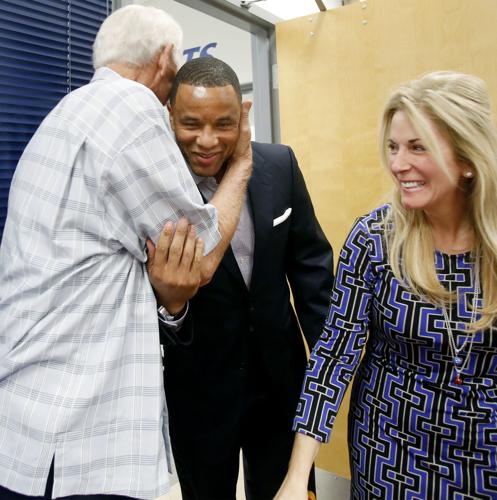
Damon Stoudamire, center, receives a hug from former head coach Lute Olson as Olson’s wife, Kelly, right, looks on during a press conference at McKale Center. Olson came to McKale to watch Stoudamire give a press conference about his return to Arizona as a coach.
But once they were done playing for Olson, the players often turned into friends and, at least once, his coach.
Davison recalled a fishing trip he took with Olson, Craig McMillan, Joe Turner and several other former UA players five years ago off the coast of Northern California.
“There were 8-10 feet swells and he says, ‘Have you got me if I get a fish?’ “ Davison said. “All of a sudden his line drops and he starts reeling it in... Joe and I grabbed his belt buckle and both his arms so he didn’t fall in.
“So all the years that he put his finger on us, disciplining us, we finally got to return the favor. It was nice to be able to reciprocate.”


