


Billy Mills might be the ranking legend of USA Olympics distance running, a come-from-nowhere 10,000-meter gold medalist at the 1964 Tokyo Olympics. If he shows up at your race, it is a very big deal.
As 36 runners stepped to the starting line at the 2000 Olympic Trials in Sacramento's Hornet Stadium, Mills stood near the group of 10,000-meter runners, on the infield near Arizona coach Dave Murray.
Among the 36 runners was one relative newcomer, Abdi Abdirahman, not a rookie but as close as it gets at the Olympic Trials. He was such an unknown that the Sacramento Bee newspaper referred to him as "Abdihakim Abdi."
Three of the 36 would qualify for the Sydney Olympics. "Abdihakim Abdi" was on nobody's radar.
Abdirahman, the son of a Conoco oil engineer, one of 10 children from a Somalian family who had moved to Tucson to escape Somalia's civil war about 10 years earlier, struggled. Murray noticed that in Lap 17, Abdirahman began to chew on his jersey.
"Every time Abdi had a bad race, he started chewing on his jersey," Murray said after the race. "I thought he was about to drop out."
A crowd of close to 20,000 roared as the race narrowed to the last mile. Abdirahman stopped chewing on his jersey. He moved into third place and began to pull away. When he reached the finish line, Abdirahman had not only made the USA Olympic team, he had finished third — 14 seconds ahead of the nearest pursuer.

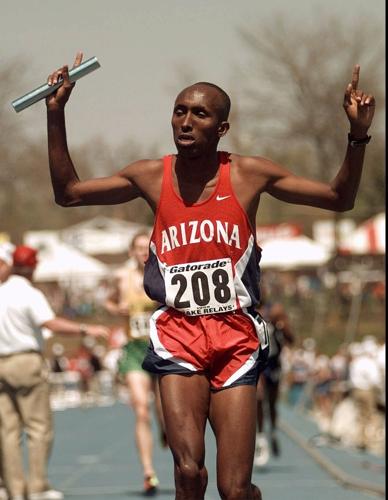
Arizona's Abdi Abdirahman crosses the finish line at the 1998 Drake Relays in Des Moines, Iowa.
He embraced Murray. He hugged Billy Mills. It was almost too good to be true.
Abdirahman, No. 24 on our list of Tucson's Top 100 Sports Figures of the last 100 years, did not compete in track and field while at Tucson High. In his spare time, he worked as a clerk at Mervyn's department store. He didn't become a United States citizen until 2000.
What came after that night in Sacramento is an American success story like few others.
Abdirahman ran the men's marathon this summer at the Tokyo Olympics, one of three Team USA qualifiers. He finished 41st. Known affectionately as "Abdi" by almost everyone, Abdirahman is 44. He is the oldest American distance runner ever to qualify for the Olympic team.
He was 10th in the 10,000 meters in 2000, 15th in both the 2004 Athens Olympics and 2008 Beijing Olympics. He switched to the marathon in 2012 and made the American team but had to drop out midway through the London Olympics race with a leg injury.
Murray, who remains his coach, says that Abdirahman's story is "almost too good to be true."

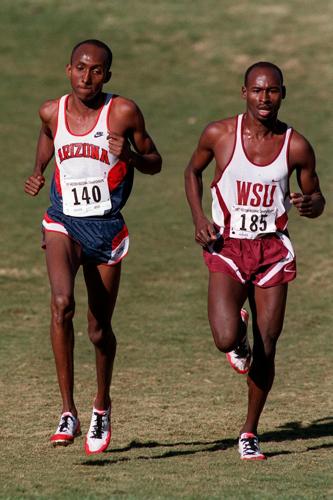
UA runner Abdi Abdirahman stays close to Washington State runner Bernard Lagat in the NCAA West Regional Championships at Dell Urich Golf Course in 1997.
That story began in 1995, when Abdirahman showed up at the UA's Drachman Stadium to watch his friend, Wildcats All-American Martin Keino, son of another 1960s Olympics distance running legend, Kip Keino of Kenya.
Keino won that day's 5,000-meter race, and another few runners finished 20 or 30 seconds behind. Abdirahman noticed.
"I thought, If those guys are on the track team, I can be on the track team, too," he told me in 1997.
Thus encouraged, Abdirahman showed up, unannounced, and asked Pima College coach Jim Miekle if he could try out for the 1996 Aztecs team. Abdirahman was wearing street shoes and jeans. Miekle told Abdirahman to give it a shot.
He finished second among all PCC runners that day, even though he wasn't properly outfitted and was maybe 15 pounds overweight. A few months later, Abdirahman won the ACCAC cross country championship and finished fifth in the NJCAA finals.
Murray heard of Abdirahman and later, as if by serendipity, saw him periodically while the PCC and UA cross country teams ran on the same dirt trails west of the Pima College campus.
"I would always say hello to Abdi as our teams crossed paths," Murray told me. "I wanted to stop him and talk about running and recruiting, but that was against NCAA rules. Abdi was a national-level runner, I could see that. But did I anticipate him being this good? No."
Abdirahman soon accepted Murray's full scholarship offer — it's rare that college track and field athletes get full scholarships — and the gamble quickly paid off. Abdirahman won the 1998 Pac-10 title at 10,000 meters, went on to win three more conference championships and finished second at the 1998 NCAA cross country finals in Kansas.

After finishing second at the '98 championships, Abdirahman told me: "I plan to make running a career. I'm just a pup."
Now the pup is the grand master of American distance running.
In June, after he had completed writing his autobiography "Abdi's World," I talked to Abdirahman as he drove from his summer training grounds in Flagstaff, returning to Tucson to meet with Murray and plan training strategy for Saturday's marathon in Tokyo.
"Many doors have opened to me because I am an Olympian," he said. "I've done all I can to keep those doors open. I'm not done yet."

