

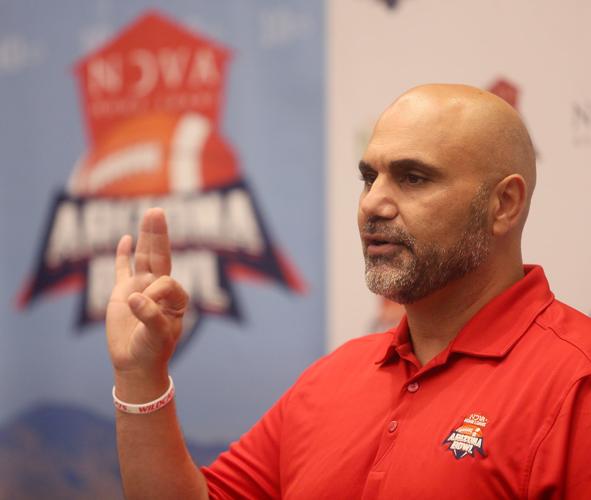


As far as Ali Farhang can determine, New Mexico State fans bought about 12,000 tickets to last year’s Arizona Bowl, but it didn’t add up — there were surely more than 20,000 Aggie fans at the game.
“Strictly through the school, we sold about 12,000,” said Farhang, chairman and co-founder of the Nova Home Loans Arizona Bowl. “But those New Mexico State fans came from every direction. We’ll never know how many. Let’s just say they kept the interstates busy north, south, east and west.”
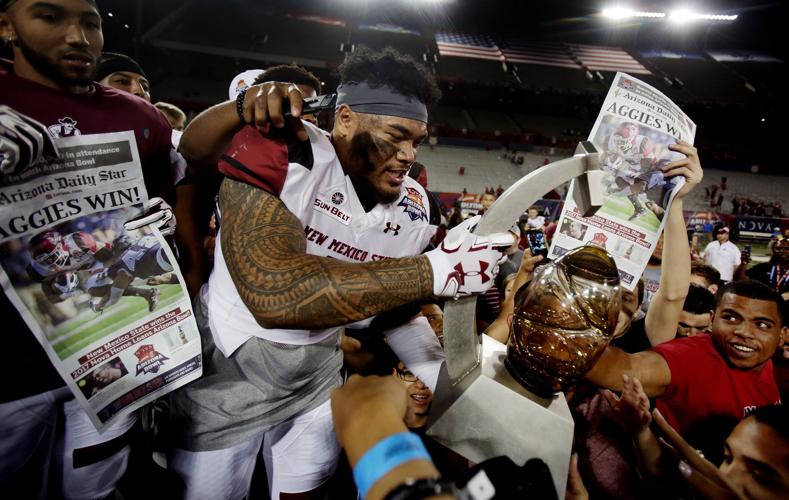
Beer sales at Arizona Stadium reached almost $200,000, a record that may never be broken, even when the UA is playing someone like Arizona State. And as if scripted by the football gods, New Mexico State — playing in its first bowl game since 1960 — won dramatically, in overtime.
Many of the Aggies and their coaches broke into tears.
All of this good fortune took place in Year 3 of the Arizona Bowl, the second-youngest of 41 college football bowl games.
What can it possibly do for an encore?
“I’m not naive enough to think we’ll get another New Mexico State,” Farhang said. “But our goals are extremely ambitious.”
Farhang remembers the inaugural Arizona Bowl, 2015, when Nevada beat Colorado State and the game’s defensive MVP, Nevada linebacker Ian Seau, cuddled the championship trophy and began to cry.
And he’ll never forget the sense of patriotism when 33,868 showed up to cheer for Air Force in Arizona Bowl II.
It’s as if the Arizona Bowl is undefeated, 3-0.
This isn’t typical behavior in a bowl game that isn’t played in Pasadena, California or Miami, Florida and doesn’t have a history stretching to 1916 or 1935. By any measurement, the Arizona Bowl has gone beyond expectations.
By comparison, Tucson’s former Insight.com Bowl, now played in downtown Phoenix, has spent the last seven years going by the name Buffalo Wild Wings Bowl; Ticket City Cactus Bowl; Motel 6 Cactus Bowl and, as of Wednesday night, the Cheez-It Bowl.
The Cheez-It Bowl is invisible in Phoenix. For the last two years, whatever that bowl was called drew fewer fans than the new Arizona Bowl.
“For our game to endure, we’ve got to give it to Tucson; it’s got to belong to the community,” Farhang said. “We are a non-profit organization. That’s how you build a lasting relationship.”
In just three years, the Arizona Bowl has distributed more than $500,000 to Tucson charities, and approximately $2.8 million in grants, gifts, tickets and other donations.
That’s not always the way the bowl business works. In the mid-market bowl games, the money flows in one direction — to ESPN.
ESPN has a division called “ESPN Events” that owns and operates 13 bowl games. It’s about as community-oriented as Nike. Last week, ESPN’s “DXL Frisco Bowl” between San Diego State and Ohio, was played before 11,029 people on a rainy Wednesday night. It was strictly TV programming.
ESPN’s New Mexico Bowl, presented by Progressive, drew an announced crowd of 25,387 on a mid-December Saturday afternoon. On the few occasions ESPN’s cameras displayed a panoramic view of Dreamstyle Stadium, however, it looked like the “2” didn’t belong. There looked to be 5,387 in Albuquerque that day.
In 2013, Arizona played in AdvoCare V100 Bowl in Shreveport on a biting cold December afternoon fit for neither man nor beast (nor sportswriters). The good ol’ Independence Bowl, also owned by ESPN Events, is now called the Walk-On’s Bistreaux & Bar Independence Bowl. And it’s not even a local bar, but one based five hours away in Baton Rouge, Louisiana.
Not exactly warm and chummy.
The Arizona Bowl has local roots. Nova Home loans is operated by Tucson mortgage executive Jon Volpe, who is from Amphitheater High School. Farhang played football at Sabino High School.
The game’s new executive director, Kym Adair, was one of Volpe’s leading marketing executives at Nova. The Arizona Bowl has just four full-time employees, including UA men’s club soccer coach Eric Rhodes and Allyson Tofel, who previously was an executive in the UA’s student affairs and enrollment division.
“We’re not mechanical,” Farhang said, smiling. “We don’t hire someone unless you can do four or five different things for us.”
Tucson’s first foray into the bowl business, the 1989 Copper Bowl, was played without a sponsor. That’s because the founders of the game — Merle Miller, Burt Kinerk and Larry Brown — learned in a hurry not to get entangled in the money game.
In the lead-up to the ’89 Copper Bowl, it was announced that a Texas-based firm calling itself H.S.E. Labs would pay $1.2 million over three years for the game to be called the Breathless Bowl.
It was a financial opportunity that few break-in bowl games could fathom. It would also be selling its name to an outsider, one without much of a track record.
To its credit, after much research, the Copper Bowl walked away from the deal three weeks before kickoff, uncertain that the Texas laboratory was a suitable partner even though a Madison Avenue firm had brokered the deal.
The Copper Bowl went on to have 11 successful seasons before the Fiesta Bowl pirated the game away, moved it to Phoenix and began calling it things like the Cheez-It Bowl.
No thanks.
Now, a generation later, Arizona Bowl IV won’t turn a lot of heads in college football. Arkansas State and Nevada aren’t sexy brands, but they’ll surely draw more eyes and more local ticket-buyers than, say, the Bad Boy Mowers Gasparilla Bowl, which drew 14,135 in Florida recently, or the Famous Idaho Potato Bowl, which drew 18,711 on a freezing night in Boise.
“You can’t tell me this game doesn’t matter to the community,” Farhang said. “It’s by the community and it’s for the community.”
The Breathless Bowl it ain’t.

