

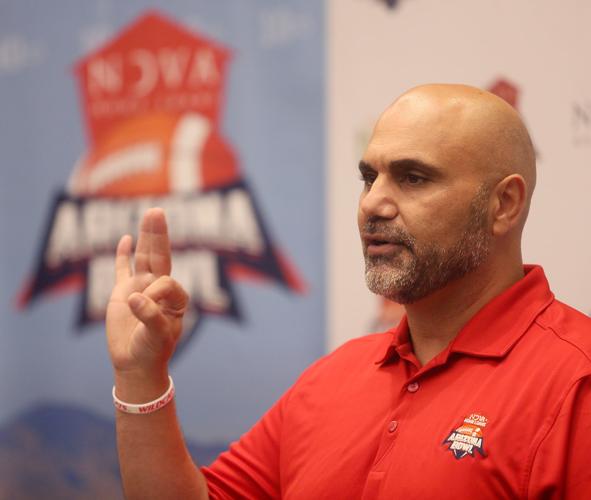
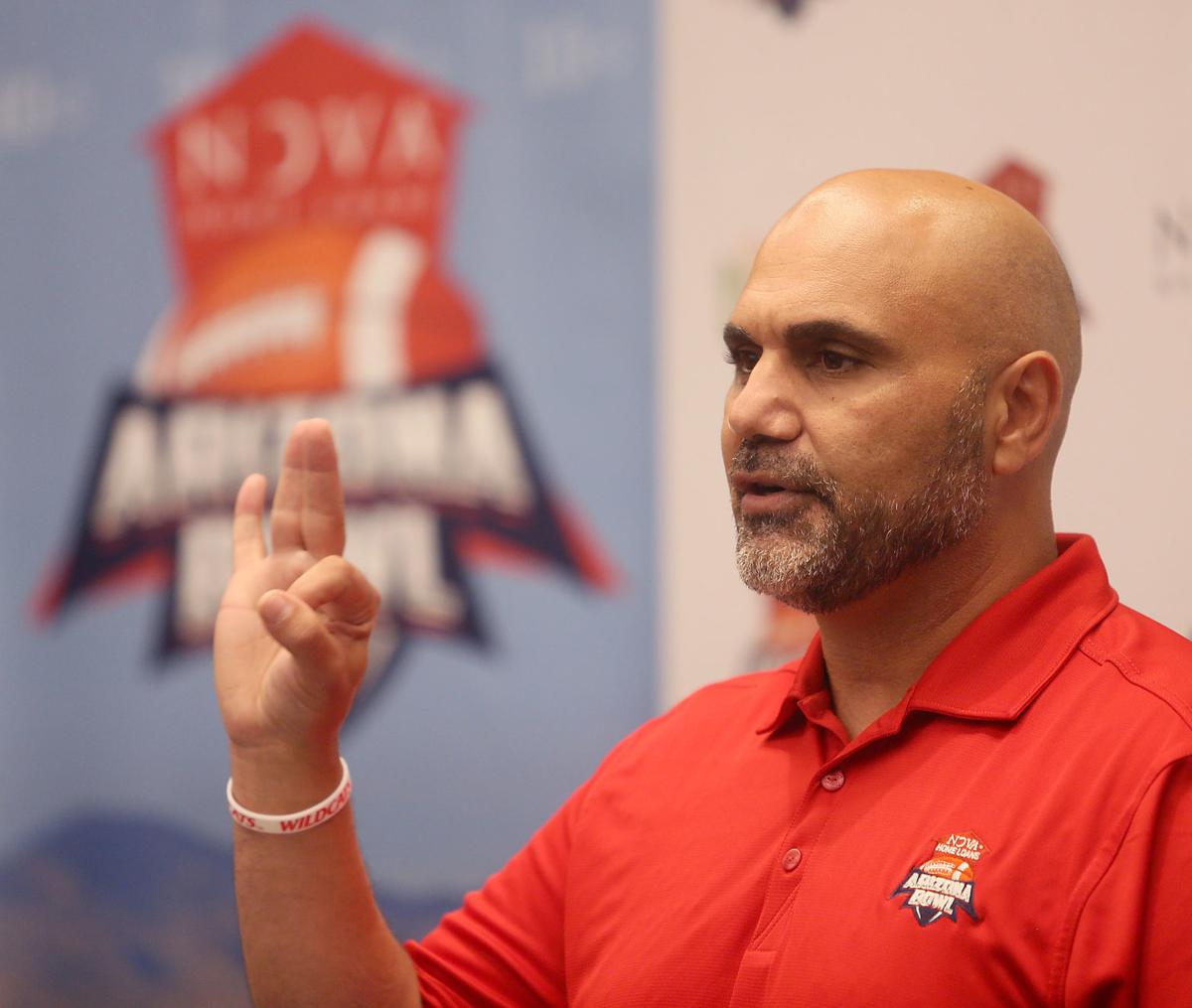
Ali Farhang recalled this week the first formations of the Nova Home Loans Arizona Bowl, the seeds that germinated for more than a dozen years before action was taken.
His was a labor of love, even if it started in Denver.
Farhang was living up in the Mile High City in the early 2000s, when Tucson lost the-then Insight.com Bowl — previously the Copper Bowl and later the Insight Bowl and the Buffalo Wild Wings Bowl, then the TicketCity Cactus Bowl, Motel 6 Cactus Bowl, Cactus Bowl, and, now the Cheez-It Bowl — to Phoenix.
Farhang felt Tucson was no little brother of the state capitol to the north.
“It felt crazy that our community — with a great stadium, the best weather — didn’t have a bowl game,” Farhang said.
“I felt helpless I couldn’t help stop it from going away. The legends of our community, the men and women who I want to be proud of me, they were all proud of that game. It didn’t feel possible with so many great people involved that it could go away.”
When Farhang returned to live and work in Tucson in 2001, he quickly joined the Fiesta Bowl committee and started what he called “a constant drumbeat about bringing a bowl game back to Tucson.” When the Fiesta Bowl Classic basketball tournament lost its luster, leaving the city without a major sporting event in late December, the drumbeat turned into a full-on rock concert.
When the Cactus Bowl spurned Tucson’s advances to return during Sun Devil Stadium renovations in 2013, the drumbeat was breaking the sound barrier.
Farhang was going to get this done.
•••
There might be no Arizona Bowl today if not for chimichangas.
Mini ones, in fact.
Looking back on it now, Farhang sees the absurdity in it all. And the naiveté.
By 2014, though, Farhang had had enough. His refrain became constant. Tucson deserved a bowl game. Conversations with like-minded friends and Tucson businessmen like Mark Irvin and Fletcher McCusker only further emboldened him.
Over Thanksgiving weekend in 2014, Farhang received a phone call from former Fiesta Bowl chief of staff and Arizona Sports and Entertainment Commission CEO Alan Young. Young repeated ASEC’s opinion that Tucson should get a bowl game, and Farhang was further encouraged.
So he acted.
Farhang set up a meeting with local prominent business leaders at Sam Hughes Place. He invited mayor Jonathan Rothschild and Pima County Administrator Chuck Huckelberry. Several former Copper Bowl officials showed up. There were chips and salsa, and, crucially, the mini-chimis. Which were a hit, as mini-chimis usually are.
“I had the audacity to set up this meeting, but this was 2014, and the real estate market had hit hard times, the economy isn’t great, there was cynicism in the air. Sometimes we have a self-defeatist attitude in Tucson,” Farhang said.
“I still think at that point I was looked at as crazy. People were still dubious. For me it was information gathering. I wanted to understand what I was facing.”
The reaction was warm, but not exactly scorching. But they planned another meeting. And then another. Irvin and McCusker — “My first two draft picks in building this thing,” Farhang said — were on board.
“I had just met Mark less than six months prior,” Farhang said. “So many of the same clients, both in town for a number of years, we’d never met. We developed a friendship and immediately identified him as a can-do person. Tell me how we can do something, not why we can’t. He was the first guy who would sit down with me and say this is a good idea.”
At the time, Farhang was coaching football at Catalina Foothills High School, and he’d just started a law practice with a new partner, and he had a wife and two young kids.
“I can’t tell you it was consuming me, but we were having discussions every day,” he said.
The first order of business: Apply for a bowl game with the NCAA. The task required a lengthy submission that pit Tucson against other potential bowl destinations, including Little Rock, Arkansas, and Austin, Texas. The application was completed around the end of January, and for three-plus months, they waited.
On May 5, 2015, they got word: The NCAA had approved the submission, with the Mountain West Conference and Conference USA as affiliated conferences.
“We got the letter of approval, and that was our ‘Oh (shoot)’ moment,” Farhang said.
•••

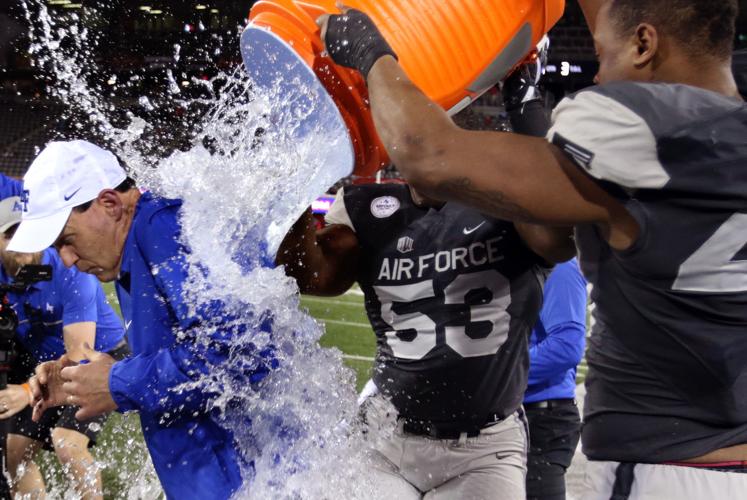
Air Force players doused coach Troy Calhoun after beating South Alabama in the 2016 Nova Home Loans Arizona Bowl. The Falcons’ participation was huge for Tucson, an Air Force town.
There was some discussion about postponing the inaugural bowl for a year, to get a better handle on things, but the very real fear existed that if they held back the game even one year, the NCAA would pull its approval.
“If I look back at it, the fact I was so ignorant about what it took to put a bowl game on was probably a good thing,” Farhang said. “You’re building a company from ground up. You have to produce the widget in months. First thing was secure the stadium, then ticketing system, and concurrently, do we have a TV package, can we do something creative? Social media? Then when is the game going to be? So many moving parts. Meeting after meeting after meeting. There were times where it was a certainty it wouldn’t happen. We tried our best. Around October 2015 was the first time with 100 percent certainty that we knew it was going to happen.”
This was a rare opportunity in the modern sports climate, which puts such a premium on legacy, to create something from scratch.
This wasn’t a rebranding or a relaunch. This wasn’t the Copper Bowl coming back to Tucson.
This was a new entity, and it needed a name. There were some … interesting … ones out there.
“The Tucson Bowl, the Chimichanga Bowl, the Sonoran Bowl,” Farhang said. “That’s when I and some other people said, ‘this whole concept of Tucson vs. Phoenix doesn’t resonate for us.’ For me, I thought Tucson is Arizona. We’re gonna be the Arizona Bowl. Tucson shouldn’t feel like anybody’s little brother. We are Arizona.”
Now that the bowl had a name, it needed a sponsor.
Around mid-October, Farhang — by now an assistant at Salpointe Catholic — stood on the Lancers’ practice field, speaking with another assistant coach, Jon Volpe. Volpe was (and is) CEO of Tucson-based Nova Home Loans.
“Hey, you want to sponsor the game?” Farhang said nonchalantly. “Sure,” Volpe responded.
Meanwhile, things were starting to coalesce on the planning end; having secured Arizona Stadium via a contract with the University of Arizona, and with the Mountain West an enthusiastic partner, it was simply a matter of lining things up. Concessions, marketing, charity — everything would have to be accounted for.
Farhang wanted to make sure the entirety of Tucson was included. A downtown block party was a necessity, he said, to give the game the Phoenix-Open-meets-bowl-game atmosphere he wanted.
They brought on Rich Moret, a local advertising exec who’d had success with the Jim Click Automotive Group; Bill Shaw, KVOA’s president and general manager, was brought aboard as well. Local sports marketing whiz Mike Feder came along, too.
“It all felt chaotic,” Farhang said.
“We were kind of drinking out of a firehose. It was like, ‘What are the issues for today?’ But everyone associated with the game were can-do people, and it was a matter of taking issues one-by-one.”
Farhang had one ace in the hole: the Mountain West Conference.
•••

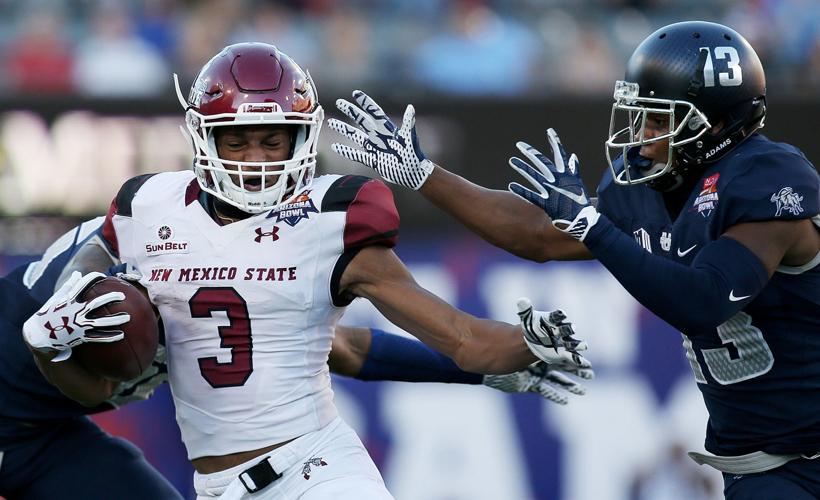
New Mexico State running back Larry Rose III starred in last year’s Arizona Bowl win over Utah State, scoring the game-winning touchdown in overtime.
On Valentine’s Day Weekend, 2015, MWC Deputy Commissioner Bret Gilliland found himself in Phoenix for his son’s soccer tournament. The Mountain West had long coveted another bowl tie-in, particularly one within their regional footprint.
Gilliland got a call from Young, now heading the Arizona Sports and Entertainment Commission, about a potential bowl partnership.
“We were already well aligned as a conference about wanting another bowl; as we looked at our number of eligible teams, we knew we needed another slot,” Gilliland said. “We were in talks about possibly even Australia. But trying to stay in the western U.S. was a focus.”
The MWC, Farhang said, became an invaluable partner.
“We really just dug in,” Gilliland said. “I knew our membership wanted to pursue it. We tried to dig in on all the moving parts. Stadium, opponent conference, funding, marketing, sponsorship, TV partners. A ton of things had to be worked through, but this was a lot of people with a lot of positive energy. We had some fits and starts. Some sponsors didn’t come to fruition, but the Campus Insiders guys came on board and that was crucial.”
Along with Campus Insiders (now known as Stadium), the game would be streamed online — the first bowl game with such a setup — and aired on the American Sports Network.
The game was officially announced on Oct. 1; by late-November, the team selection began to take shape.
“I remember being in a hotel room in San Diego at our conference championship game and (MWC commissioner Craig Thompson) and I were on multiple phone calls around the country,” he said.
They were facing a quandary.
Conference USA did not have enough bowl-eligible teams to send someone to the Arizona Bowl. Nor did the Sun Belt Conference. But the MWC wasn’t about to be burned again — not after Wyoming was left without a game after going 6-6 in 2014.
The idea came up: Why not pit two Mountain West teams against each other? Both 7-5 Colorado State and 6-6 Nevada were both eligible. They hadn’t met during the regular season, adding a level of competitiveness to the game.
But no two teams from the same conference had played against each other in a bowl game since 1979.
“I tell people this all the time — you try to plan out these bowl relationships and lineups and every November, the second or third week, things start to crystallize and it’s a different set of variables every year,” Gilliland said. “It’s like this Rubik’s Cube.”
This wasn’t a dream scenario, though. Bowl games exist not just as a reward for teams who deserve recognition after a long regular season, but to foster matchups with other leagues. It’s a time for teams, and conferences, to puff their chests.
“We looked at myriad options, because having two (MWC) teams wasn’t super-attractive for us,” Gilliland said. “We also knew it was imperative to have a game. We were lucky because those two teams had not played each other. But first and foremost, the benefit was our teams were all in bowl games. No one got left home. You start with that — you’re in a game, you’re playing — and you realize this is unusual, so let’s embrace it, make it an opportunity.”
With the game set, Farhang set out to drum up some interest in the community.
“It became real when Nevada and Colorado State were penciled in,” he said.
“I went everywhere trying to drum up ticket sales. I went to Rotary clubs, breakfast clubs, sent out emails, got billboards, did the radio shows. We went to pretty much every possible event and talked to as many people as we could.”
•••
By kickoff, nearly 25,000 tickets had been sold — the second largest attendance at an inaugural bowl game.
Nevada would go on to win the game 28-23, with Wolfpack running back James Butler taking offensive MVP honors and Ian Seau — nephew of Chargers great Junior Seau — winning defensive nods.
For Farhang and the bowl committee, the game was a resounding success, bringing in thousands of dollars for charity and setting the stage for a successful experience for years to come.
“I’ve had a 30-year career in college athletics, and this was, while challenging, certainly enjoyable,” Gilliland said. “It was sort of this blank canvas that we had to work with.”
The game has grown by leaps and bounds in the last two years.
In 2016, bolstered by the participation of the 9-3 Air Force Falcons, who brought out members of the Davis–Monthan Air Force Base in droves, attendance soared to more than 33,000. Last year, in front of an announced crowd of 39,132 — nearly double the first year’s attendance — New Mexico State beat Utah State 26-20 in overtime.
When the Aggies rushed the field after the game, it brought back waves of excitement for Farhang.
Because it was before that second game, when Air Force beat South Alabama, that things really came alive.
“That moment for me was the second year,” Farhang said.
“Mark Irvin and I went to the MWC championship game in Wyoming with the complete intent to pester and annoy Commissioner Thompson to agree to get Air Force. It was like 3 degrees and we were in a box with Wyoming and SDSU athletic directors, and the only way we had a chance was if SDSU beat Wyoming. And I’m in a box with reps from every school and I can’t root for anyone.
“So instead we went on the field and rooted our (butts) off for San Diego State. And they won. Five seconds to go, SDSU six-yard line, the pass goes incomplete, and we rushed the field and jumped on the SDSU guys.
“The next morning we found out we got Air Force. That’s when I knew we were on to something.”
He got further confirmation after the game.
“All the ADs and football coaches got together, and I got a text that Air Force reps stood up at the MWC meetings and said, ‘We really enjoyed the experience and if we don’t make the conference championship game, we’d like it to be our game,’” he said.
“But I really knew we were on to something when every school objected. They wanted to come to Tucson, too. That was a highlight for me.”

