


When Arizona last publicly filed a financial report to the NCAA, in 2023-24, it said football pulled in over $30 million in ticket sales, donations and media rights.
Now, for the first time this season, players will officially get a cut of that revenue.
A big one, too. According to industry estimates from NIL platform Opendorse, Wildcat football players collectively could receive more than $13 million for the 2025 season from the school alone, on top of any NIL deals they also might have.
Thanks to the House settlement that went into effect July 1, Arizona is among the schools now paying athletes what it calls “revenue-sharing,” or what are essentially salaries for players who are now professional.

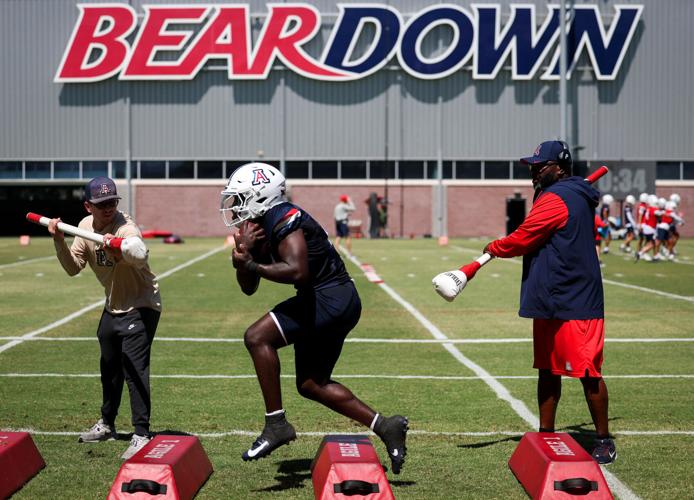
Arizona running backs complete drills during training camp at Tomey Field, Wednesday, July 30, 2025.
Arizona AD Desireé Reed-Francois has said UA will pay the maximum of $20.5 million to athletes, as all power-conference programs are expected to in order to remain competitive, but she has declined to specify what percentage each UA sport will receive.
Still, by using estimates of industry standards calculated by NIL platform Opendorse, it is possible to get a rough idea of what the school might be paying Wildcat football players this season.
Basing its data in part on disclosures and budgets from collectives and colleges between July 1, 2021, and June 25, 2025, Opendorse estimated that power conference schools will give an average 65.6% of their $20.5 million share to football teams.
If Arizona follows that average, the school would pay its football players a collective $13.4 million for the 2025 season. If UA also follows the position-by-position estimates Opendorse published in its 2024-25 annual report — and Opendorse’s estimates that starters are getting an average 80% of each position group’s total — here’s how a breakdown in compensation could look at Arizona:
(NOTES: The first figure after each position is a total for the entire position group, including all starters and reserves, based on Opendorse industry averages. All specific player estimates are based solely on Opendorse’s reported industry averages, and were not received from UA sources; UA is not releasing player compensation information.)
Quarterback: $2.26 million (16.9% of the $13.4 million in total football player payments). If 80% goes to the starter, presumably Noah Fifita, he would theoretically be paid $1.82 million under this formula in 2025. Roughly $450,000 would be divided among UA’s backup quarterbacks.
Running backs: $1.19 million (8.9%). If UA brought in Ismail Mahdi to become the starter, industry averages suggest the school would pay him in the high six figures, while other rotation running backs would split up the rest.
Wide receivers: $2.06 million (15.4%). If UA projects three starting wide receivers, they would average in the mid six figures — if the starting pool received 80% of the position group amount — and rotation players would get the rest.
Tight end: $603,000 (4.5%). That suggests roughly $480,000 for a starter and the rest to backups.
Offensive linemen: $1.9 million (14.2%). Under Opendorse’s estimates, UA’s starting O-linemen collectively would be paid $1.52 million of this total, while backups would get the other $377,000.
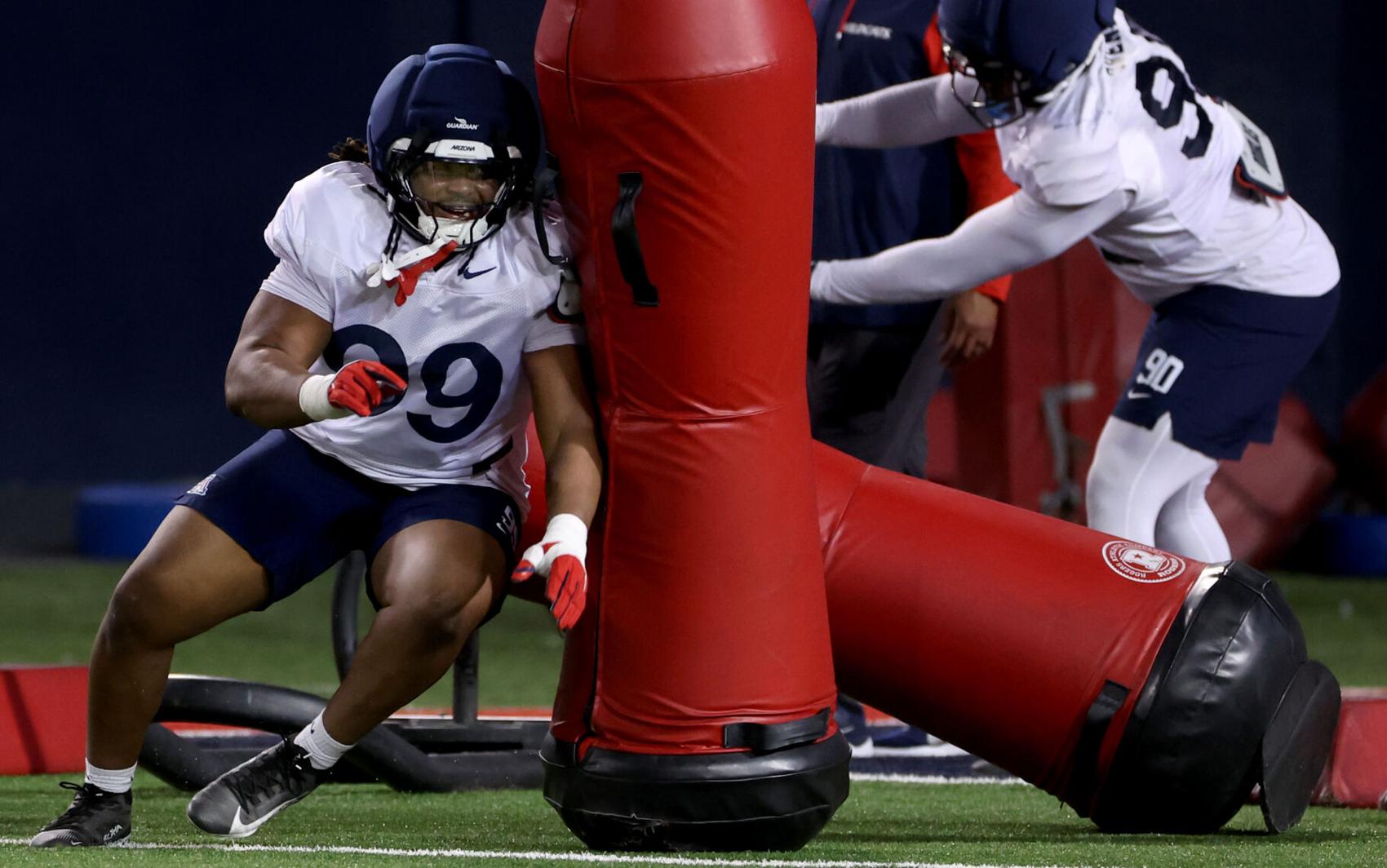
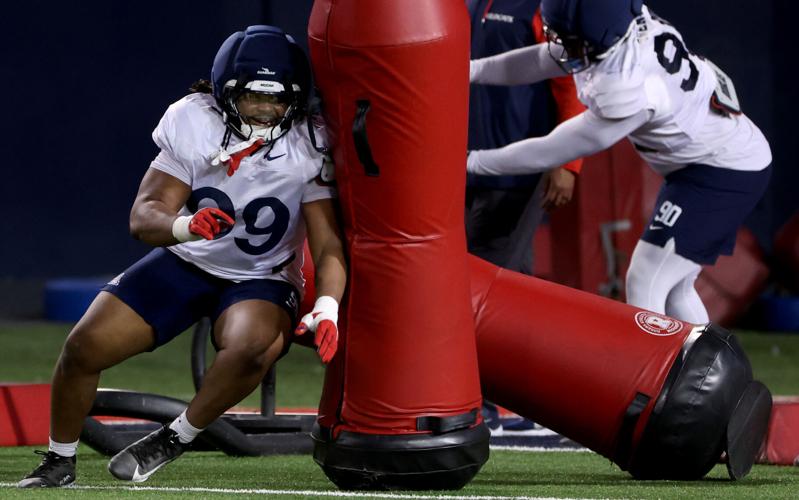
Lineman Deshawn McKnight (99) weaves through a maze of pads as the defense works out during the Wildcats’ spring training session at Arizona Stadium on April 5, 2025.
Defensive linemen: $1.83 million (13.7%). Similarly, assuming UA placed standard valuations on its D-line, expected starters Tre Smith, Deshawn McKnight, Tia Savea and Dominic Lolesio would collectively get $1.46 million, and backups would get $361,000 if UA matched Opendorse averages.
Linebackers: $1.59 million (11.9%): If UA planned on three starting linemen, they would theoretically combine for $1.27 million while reserves picked up a collective $314,000.
Defensive backs: $1.74 million (13.0%): The group of starters would be worth $1.39 million collectively and reserves $348,000, though UA might be giving this group a higher percentage because the Wildcats might start five defensive backs.
Specialists: $201,000 (1.5%): Opendorse estimates kickers, punters and other specialists will get only a tiny share of the football pie.
It is also worth noting, however, that the amounts may vary widely within position groups even if Arizona gives the average of $13.4 million to football.
For example, the Wildcats may have allocated more to help rebuild their offensive line with several power conference transfers, while they also managed to get four starting defensive backs back from the transfer portal: Genesis Smith, Dalton Johnson, Treydan Stukes and Marquis Groves-Killebrew.

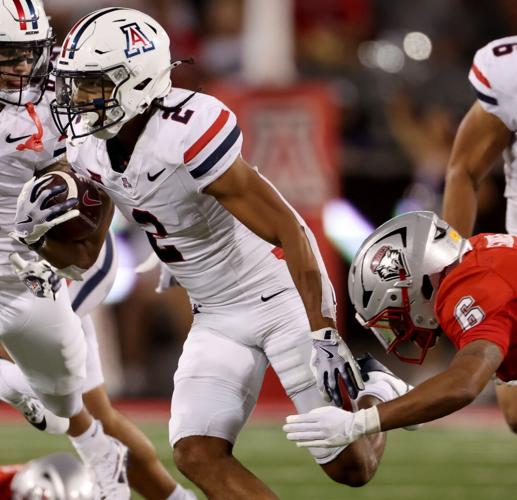
Arizona defensive back Treydan Stukes looks for room to run after picking off a pass against New Mexico in the season opener on Aug. 31, 2024.
“Every program’s percentages will look different based on their strengths, needs and styles of play,” says Braly Keller, Opendorse’s director of collegiate services and insight.
Also, whatever UA football players receive from the school is in addition to the NIL payments they may be receiving.
NIL was uncapped until the House settlement was approved in June, leading to the “front-loading” of NIL deals worth up to seven figures around college football. Now, any deals of more than $600 must be approved through a new NIL GO clearinghouse, though that structure is expected to face legal challenges.
Pre-House NIL contracts that were run outside UA have generally been kept private, while NIL and revenue-sharing deals that now run through UA will not be available to public records requests because of a new Arizona NIL law. Other salaries at UA, including the $3 million the school agreed to pay head coach Brent Brennan in 2025, remain subject to public records requests.

