



Arizona and Oregon. ASU and UCLA. USC and Oregon State.
Are these NCAA regional pairings or Pac-12 Tournament pods?

Michael Lev is a senior writer/columnist for the Arizona Daily Star, Tucson.com and The Wildcaster.
Welcome to postseason college baseball in a post-realignment world, where rivals are torn apart and brought back together again.
When our beloved Pac-12 Conference imploded in 2023, those of us who chronicle college baseball quickly came to a collective conclusion: The NCAA Tournament now could feature West Coast regionals packed with West Coast teams.
So it came to be Monday, when the field of 64 was revealed. Arizona is headed to Eugene along with Cal Poly and Utah Valley. ASU is going to Los Angeles along with UC Irvine and Fresno State. And USC is flying up to Corvallis along with TCU (the lone interloper) and Saint Mary’s.
If we can’t have the Pac-12 Conference anymore — as we came to know it anyway — at least we can have postseason matchups pitting former Pac-12 teams against each other. Heck, even the ESPN announcers assigned to the Eugene Regional — Roxy Bernstein and Wes Clements — are Pac-10/12 originalists.

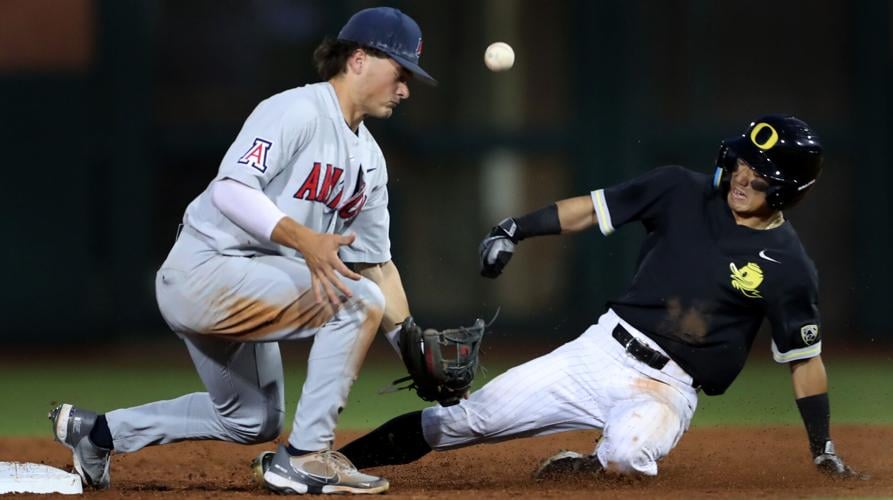
Facing Oregon — a possibility for Arizona in the NCAA Tournament’s Eugene Regional — would be nothing new for the Wildcats and Mason White, shown here against the Ducks in the final of the 2024 Pac-12 Tournament in Scottsdale.
Is this repackaging of the Pac a consolation prize? Yes, of course. But it’s kinda fun. And it’s kinda old-school.
Before the current tournament format was adopted, Arizona played mostly teams from the West in regional play. In 1992, its opponents were Washington and Hawaii. In ’89, Arizona hosted Hawaii, Long Beach State and Loyola Marymount. In ’87, the UA faced Pepperdine and Hawaii in Tempe.
Although the NCAA Tournament is a national event — in theory, at least — there’s something to be said for being able to construct truly regional regionals. Besides rekindling old rivalries, it greatly increases the chances of West Coast representation in the Super Regionals and maybe even Omaha. No matter what, a team from the West is coming out of Eugene and L.A. And if doesn’t happen in Corvallis, it’ll be TCU repping the Big 12.
Anything that might mitigate the SEC’s omnipresence should be considered a positive.
Although Arizona, among others, is in a new conference, the SEC-ness of it all hasn’t changed. The same frustration exists out West when it comes to getting what we perceive as a fair shake.

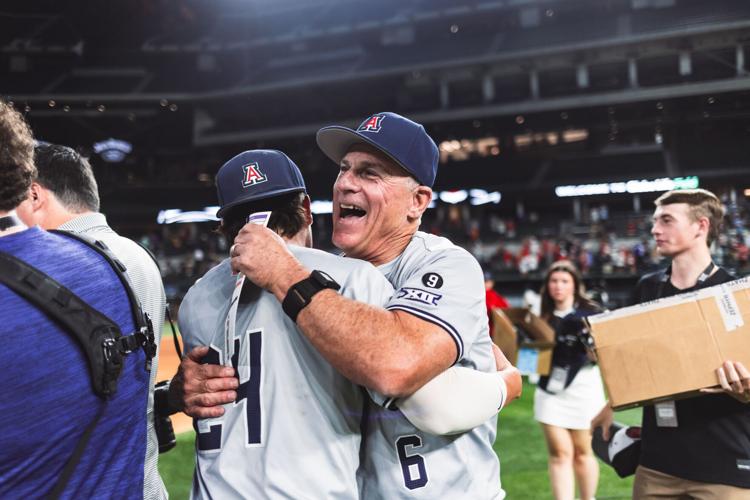
Arizona coach Chip Hale, right, hugs shortstop Mason White after the Wildcats defeated TCU 2-1 in 10 innings in the Big 12 Baseball Championship title game on May 24, at Globe Life Field in Arlington, Texas.
While the SEC led the way with 13 participants, including eight hosts, the Big 12 ranked third with eight entries — fitting considering it’s widely viewed as the third-best baseball conference.
The Big 12 not getting a single host spot for the first time definitely stings and reeks of the disrespect we came to know and loathe — but more or less accept — in the Pac-12.
Unfortunately, the Big 12’s best bets — Arizona and TCU — basically boxed each other out.
The Wildcats probably lost any hope of hosting when they lost two of three to lowly Utah at Hi Corbett Field May 9-11 — followed by a series-opening defeat at Houston on May 15.
The Horned Frogs were in prime position to host with multiple metrics on their side, including rankings of No. 18 in RPI, No. 18 in strength of schedule and No. 14 in nonconference strength of schedule. But TCU lost three of four vs. Arizona — including the Big 12 Baseball Championship title game — and two of three to Southern Miss in Fort Worth. The Golden Eagles therefore got the No. 16 overall seed and became the second host from the Sun Belt — despite that league ranking five notches below the Big 12 in conference RPI, per WarrenNolan.com.

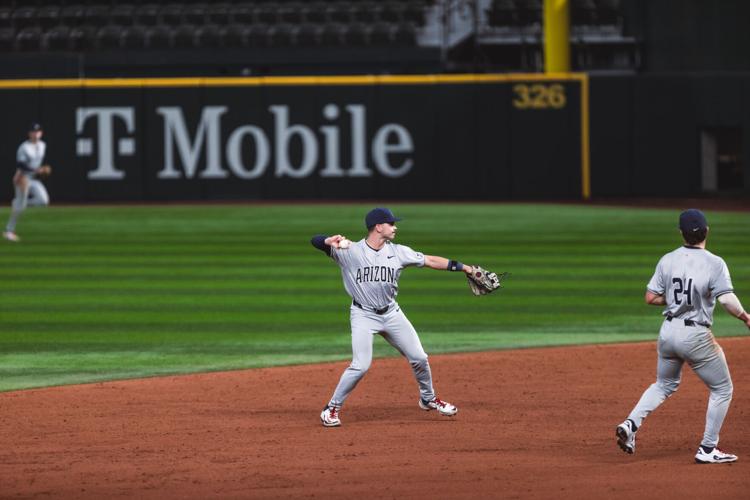
Arizona second baseman Garen Caulfield prepares to throw to first against West Virginia in the semifinals of the Big 12 Baseball Championship on May 23, at Globe Life Field in Arlington, Texas.
“I think everybody’s pretty disappointed,” UA coach Chip Hale said Monday on behalf of the Big 12. “As a coaching fraternity in the league, that was the feeling, like, ‘Come on, one of these teams needs to (be) a host.’”
“There probably could have been 1-2 hosts,” UA senior second baseman Garen Caulfield opined. “But it was a really competitive conference, and everyone beat each other up, especially at the end. That’s probably what led the committee to go with another SEC school or whatever happened.
“We’re just focused on the present moment, getting down to Eugene and having the best practice we can. That’s what we’re going to worry about right now.”
Caulfield, who’s in his fourth year at Arizona, said it feels as if he’s been to Oregon’s PK Park “10 times.” He actually has played two series in Eugene, as have fellow seniors Tommy Splaine and Eric Orloff.
While it should be helpful to some degree to play in a familiar setting — and, if the regional goes according to form, against a familiar foe — it doesn’t guarantee success. As Hale reluctantly noted, it hasn’t mattered where the Wildcats have played in the past three NCAA Tournaments; whether at home or on the road, they failed to advance past regionals all three times.

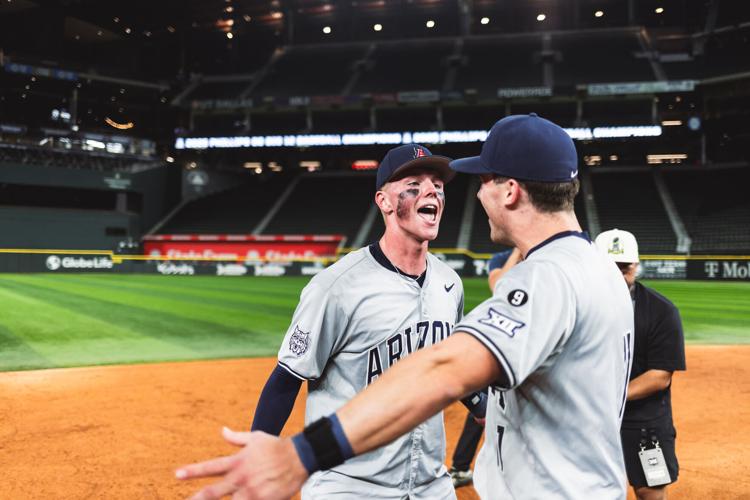
Arizona first baseman Tommy Splaine, left, celebrates with center fielder Aaron Walton after the Wildcats defeated TCU 2-1 in 10 innings in the Big 12 Baseball Championship title game on May 24, at Globe Life Field in Arlington, Texas.
“A lot of it is matchups,” Hale said. “Last year ... the teams that were coming to us, they were all really tough matchups for us, whether we were at home or whether we were playing on Mars.
“We just have to play better baseball. That’s what it came down to. We just didn’t play well enough on that weekend. And if you don’t play well enough on the weekend, you’re going to go home.”
Interestingly, when asked if he had a notable memory from playing at PK Park, Splaine said: “I just remember losing to them in the Pac-12 championship two years ago.”
He was referring to the 2023 Pac-12 Tournament title game in Scottsdale. The Ducks won 5-4. It was the first of three consecutive conference tournament championship games Arizona would reach and the only one it would lose. All three were decided by one run.
Whether the Wildcats can carry that type of competitiveness into an NCAA regional remains to be seen. Perhaps thinking of it as “Pac-12 Tournament Pool B” will put them in the right frame of mind.


