


There's no debating Mike Candrea's place in Arizona athletics history.
He's on a short list of the most successful and influential coaches at the UA, akin to figures such as Lute Olson, Jerry Kindall, Frank Busch and Dick Tomey, among others. However, Candrea is in a class of his own.
Between his first season at Arizona 40 years ago in 1986, to his last season in 2021, Candrea compiled 1,674 wins, 24 Women’s College World Series appearances and eight national championships. He has the second-most wins by a college softball coach behind Carol Hutchins.
Candrea's success at Arizona steered him to leading Team USA Softball in two summer Olympics in 2004 (Greece) and 2008 (China), winning a gold and silver medal. Candrea, who's in the USA National Softball Hall of Fame, also won two gold medals and a silver medal with Team USA in the World Cup of softball.
Candrea is in the breath of every conversation regarding the evolution of softball in Tucson and the sport on a global platform since he first led the Wildcats in 1986.

Coach Mike Candrea won his first career game at Arizona in 1986.
Before Candrea became the architect of Arizona softball and the face of USA Softball, he had aspirations to be a baseball coach.
It didn't matter where, Candrea said he just wanted to coach the "bat-and-ball game."
Candrea — whose father was a jazz musician in New Orleans before moving the family to Phoenix for most of Candrea's childhood — was coaching baseball as an assistant at Central Arizona College in Coolidge and was a part of a national championship-winning team in 1976.
In 1982, four-time Olympian and UA alumnus George Young, who will be inducted into the Arizona Sports Hall of Fame this year, "became a very good mentor in my life and came into my office" with an opportunity Candrea had been pining for. Then, CAC's athletic director, Young, presented Candrea with a head coaching gig. With one twist.
"'Mike, I need your help. I need you to coach the women's softball team,'" Candrea recalled. "'George, I don't want to coach softball, I'm a baseball guy.'"

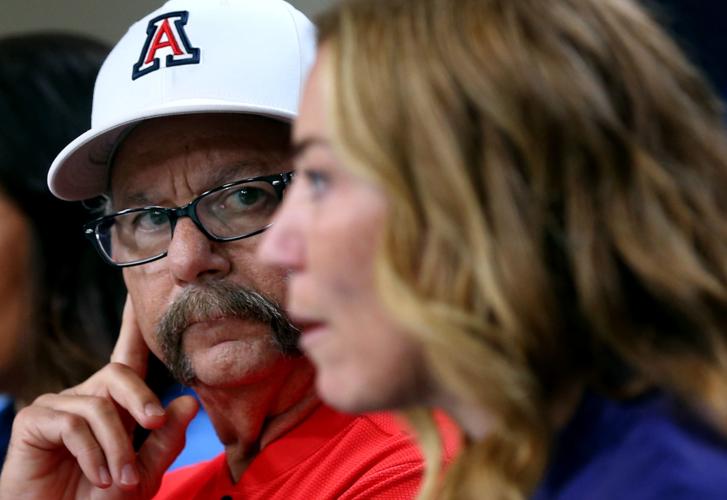
Arizona’s head coach Mike Candrea listens to Washington head coach and opening day opponent Heather Tarr speak during a press conference the day before the first games in the NCAA Women’s College World Series, Wednesday, May 29, 2019, Oklahoma City, Okla.
Young begged Candrea to take the job. Candrea hesitated, but realized, "I had the freedom to call my own shots," he said. He accepted the job and was Central Arizona's softball coach.
Candrea said his inaugural season "was a decent year," but he needed a workhorse pitcher to build around, so he recruited Phoenix native and Greenway High School star Connie Clark, who later led Cal State Fullerton to the Women's College World Series title in 1986. Candrea and Clark won two national championships together before the pitcher transferred to a bigger stage.
Candrea was hired by Arizona athletic director Cedric Dempsey in 1985 and replaced Paula Noel, who didn't have a winning record in Pac-10 play.
"When I was looking through the rearview mirror, I said, 'What the heck happened to my life?'" Candrea said. "It's hard to believe how quickly time goes by. It seems like it was just yesterday that I rolled into Tucson. I took a chance on a job that I really didn't want.
"I didn't want to be a softball coach, I wanted to be a baseball coach, and I got talked into it. But it goes to show you where life can take you sometimes, if you open up and explore a little bit and get out of the box."

Mike Candrea became the most well-known softball coach in the country during a 1990s dynasty that saw UA win titles in 1991, 1993, 1994, 1996 and 1997.
Candrea was content with his teaching and coaching job at Central Arizona, "but I said 'If I'm going to coach, I'm going to coach at the highest level,'" Candrea said.
"They gave me a chance to come here," he added. "I thought I was going to the big time."
Shaking things up
When Candrea first took over Arizona, he identified the nearby heavyweights and rivals — and UCLA was the clear-cut team. UCLA "was the gold standard," and "we snuck up on them," Candrea said.
"I went right to work and said, 'If I'm going to be a player at this level, I gotta understand what it's going to take to beat them — and recruit with them,'" Candrea said of UCLA. "That was the big thing."
Candrea prioritized recruiting Arizona athletes "with a sprinkling of California athletes." Six years into the Candrea era, the Wildcats were crowned national champions in 1991. The national title "opened the door in Southern California and we started to get better and better players and never looked back," Candrea said.

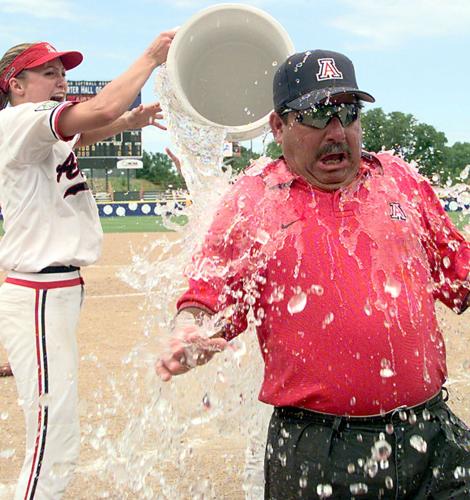
Arizona coach Mike Candrea is showered with water May 28, 2001, after his team defeated UCLA, 1-0, in the NCAA Division I Softball championship game in Oklahoma City.
Candrea's most prominent in-state recruit in the early years was Scottsdale product and pitcher Susie Parra, who holds the record for the lowest ERA (0.30) in program history. Parra "was a game-changer" and the three-time All-American led the Wildcats to three national championships from 1991-94.
"I wanted to own the state and she was a big part of that," Candrea said of Parra. "We owned the state of Arizona for softball."
Candrea "reinvented the game a little bit" from a preparation and practice standpoint — and uniforms. Candrea claimed Arizona as one of the first college softball teams to wear pants.
"How can you play this game if you're wearing shorts?" Candrea said.
Candrea introduced a baseball-style practice structure and drill work, "and some aspects of hitting that was completely different back then," he said.
"They had no idea about breaking down skills, so I felt like I had an advantage there," Candrea said. "If I had that, along with some good athletes, then we can put Arizona on the map."

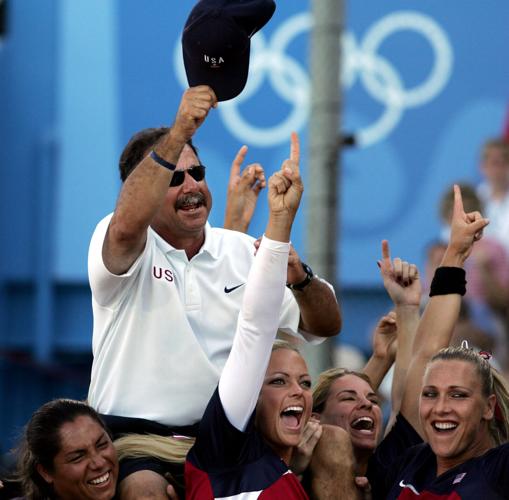
Members of the United States softball team, including pitcher Jennie Finch, put coach Mike Candrea on their shoulders as they celebrate their gold medal victory against Australia at the 2004 Olympic Games in Athens.
Candrea "would never end a drill until we got it right," said former UA infielder Jenny Dalton-Hill. "My freshman year, I made drills last a really long time, because I was learning a new position and made a lot of mistakes, but practices were when you were supposed to make all of those mistakes, so it doesn't happen in games. I never once heard him complain that I needed another rep or get angry that I needed another rep; he just gave me another rep, another rep and another rep.
Added Dalton-Hill, who fought back tears: "While that wasn't a big deal, I was allowed to fail to learn how to get it right. That's a life lesson: it doesn't matter how many times you fail, it's how many times you get back. That's literally who he is. He lived that through how he coached us. The only way you win at the highest level, is to get it right in practice. He gave us those opportunities to fail at a high level, so the game slowed down."
Candrea created instructional VHS tapes on techniques to hit a softball and play defense.
"You were not an elite softball player unless you had a Mike Candrea VHS hitting tape," said Tucson native and former UA pitcher Kenzie Fowler, whose grandfather shared an office with Candrea at Central Arizona as the men's basketball coach. "That was obviously before YouTube, but that was how every single one of my teammates learned how to hit. Every elite softball player had his VHS tape.

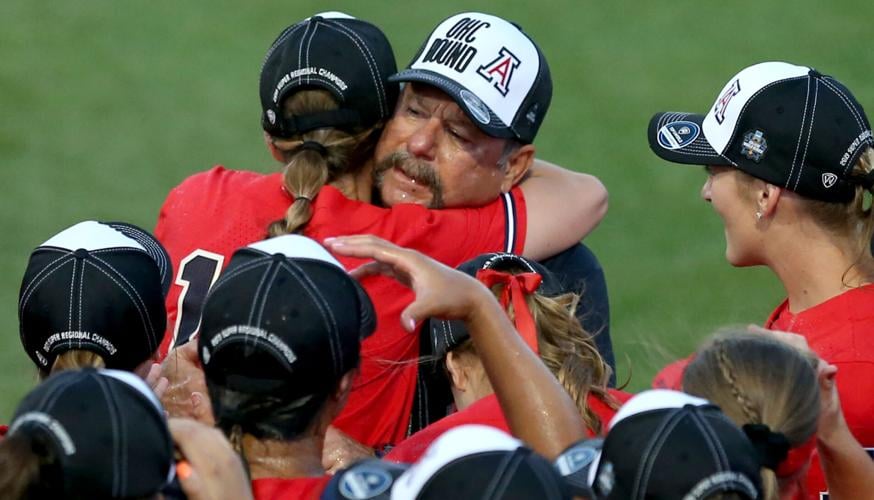
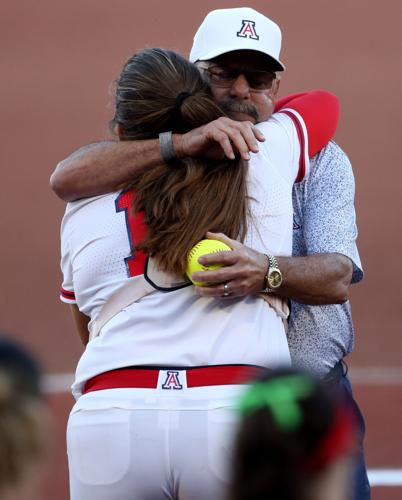
Former Arizona coach Mike Candrea gets a hug from UA catcher Izzy Pacho (15) after he threw out the ceremonial first pitch before the Wildcats’ game against rival Arizona State in the first-ever Pac 12 Softball Tournament game on May 10, 2023 at Hillenbrand Stadium in Tucson.
"He was the only one willingly putting out information that helped the sport grow. One thing he doesn't get enough credit for, is how much information he put back into the sport. He could've held it close to his chest and held it all for himself."
Candrea introduced technology to test hitters' exit velocity at the plate, spin rate of pitches and launch angle of hits.
"I don't think anyone could understand the level of awareness and acute understanding of what he was doing," said Dalton-Hill. "He was cutting edge on a lot of frontiers."
'It was like going to heaven'
Candrea brought a winning culture to Arizona's softball program and led the Wildcats to unprecedented success — winning that wasn't going to be sustained unless Arizona had a recruiting advantage.
Arizona needed a world-class facility if it wanted to keep winning national championships.
The start time for one of Candrea's first practices at Arizona was delayed because a P.E. class at the UA was using Bear Down Field, the softball team's previous home venue.

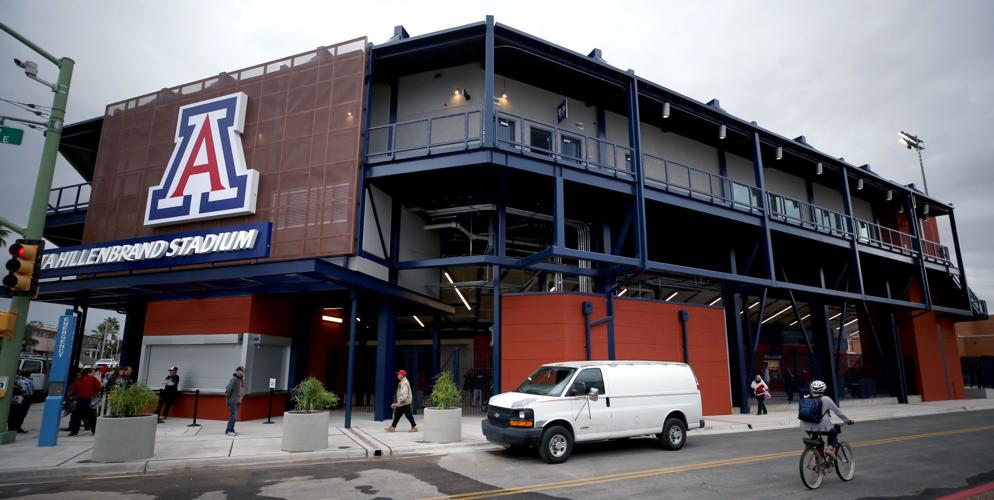
The new facade of the west side of Hillenbrand Stadium, Thursday, February 14, 2019, Tucson, Ariz.
"I said, 'Oh my God, what did I do?' It seemed like I was going backwards for a minute there," Candrea said. "But it was an opportunity and I knew how to break down the game and I recruited before because of baseball and I felt like softball was coming into its own."
Eventually, longtime donor Bill Hillenbrand wrote Candrea a check for $1.2 million to create Rita Hillenbrand Memorial Stadium, "which was the first of its kind in the country," Candrea said. Arizona's venue was the first on-campus softball stadium at the NCAA level. To this day, Hillenbrand Stadium is considered one of the premier softball venues in the U.S.
"It was like going to heaven," said the former Arizona softball coach. "Honest to God, every time you walked out there, you couldn't believe this happened to us. It made recruiting a lot easier. Back in the day, the arms race was facilities. To have a softball stadium that was the first of its kind, it gave us a big advantage for a while. Then the SEC came into softball and brought in their football money and built up their facilities."

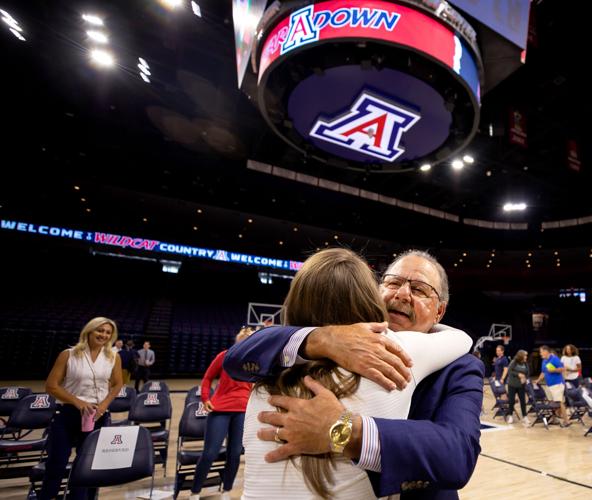
Former Arizona coach Mike Candrea gives new Arizona coach Caitlin Lowe a hug following a press conference at McKale Center, 1721 E. Enke Dr., in Tucson, Ariz. on June 9, 2021.
Said current Arizona head coach Caitlin Lowe: "You just walk in there and feel the history. It's built by Candrea and his dreams of the work he put in every single day, the people he brought in and the lives that he touched. It's a true testament to him as a person."
Passing the torch
After 36 seasons at the helm, Candrea hired Lowe to succeed him following the 2021 season. Lowe "was handpicked by me, because of her skills," Candrea said.
"I was able to coach her in the Olympic games and at Arizona and she was always a quiet leader," Candrea said. "The more I saw her on my staff, the more I saw her ability to lead and communicate. She's a sharp young lady and she has surrounded herself with great people."
Lowe, who's entering her fifth season, said it's "100% an honor" to extend Candrea's legacy.
"Any alum that you talk to and has come through this program and played for Coach Candrea, they take serious ownership and responsibility in continuing the legacy that he built," Lowe said.

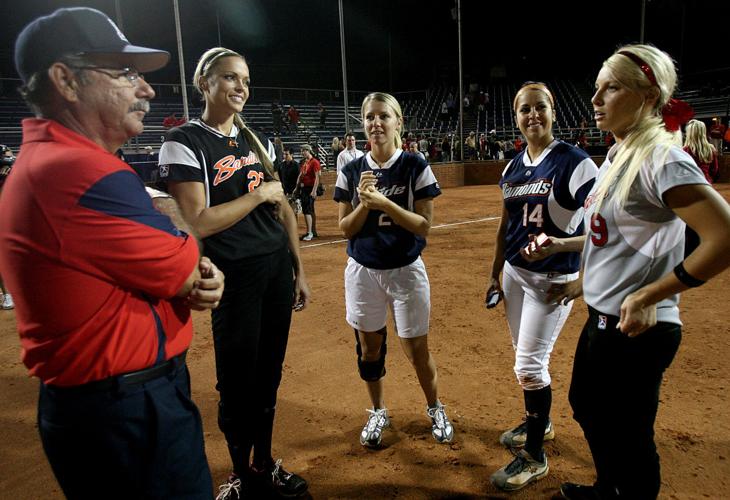
Coach Mike Candrea, far left, stands with Jennie Finch, Caitlin Lowe, Chelsie Mesa and Taryne Mowatt following a game between the National Pro Fastpitch All-Stars team and the Wildcat softball team at Hillenbrand Stadium, Monday, Oct. 4, 2010.
Candrea currently serves as a special assistant to athletic director Desireé Reed-Francois and has an advisory role with the UA softball team.
"The amount of love and care he puts into our program, the facility, our players, it's unmatched," Lowe said. "When you have someone waking up and trying to find ways to make us better, it's totally game-changing on our end."
When Candrea reflected on his career as a softball coach, "Are there things you would do differently? Sure," he said.
"But at the end of the day, I've been blessed to follow my passion in life and do what I love to do," Candrea added. "I was in love with the bat-and-ball game and I didn't care how much money I made. I wanted to be involved in baseball or softball my whole life and lead young people. To me, those benefits are those young women that are still a part of my life. I don't miss a birthday."
Nowadays, part of his morning routine is "getting up and sending a text message to every alumni I've ever coached."

Former Arizona Wildcat Jennie Finch says Candrea remains “a second father to us all.”
"One thing I like about the cell phone is I can keep in contact with the past," Candrea said. "To be a part of their lives and to be at their weddings, there's a lot more to winning and losing on the field. It's watching them grow into young women and being a part of them for life. That's a pretty unique experience.
"My job was to prepare kids for life after softball. If we can give them the skills to be successful in life, that's a win-win situation. ... What's crazy about life is that it goes quick, so you gotta do something that you enjoy — and I'm glad that I do something that I enjoy."
Candrea was the engine to Arizona's rise to national stardom; he was there when the 1996 Olympics added softball as a medal-winning sport, and he saw the influence of ESPN's coverage of the collegiate softball postseason.
The Athletes Unlimited Softball League is a professional league that is about to enter its second season as a professional softball league in the U.S., and former UA star and Olympian Jennie Finch is an advisor for the league. Dalton-Hill, who also does commentary for ESPN's softball coverage, is the general manager of the Chicago Bandits.

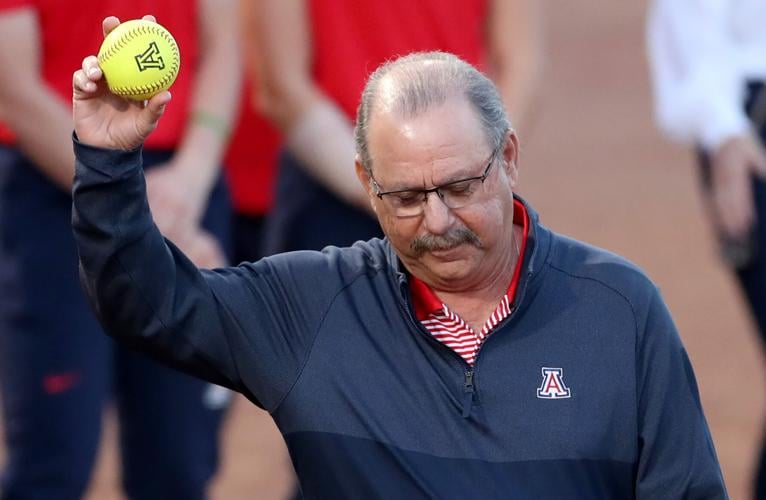
Arizona Wildcats former head coach Mike Candrea acknowledges the crowd as he comes to the circle to throw the ceremonial first pitch before the 'Cats game against Alabama at the Mike Candrea Classic at Hillenbrand Stadium, Tucson, Ariz., February 11, 2022.
"Coach Candrea has impacted the game globally in so many ways for us Wildcats and beyond just Wildcats — softball players in general and coaches in general and beyond the playing field," Finch told the Star.
Softball "is in a good place right now," Candrea said.
"There's a lot of eyeballs on the game, a lot of coverage and the Olympics have been good to us," he said. "I look back and I'm thrilled to be a part of the journey and be a part of the growth. I look at the game in a different light than most people."
Candrea "put softball on the map," Lowe said.
"He was so empowering to female athletes and crushed all of the ceilings," Lowe said. "We can talk about his impact in Tucson and the U of A, but his incredible impact is with the sport and for women around the country. Anywhere you go around the country, people know his name and what he did and are respectful and appreciative for what he did to put softball on the map."
When Arizona kicks off its season at the Candrea Classic on Thursday, Candrea will be honored and will throw out the first pitch, 40 years after his first season in Tucson.
"I couldn't be prouder of something," Candrea said of his coaching journey at Arizona. "The blood, sweat and tears you put into a program for 40 years, you want it to continue to go.
"When I came here, I didn't want to be a flash in the pan; I wanted to be a consistent winner. Part of that is taking care of your past. We have a tremendous alumni base that we've tried to keep involved in the program, and the future has to continue to bring you the things that you want from the program. It all starts with leadership.
"When I coached, the biggest job was to build this beautiful ship and put the right people on it and keep it rolling in the right direction. The big part of leadership is surrounding yourself with the right people. It takes a village to be successful."
They said it
Finch: "We are better people because of Coach Candrea. I'm just so thankful for his consistency and bringing his A-game despite what was happening around him. He's always that rock for so many. ... I'm so thankful and blessed to call him coach.
"It was a special treat to do it again after my Wildcat days on Team USA and travel with him and be led by him and be around his greatness — and he brought it every single day. I'm thankful and indebted to coach for all that he's done and what he has meant to so many."
Dalton-Hill: "We gained national attention at a time when that was really hard to garner, and he put himself in a spotlight, because not only did he win, he did it the right way. He was able to bring women together from diverse backgrounds and had diverse personalities and maybe didn't get along, but had a desire and will to win that was greater than anyone else in the country."
Fowler: "He was the ultimate professional. He never let his guard down with us. I think that's just who he is. It's not an act. He just wants to be the best at what he's doing. I always appreciated that it was a no-bull situation when he would talk to us and that's how I liked how to be coached. Just tell me what I need to do better; don't give me fluff, give me facts. ... That business-like approach trickled and sprinkled around the program."
Former UA softball player and administrator Erika Barnes: "You practice what you preach and you walk the walk and demonstrate leadership skills and he did that every day. That was the way he lived his life and he was very intentional. He's truly a fan of wanting to see his players do well in life. He's a proud papa."
Former Arizona volleyball coach Dave Rubio: "Softball is where it is today because of Mike Candrea. ... He brought a brand name to Arizona and created it the way Lute (Olson) created it for basketball. Mike created that standard for softball. He set the standard, especially in those formative years.
"He was an amazing role model for a lot of coaches who are not currently coaching in the NCAA. Softball has come so far and has become a marquee women's sport. Mike is the godfather of all of that."
Former UA pitcher and Big 12 Player of the Year Devyn Netz: "Coach is someone who has been around the game of softball, but also someone who has helped grow the game to what it is today. As much as people see all that he has accomplished, the kind of person he is is second to none. He is someone that sees you for more than your sport and wants the best for your life beyond the field."
Former Arizona infielder Katie Swan Milo: “Coach Candrea put in endless hours on and off the field to not only build the legacy of Arizona Softball, but to transform women’s softball across the world. Coach Candrea prioritized us. He always treated us as elite Division 1 college athletes when he could have easily put that time into coaching men’s baseball. I am forever grateful for his dedication to me, my teammates and the greatest game on dirt. Thank you, Coach.”
Former UA pitcher Becky Lemke: "He's been one of the most influential people in my life. Period. I was very lucky and so grateful that I got the opportunity to play for him, because a lot of people don't. I hit the lottery when I got to play for him. He has the amazing impact of not only teaching us on the field, but also life.
"He's so good at coaching the game and coaching you at life. He was all about balance. ... He was very big on integrity and that is what builds the best athletes. ... He'll never miss a birthday. He sends me a 'happy birthday' message every year and tells me that he loves me and I tell him that I love him back. When there's hundreds and hundreds of alumni that keep wanting to come back, it's because of him. He's the glue and he's the reason."
Former UA All-American Leah Braatz: "Arizona softball is not just a program; it is a culture. It is a family. And at the heart of that family stands Coach Mike Candrea, a man who built a legacy from the red dirt of a raggedy field behind the tennis courts into a national powerhouse that changed the face of the sport forever."
USA Softball Hall of Famer, Olympic gold medalist and former Wildcat Leah O'Brien-Amico: "Coach Candrea is so much more than just a softball coach to me. He's like a second dad and has impacted my life far beyond the softball field. When I went to Arizona to play softball, I had no idea I was choosing the best option for not just the sport but preparing me for life. Coach Candrea had such a high standard and a level of excellence that was expected. ... His belief in me allowed me to elevate to the top level and become an Olympian. ... He's my favorite and I believe he is the greatest of all time."



