



Durbin
SPRINGFIELD — Even as Illinois' political geography shifted under Sen. Dick Durbin’s feet, the five-term incumbent never forgot where he came from or the people who first sent him to Washington, downstate political observers said.
Durbin worked tirelessly to direct federal resources for economic development and to rectify systemic flooding issues in his hometown of East St. Louis, recalled state Rep. Jay Hoffman, D-Swansea.
And no Durbin visit to the Metro East region was ever complete without a stop at Kruta Bakery in Collinsville, a favorite from his childhood.
“That's the type of roots that he had in the Metro East that are going to be missed,” Hoffman said, alluding to Durbin's announcement this week that he will not seek reelection to the U.S. Senate in 2026.
Decatur Mayor Julie Moore Wolfe, calling Durbin “a true friend to Decatur going back,” has a similar feeling as he prepares to walk out the door.
She noted that it was Macon County’s strong support for Durbin that pulled him across the finish line in his initial run for Congress in 1982, when he defeated eleven-term incumbent Republican Rep. Paul Findley by a razor-thin 1,400-vote margin in a district that stretched from Quincy to Springfield to Decatur.
"It was Macon County voters that put him in office, and he never forgot that,” Moore Wolfe said. “And even though he is one of the most powerful people in America, he has still made time for Decatur. I mean, I get invited to sit down with him for lunch at least once or twice a year. He truly cares about what happens here.”
“It's hard to imagine having that kind of access again to someone in that major of a position," Moore Wolfe said, a sentiment echoed by a number of local government and community leaders across Central and Southern Illinois.
Indeed, Durbin has been downstate Illinois’ voice in the Senate for nearly three decades. He inherited the mantle directly from Sen. Paul Simon, a Democrat from Makanda who served for a dozen years before passing the torch to his handpicked successor.
It’s not a hard-and-fast rule, but Illinois’ representation in the Senate has historically often been divided between a person from the Chicago metropolitan region and another from Central or Southern Illinois.

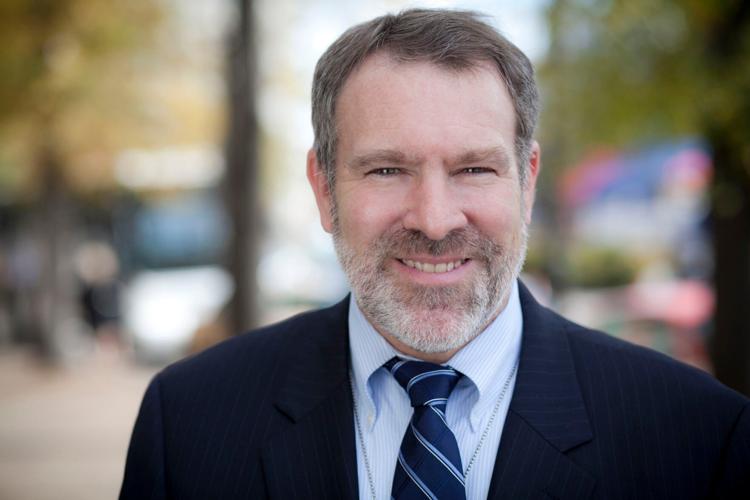
Budzinski
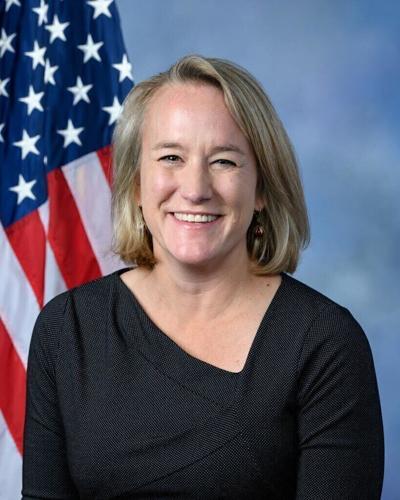
“The legacy of a downstate voice being in the United States Senate has directly benefited downstate communities for quite some time,” said U.S. Rep. Nikki Budzinski, D-Springfield, whose district overlaps with areas Durbin represented during his time in the House.
“And so the announcement of Senator Durbin's retirement is… undeniably a loss for our downstate communities as he's been my real kind of go-to person.”
Among others, the lineage of downstaters in the upper chamber also includes Alan Dixon, a Belleville Democrat who served from 1981 to 1993; Everett Dirksen, a Pekin Republican who served from 1951 to 1969; and Scott Lucas, a Democrat from Havana who served from 1939 to 1951. The latter two also served stints as their party's leaders in the Senate.
But the traditional balance appears likely to end with Durbin.
Given Illinois’ strong Democratic tilt in federal elections, the party is heavily favored to hold Durbin’s seat. But nearly all of the declared and likely candidates live in Chicago or the suburban collar counties, reflecting the broader shift in the state’s political geography since Durbin was first elected to the upper chamber in 1996.
Over the past few decades, Democratic power has waned downstate as voters historically aligned with the party through labor unions and economic interests but often out of step with the national party on cultural issues like abortion and guns, have shifted heavily towards Republicans. It was a gradual movement that went into warp drive with President Donald Trump's ascendance onto the national political scene.
On the flip side, Chicago’s suburban collar counties, once the bedrock of the state Republican Party, have now become reliably Democratic, a change that can be partly attributed to the region’s diversification but also to backlash against the GOP’s increasingly rigid social conservatism and the unpopularity of Trump among white voters with college degrees, particularly women.

Shaw
“Even in the case of Durbin, I think he believed it was more his responsibility for good government than it was a political opportunity to get votes (in downstate Illinois), particularly later in his career when he was well-established and had a really strong base throughout the state, and could expect strong support in Chicago and the suburbs," said John Shaw, the director of the Paul Simon Public Policy Institute at Southern Illinois University Carbondale.
Durbin, addressing reporters gathered in his Springfield backyard — the same place he announced his candidacy for Senate in 1996 — acknowledged earlier this week that as a downstate Democrat, he’s part of “kind of a vanishing breed when you consider federal office, particularly United States Senate.”
But, he said, the region shouldn't be written off.
“My message to everyone interested in running for office statewide: Run in the entire state from one corner to the next,” Durbin said Thursday. “Don't assume a damn thing. These are voters who want to hear from you and want to know if you’re going to make their lives any better.”
Potential contenders have downstate ties
The only declared candidate so far is Lt. Gov. Juliana Stratton, who hails from the Bronzeville neighborhood on Chicago's South Side. She was endorsed by Gov. JB Pritzker on Friday, cementing her status as a frontrunner in the race.
However, several other candidates are expected to jump in over the coming days and weeks. Among them: Rep. Raja Krishnamoorthi of Schaumburg, Rep. Lauren Underwood of Naperville and Rep. Robin Kelly of Matteson.
Illinois Treasurer Mike Frerichs, who now lives in Chicago but has deep roots in Champaign County, is also reportedly among those considering a bid.

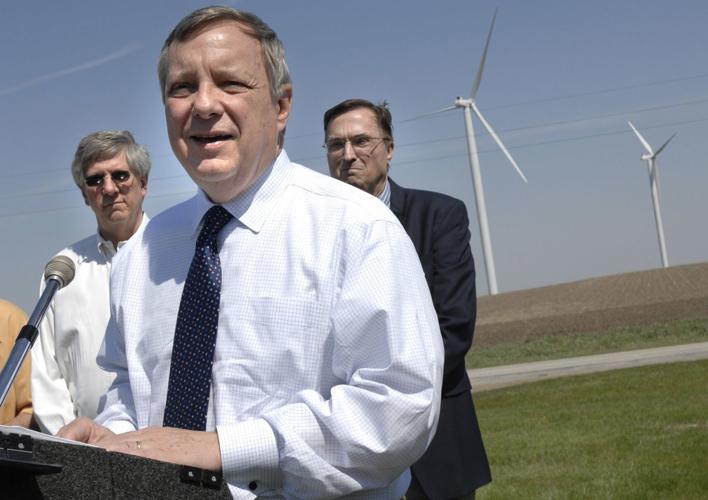
U.S. Sen. Dick Durbin, D-Ill., speaks Saturday, April 21, 2007, next to Normal Mayor Chris Koos, left, and Bloomington Mayor Steve Stockton, right, at the Twin Groves Wind Farm near Ellsworth.
All have some degree of downstate ties, Frerichs most directly. The Gifford native served as Champaign County Auditor and represented parts of east-central Illinois in the state Senate before his election to statewide office in 2014.
Krishnamoorthi was raised in Peoria. Kelly attended Bradley University in Peoria and her congressional district, though based in Chicago and its south suburbs, includes swaths of downstate stretching as far south as Danville.
Many have traveled the state extensively. Krishnamoorthi, long expected to run for Senate once Durbin retired, has been hosting official congressional events and appearing at political events across central and southern Illinois over the past year. This week, this included stops in Logan County and Urbana to highlight the impact of tariffs on farmers and businesses.
Kelly made a point to visit all corners of the state when she was chair of the Democratic Party of Illinois from 2021 to 2022.
Stratton frequently travels the state and has served as chair of the Governor's Rural Affairs Council, a group set up to address the challenges facing the state’s rural areas. She has also spearheaded the "Ag Connects Us All" campaign, which is her attempt to bring people across regional, racial and cultural lines on the issue of agriculture.
"So they all have a card to play in terms of the downstate messaging," said Porter McNeil, a Quad Cities-based political consultant. "And the question would be, 'who has the resources to drive that message and to build a campaign around those messages downstate?'"
McNeil, who is not affiliated with any campaign, suggested that Frerichs may have an advantage downstate in a field of candidates whose political careers were molded in the Chicago region.
"Mike Frerichs has the lane downstate if he runs," McNeil said. "He's really the only downstater that whose name is on the shortlist. So there is a lane to take, and that's his lane should he decide to run."
Whether Frerichs runs or not, a crowded primary in which votes will be spread widely among the candidates means that downstate voters could still play a key role in deciding who the nominee is.
As an example, McNeil recalled the 2002 Democratic gubernatorial primary, when Rod Blagojevich's aggressive campaigning downstate helped put him over the top in a three-way race in which he lost in Cook County and the collar counties.
'Whatever we're doing, keep doing it'
Several downstate elected officials say they hope Durbin's replacement maintains a focus on the needs of the entire state.
“I want to see a commitment to our downstate communities,” Budzinski said. “And that means showing up first and foremost. It means listening. I think it's about meeting our voters in downstate Illinois where they are, and not expecting them to meet you where you are on issues.”

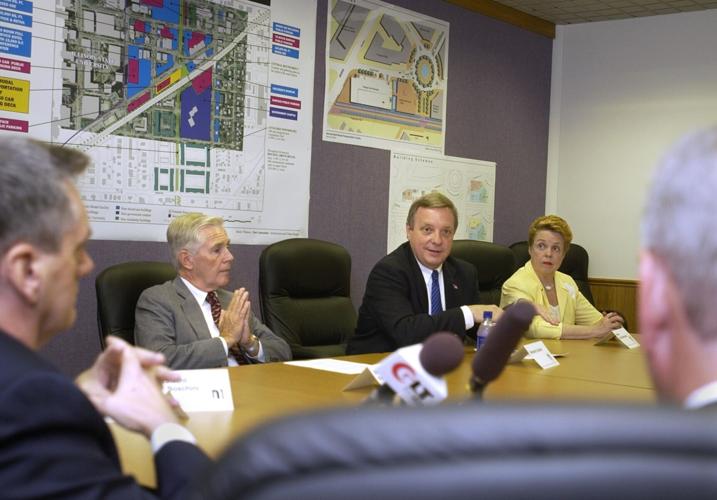
From left, Normal Mayor Kent Karraker, U.S. Sen. Dick Durbin, and Bloomington Mayor Judy Markowitz discuss the future of Amtrak in this July 2002 file photo.
Hoffman, who has represented portions of the Metro East in the state legislature on-and-off since 1991, said that "it always is a loss when you lose someone who grew up in the same area you grew up, understands the dynamics of relationships in that area, understands the industry in that area, understands the school systems,” referring to Durbin.
“So I would say, yeah, it's going to be a loss to central and southwestern Illinois," he said. "But I can assure you that for me to support someone, you're going to have to prove that you understand the needs of downstate Illinois, not just the city of Chicago and then around the surrounding suburbs.”
In some ways, Durbin said he had to do the reverse before he was elected in 1996: introduce himself to voters in the northern portion of the state.
Durbin was able to do so and, over the course of his time in the Senate, it became harder to pin down exactly where he was from.
"I'll let you in on a little secret: We did some polling after 10 or 12 years I'd been in the Senate," Durbin recalled. "And we asked the voters, 'Where do you think Durbin's from?'
"The people in Chicago said, 'Well, of course he's from Chicago.' The people downstate said, 'Well, of course, he's from downstate.' And I said, 'Whatever we're doing, keep doing it.'"
"You build up a base of support," Durbin said. "And I've tried to do that."

