


The success of the booming craft beer industry in the United States has inspired a pair of Mexican entrepreneurs to join the movement, starting the first microbrewery in Nogales, Sonora.
Andres Vega and Rene Garayzar launched Nogales Brewing Co. in July of last year and have slowly grown their business, in effect creating their market as they go.
While modern craft brewing in Mexico is several decades old, the country is dominated by the large brewers — Cuauhtémoc-Moctezuma, a subsidiary of Heineken, and Grupo Modelo, owned by Anheuser-Busch InBev.
Craft beer makes up less than 2 percent of the more than $20 billion beer market in Mexico, with even the larger craft brewers having little to no presence in many areas.
Considering that the most popular brands of Mexican beer, such as Tecate and Corona, are less than a challenging taste experience, Vega and Garayzar said they’ve had to become beer evangelists.
“When people tell us, ‘Oh, I don’t like beer.’ Well, how do you know? Have you ever tried this style or that one? Try them all, and not just the ones we make,” Vega said. “From a Tecate to something that tastes like guava or orange. Maybe a porter or a stout that can taste like coffee or chocolate.”
Although people may not be used to the different tastes, they are fast learners, Garayzar said. When Nogales Brewing Co. debuted its beer at last year’s Nogales Tequila Festival, it sold out the first day.
challenging business
The two men, friends since kindergarten, decided to go into business together shortly after leaving college. Both studied engineering: Vega, 24, at the Autonomous University of Baja California; and Garayzar, 25, at Arizona State University. They always planned to come back to Nogales.
Through the support of their parents and about $13,000 in economic development loans, they have managed to position their beer in five restaurants and are a few months away from opening a storefront.
Still, they said, capital is tight and starting the business has proven to be much more difficult than they expected. All of their beer sales are going back into the company. “We thought we were going to invest that (loan) money and launch the brewery, but it’s taken double that,” Vega said.
Craft brewing is particularly difficult in Mexico. The big brewers malt their own barley but the microbreweries have to import most of their ingredients, which makes their product more expensive.
That higher sale price is made even more so by the 26.5 percent excise tax on beer along with the 16 percent value added tax, Garayzar said. “When a large brewer can sell a six-pack for say 60 pesos, those added taxes don’t mean as much as for one of ours that sells for 150,” he said.
There’s also the challenge of selling their beer through retailers. Although in 2013 the Mexican Federal Competition Commission forced large brewers to limit their exclusivity contracts to 20 percent of their clients, that still means there are places in Nogales that do not sell any other kind of beer.
Even in places where they can sell, beer on tap is really not standard in Mexico, so they either have to set up a tap system for them or bottle, an added expense.
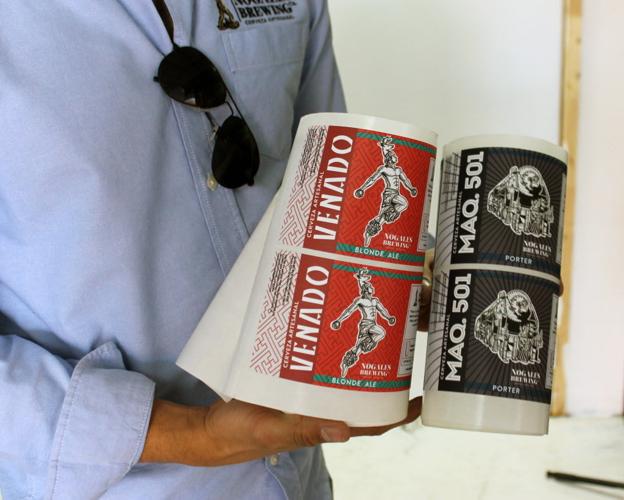
On the plus side, they said, the beer labels serve as their calling card, helping to get their brand out there.
The names of their beers are all Nogales-related. Venado, Mono Bichi, Bellota and Maquina 501 are meant to strike a chord with locals.
The next step
Having a good, quality beer isn’t the problem, they said. Although they started out as hobbyists, making beer for their friends and family, Garayzar spent almost a year at Central Washington University learning about the science of beer. And the restaurants keep ordering, they joked, so they must be doing something right.
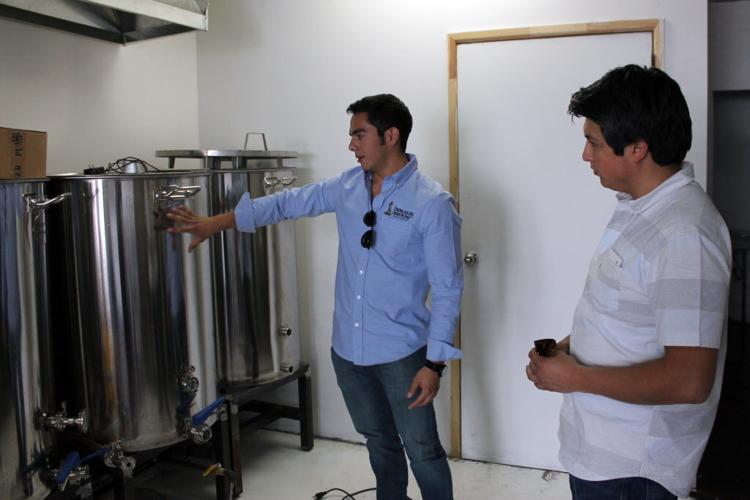
But they are still struggling to keep up with orders with their current setup. It takes them close to five hours to produce 10 gallons.
Next week they are stepping up production, not only to meet their current commitments but also to build up inventory for the opening of their storefront. Their new system will produce 65 to 70 gallons every six hours.
Once they get up to speed, they will be ready to expand and sell in Hermosillo and throughout the country. They have already fielded inquiries from a distributor out of Guadalajara.

