




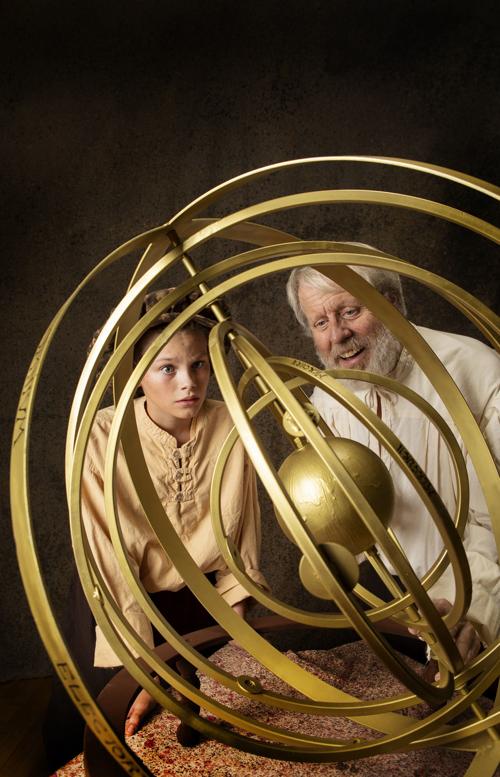
Go figure. A play written 82 years ago about a man who died 376 years ago feels like it’s plucked out of today.
Bertolt Brecht’s “Galileo,” in a riveting production at the Rogue Theatre, is pulled from the story of Galileo Galilei, a polymath who discovered that the sun is the center of our solar system, not the earth, as the Catholic Church preached.
Oh, that got him into a load of trouble.
He had scientific proof, but the church had its belief. Facts were not going to sway that. Sound familiar?
This Cynthia Meier-directed production is clear, rhythmic and beautifully acted, especially by Joseph McGrath, in the role of Galileo, and Hunter Hnat as Andrea, Galileo’s former student-turned-scientist.
Brecht’s epic theater style wants the audience to be removed from the action on the stage, to always be aware that it is watching a play.
But it is hard not to be immersed in this production. Part of that is the Meier-designed costumes, elaborate and beautiful, and her staging.
But it is also because of the title character. Galileo is brilliant, arrogant and deeply flawed. McGrath takes us on a journey that sees Galileo at the top of the scientist heap to a man imprisoned in his own home, under house arrest (the church condemned him as a heretic for his theory about the solar system; he recanted when he thought he was going to be tortured but did not escape arrest). McGrath, in one of his most nuanced performances, gives us a man who comes close to being broken, but his inquisitive mind and commitment to scientific proof won’t let him break. It is thrilling and heartbreaking.
Hnat makes Andrea’s desperation palpable when he hears Galileo has recanted, allowing the church to believe what it likes rather than what is true.
The whole cast was solid. Among the many standouts: eighth-grader Owen Saunders (young Andrea), who showed a poise and an ability to be present that belies his age; Tyler West, who played several characters, all with a distinction and most with humor; Holly Griffith, as Galileo’s daughter, convincingly went from an overly giddy young woman to a prayer-obsessed grown woman; and Kathryn Kellner Brown commanded attention as Galileo’s bossy housekeeper.
There is a large cast of characters, and most actors played multiple parts.
Meier used wildly wonderful, and often quite funny, masks (by Aaron Cromie) to help us distinguish them.
But those masks further underscore what is a central theme of “Galileo” — the search for, and the denying of, truth. Even when proof is just a glance through a telescope away.
Truth, too, is central to our lives now — which should be a given, but it is not. It’s near impossible not to draw the parallels between Brecht’s play and that fact. Which makes “Galileo,” a story that took place centuries ago, speak to us in 2018.

