


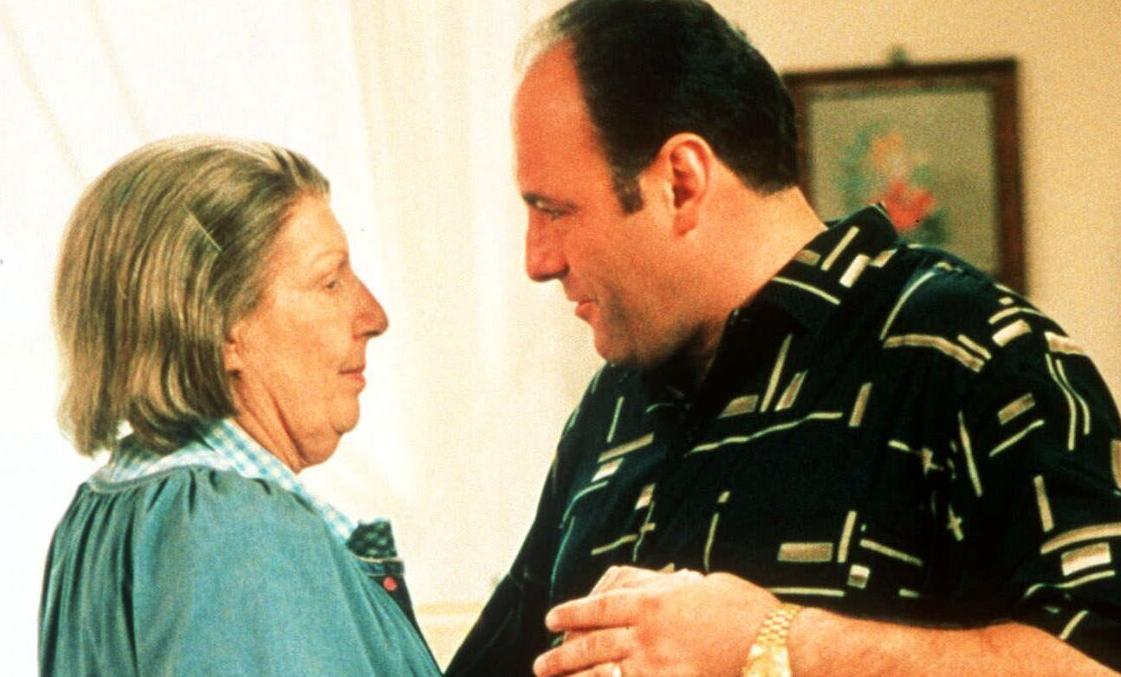
Nancy Marchand, the Buffalo-born character actress, died in 2000. That’s a long time ago, but she is not forgotten by her fellow castmates on “The Sopranos.” One of them, in a new book, says her wry smile lives on “like the Cheshire Cat’s.”
Those are the words of Michael Imperioli in “Woke Up This Morning: The Definitive Oral History of The Sopranos,” which comes out Nov. 2. The authors are Imperioli and Steve Schirripa, who played mobsters on the groundbreaking show. The writer who helped them put the book together is Philip Lerman, a Manhattanite who also counts as a Western New Yorker for his summers at the Chautauqua Institution.
Tony Soprano is the mob boss at the center of “The Sopranos,” but it is his domineering mother, Livia, who is the linchpin of the series. She was played by Marchand in a giant step away from the patrician roles for which she had been known: the imperious newspaper publisher on “Lou Grant,” for which she won four Emmys, and grand dames in the works of A.R. Gurney, the Buffalo-born playwright.
David Chase, creator of “The Sopranos,” had a fraught relationship with his own mother. He would often tell hair-raising stories about her, and people would tell him that he should do a show about it. To Chase, the story of a TV producer and his monster mother did not sound very promising. Ah, but a mobster and his monster mother – now that could be interesting.
“People always ask: Is this a show about the mob?” Lerman says. “Is this a show about good and evil? Is this a show about how you atone for your sins? There are a lot of ways to think about ‘The Sopranos,’ but it started out as a show about a mob boss and his mother. That is where ‘The Sopranos’ starts, and everything else grows from there.”
Chase’s dilemma was how to cast the role of Livia. The book’s oral history tells the tale.
Imperioli: “You’d think finding the right Tony Soprano would be the hardest part of the process.”
Chase: “The hardest to find what I wanted was Livia.”
He was searching for someone who could not only convince audiences of her inner evil but could convince him – and somehow be the mother he had known.
Chase: “It was agony. I don’t know how many actresses we saw, and they all did this crazy Italian-mama thing.”
Chase, according to the casting director, Georgianne Walken, was never one to say, in the moment after an actor finished an audition, “That’s it.”
Walken: “The only time he ever said that to me was about Nancy Marchand. … She won David’s heart. She WAS Livia. No ifs, ands, or buts about it. The fact that she had played all these incredibly erudite, arrogant women just got washed away.”
Chase: “Nancy Marchand came into the office, I looked at her and I said, ‘My God, that’s my mother. She’s channeling my mother.’ It was unbelievable. I was a happy guy. The cadence, the attitude, oh, Jesus God, and all my family went nuts when they saw her.”
Marchand understood right away she was playing a badass based on a real one.
Chase: “At one point she said, ‘I trust that this creature I’m playing is deceased.’ ”
How bad a mother are we talking here? Well, when her son puts Livia in a nursing home, she orders a hit on him. And Tony’s mother complex is what brings him to the therapy sessions that are the beating heart of the series. More than the FBI or other gangsters, Tony’s greatest enemy was always his mother.
Marchand died of lung cancer one day before her 72nd birthday. She had worked through her illness in the first two seasons of “The Sopranos,” alternating weeks of work with rounds of treatment. She appeared posthumously in one scene at the start of the third season through the use of CGI-style technology. Livia had originally been written into four of the first six scripts of that season, but no thought was given to replacing her with another actress. She was, in every sense, irreplaceable.
Now the role of Livia falls to Vera Farmiga in “The Many Saints of Newark,” a prequel to “The Sopranos” that will open in theaters and on HBO Max on Friday. (Farmiga already has experience as a terrible TV mother: She played Norma Bates on A&E’s “Bates Hotel,” the “Psycho” prequel.)
Marchand grew up on Ruskin Road in Eggertsville, the daughter of a dentist and a piano teacher. She was shy, so her mother sent her to the Studio Theatre School to learn confidence. She loved acting right from the jump. She would take the Main Street bus into the city, transfer at Delavan Avenue, and walk to the school, which was then at Lafayette Avenue and Hoyt Street.
“I loved acting so much,” she once told The Buffalo News. “I was willing to spend my whole day riding the bus,” no matter the weather.
Her life came full circle in 1991 when she appeared in Gurney’s “Children” at the Studio Arena Theatre, playing the role she had played in the original New York production in 1976.
But perhaps her greatest performance in a Gurney play came in New York in 1988’s “The Cocktail Hour.” New York Times theater critic Frank Rich offered her a rave review:
“Just to hear the actress order a refill of her martini – a frequent occurrence – is to get a lesson in comic timing and inflection. Yet the performance doesn’t settle merely for a blunt, gin-dry astringency. While the mother has narrow notions of domestic decorum and little use for intimacy, she somehow emerges as generous and vulnerable in Ms. Marchand’s portrayal. What might have been a New Yorker caricature is instead a complex illustration of how both nurturing affection and punishing neglect can coexist in reticent parents of the breed Mr. Gurney describes.”
Marchand was that rare performer who was a part of prestige television in its original iteration (as Clara in NBC’s Philco Television Playhouse version of “Marty” in 1953) to the beginnings of what we think of as prestige TV today (as Livia in the show that started the current spate of longform storytelling in 1999).
“Nancy Marchand features prominently in the book,” Lerman says. “Everybody revered her on that set. They all adored her. Everyone who played a scene with her told us how generous she was as an actress, and how attentive she was. They were all in awe of her talent. And they all had stories.”
Back to the oral history:
Imperioli: “We have a million stories about Nancy Marchand. She was one of a kind. A wonderful actress and a wonderful person. It’s hard to pick one story that encapsulates who she was — but I like what my buddy Johnny Ventimiglia told us.”
Ventimiglia: “We had this scene in her hospital room. And in between takes, she’s reading a newspaper. She’s quiet. I don’t want to bother her. She’s Nancy Marchand! In those days, you could smoke on the set, so I just wait and I’m smoking a cigarette, and she goes, ‘Oh, this is a very interesting story.’ She starts describing to me the obituary of somebody who was a member of an acrobat family, who had just died at 90-something.”
Marchand regaled Ventimiglia with the life story of the dead acrobat for several minutes.
Ventimiglia: “And when I got up and walked around, finally I looked at the newspaper. There was no obituary. She was just making it up to entertain me. She was just doing it for my benefit in some way. That really touched me, the fact that she would do that. That was Nancy.”
Imperioli: “It reminds me of her generosity of spirit, her dry wit, and the wry smile that stays with us, like the Cheshire Cat’s, long after she’s gone.”

