






Since COVID-19 isolation began, I’ve been intrigued by various TV personalities broadcasting from their home offices and living rooms, surrounded by bookshelves crammed to capacity. Each time I observe such an intellectual ambiance, I find myself asking the same two rhetorical questions:
1. When was the last time you opened one of those books?
2. Why do you keep them?
Many possible answers to question No. 2 come to mind:
Maybe your home came with built-ins and was a good fit for obsolete texts from university days to which you still have an emotional attachment.
Perhaps you want to communicate that you are an erudite member of society, as opposed to being part of the great unwashed and unread.
Or maybe the best reason of all: you keep them because you have read them and really love them. And who knows, you may want to re-read them one day or pass them down as heirlooms to the next generation.
Whatever the reasons, they’re all good. In this technological age, nothing equals the smell, feel, warmth and knowledge about the owner inherent in a book on their shelf.
Trying to (unsuccessfully) decipher the titles from TV offices and home bookshelves got me to thinking about my own collection. Although a techno-weenie, I’m not much of a book buyer either, as my two spindly bookcases will attest. However, the volumes I do have speak, well, volumes about the story of my life.
Protesters laid in the road for 8 minutes and 46 seconds in symbolic protest of the death of George Floyd.
I have quite a few French books, including samples sent from publishers as an incentive to buy a class set, cute books with a French twist received as gifts, and a variety of others in la belle langue which I refer to from time to time. I’ve even reopened a few during this time of social quarantine. They are a reminder of my career choice to become a teacher of one of the most beautiful languages and richest cultures in the world. What a great ride it was.
I also have a small collection of books on the history, geography and fun facts of Arizona. When I started teaching middle school, I got “volunteered” to teach Arizona social studies in addition to French. These books, which I used as adjuncts to the text, are another piece of the mosaic of my teaching career. I discovered that Arizona social studies was not only a multilayered subject to teach but a real brain stretcher for me. The subject provoked my curiosity about other Arizona cities and their diverse inhabitants.
No writing about my book collection would be complete without mention of my “Chicken Soup for the Soul” books. With my eternal love of human-interest stories, I gobbled them up at the used bookstore and have re-read many submissions which are universally life-affirming.
Full disclosure, I still have a couple of old, thick dictionaries, a thesaurus and other reference books for which there is no need, since a computer can do the same job with a click or two. However, they do have a practical application, on the bottom shelf of my bookcase, as a sturdy anchor for the other books.
Readers, I welcome your comments about what books are on your bookshelf and why. Please email me at Babette2@comcast.net.
Photos: Sunshine Mile (Broadway) in Tucson
Sunshine Mile in Tucson
Updated
Hirsh’s Shoes was built in 1954 and is one of 29 buildings in the district designed by architect Bernard Friedman’s firm.
Sunshine Mile in Tucson
Updated
Hirsh's Shoes, 1954, on the Sunshine Mile (Broadway Road) in Tucson.
Sunshine Mile in Tucson
Updated
Hirsh’s Shoes at 2934 E. Broadway, in Tucson, circa late 1950s (courtesy Hirsh’s Shoes) and in 2016 (Mike Christy / Arizona Daily Star).
Sunshine Mile in Tucson
Updated
The distinctive Chase Bank at Broadway and Country Club was once a Valley National Bank. It was designed by Don Smith of Friedman and Jobusch Architects in 1971.
Sunshine Mile in Tucson
Updated
Construction workers build the Valley National Bank on the northwest corner of East Broadway Boulevard and North Country Club, on March 18, 1971.
Sunshine Mile in Tucson
Updated
Valley National Bank, 1973, on the Sunshine Mile (Broadway Road) in Tucson.
Sunshine Mile in Tucson
Updated
The Welcome Diner, built in 1964 as Sambo’s Pancake House, is on the western end of Tucson’s historic Sunshine Mile.
Sunshine Mile in Tucson
Updated
Solot Plaza on the Sunshine Mile (Broadway Road) in Tucson.
Sunshine Mile in Tucson
Updated
Kelly Building, built in 1964-65, on the Sunshine Mile (Broadway Road) in Tucson. Architect: Nicholas Sakellar
Sunshine Mile in Tucson
Updated
View from Country Club Road on the Sunshine Mile (Broadway Road) in Tucson.
Sunshine Mile in Tucson
Updated
Store in the Solot Plaza, built in 1958, on the Sunshine Mile (Broadway Road) in Tucson. Architect: Nicholas Sakellar
Sunshine Mile in Tucson
Updated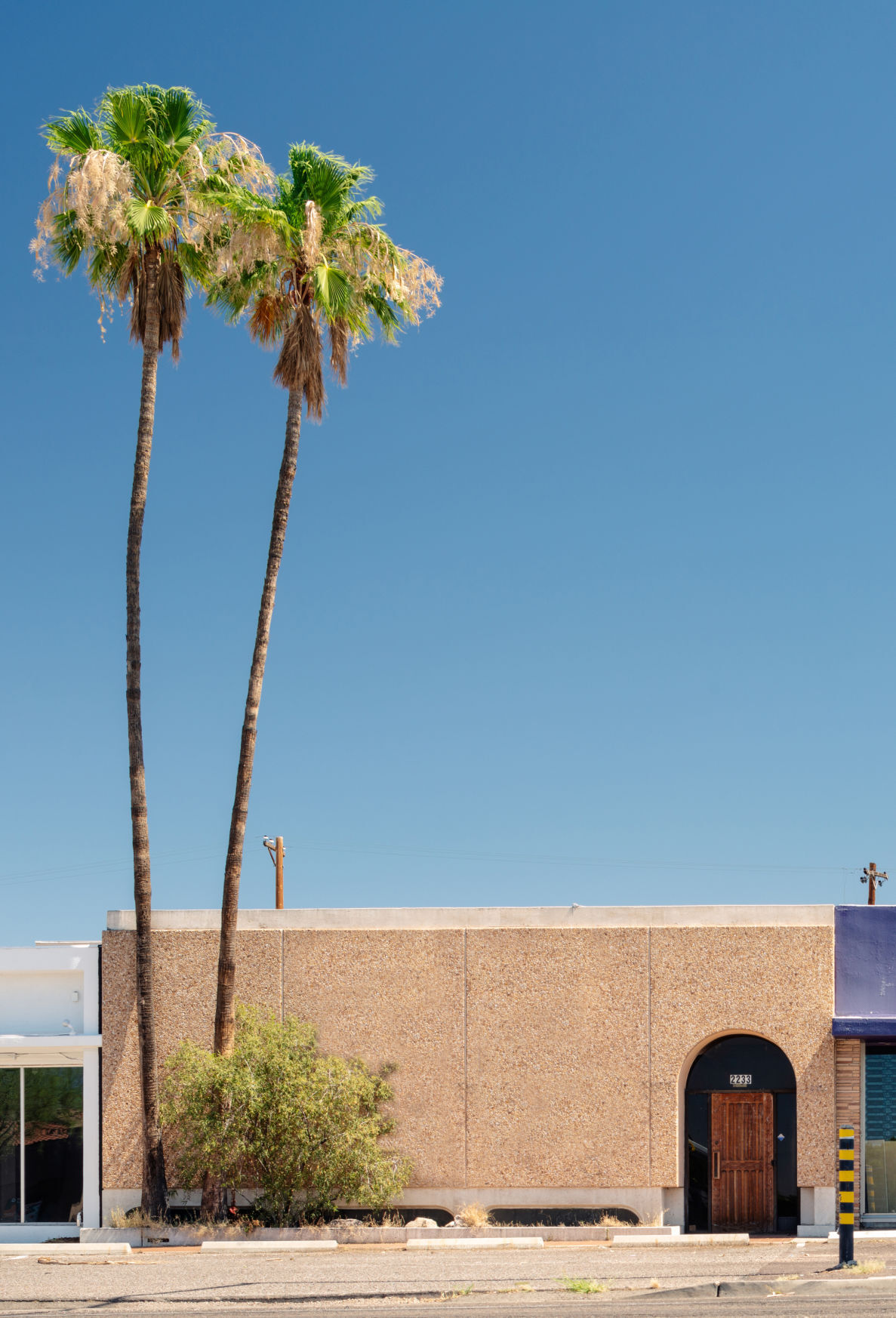
Friedman and Jobusch Office, built in 1950, on the Sunshine Mile (Broadway Road) in Tucson. Architects: Friedman and Jobusch
Sunshine Mile in Tucson
Updated
Old Pueblo Medical Group, built in 1965, on the Sunshine Mile (Broadway Road) in Tucson. Architect: Cain, Nelson and Ware
Sunshine Mile in Tucson
Updated
American Evangelical Lutheran Church, built in 1954, on the Sunshine Mile (Broadway Road) in Tucson. Architects: Jaastad and Knipe
Sunshine Mile in Tucson
Updated
Arizona Auto Refrigeration, built in 1951, on the Sunshine Mile (Broadway Road) in Tucson.
Sunshine Mile in Tucson
Updated
Old Tucson Jewish Community Center, built in 1953, on the Sunshine Mile (Broadway Road) in Tucson. Architect: Bernard Friedman
Sunshine Mile in Tucson
Updated
Anne Rysdale was Arizona’s only female registered architect when she developed and built the Haas Building in 1957.
Sunshine Mile in Tucson
Updated
A public workshop will be held May 18 from 9 a.m. to noon at First Assembly of God church, 1749 E. Broadway, to gather public reaction to a report on transforming the Broadway corridor into a public space as the city widens a portion of the street to six lanes.
Sunshine Mile in Tucson
Updated
The Chase Bank at 3033 E. Broadway Blvd. is one of several architectural distinctive buildings along the Sunshine Mile.

