



Tucson’s Los Reales Landfill has a new name, but the change is only the first step in an effort to completely restructure the facility into an environmentally conscious resource.
Tucson City Council voted unanimously Wednesday to rename the landfill to “Los Reales Sustainability Campus” as the facility takes on the goal of achieving zero waste.
The move supports the climate emergency declaration the City Council adopted in September 2020, which committed Tucson to become a zero-waste city by 2050 and reach carbon neutrality by 2030.
“We have been really trying to look at the Los Reales Landfill as a space for innovation and sustainability,” Mayor Regina Romero said. “In order to become a zero waste city, we really have to reimagine and think about our landfill in a different way.”
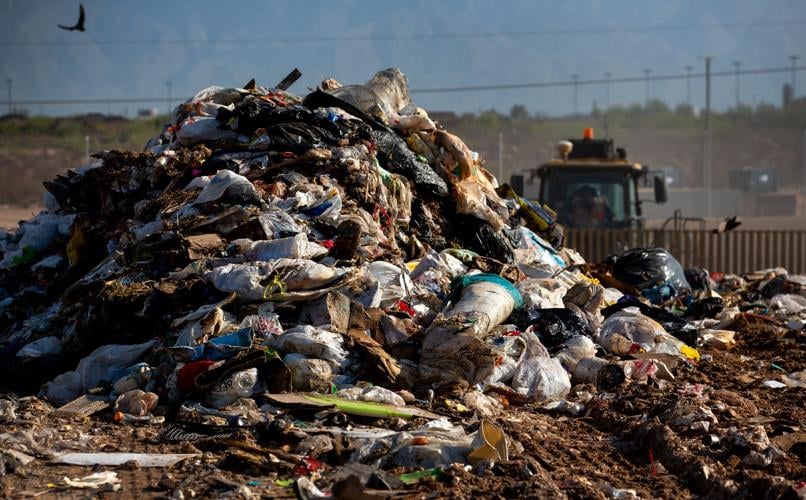
Los Reales opened in 1967 and is Tucson’s only active landfill. Every day, the facility takes in about 2,300 tons of solid waste, and the city says it spends more than $8 million every year to process waste here.
The facility’s new name comes with plans to change its landscape while implementing sustainability programs to divert as much waste as possible away from the landfill.
For the past year, city officials have been looking into implementing Tucson’s climate resiliency goals within the 1,200-acre landfill. According to Carlos de la Torre, director of Tucson’s environmental and general service department, Los Reales was the ideal place to begin looking at waste as an asset instead of a liability.
“We are identifying one single asset that can be a model for what the climate resolution will look like,” he said. “We’re thinking Los Reales is a key component of that, and we’re able to check a lot of those boxes with the facility that we already own.”

Piles of glass bottles wait to be crushed at Los Reales Landfill. The revamp of Los Reales has many sustainability programs including a tree nursery, a processing center for construction debris and a material recovery facility to siphon off recyclables from waste dumps.
Zero waste
While the plan is still in nascent stages, the long-term goal is to reroute the cycle of waste throughout the city so it’s reused as production material instead of buried in the landfill.
But how does a landfill, a dumping site for the city’s trash, reach the objective of creating no waste?
Of the waste the city’s recycling program receives, only about 17% is actually recycled. De la Torre envisions a “multi-pronged” strategy of diverting waste to raise this number to 40%.
Some initial ideas include composting food waste, filtering recyclable materials out of the landfill and sending plastic to a waste-to-energy facility where the material is burnt and turned into electricity or fuel.
Ultimately, some of the waste that ends up at the landfill won’t be able to be reused. The term “zero waste” is more of an aspirational goal.
“Is it going to go to purely zero (waste)? Probably not,” de la Torre said. “But we’re trying to reduce the volume by anywhere between 60 to 70% once we have exhausted all the means to make sure that we find a beneficial use for those products before we go out there and landfill them.”

Old refrigerators are lined up at Los Reales Landfill.
Public use
Los Reales has about 70 years left of capacity for the city’s waste, according to de la Torre. Part of the sustainability campus initiative, he says, is to add public use components to “maximize the full extent of what could be out there.”
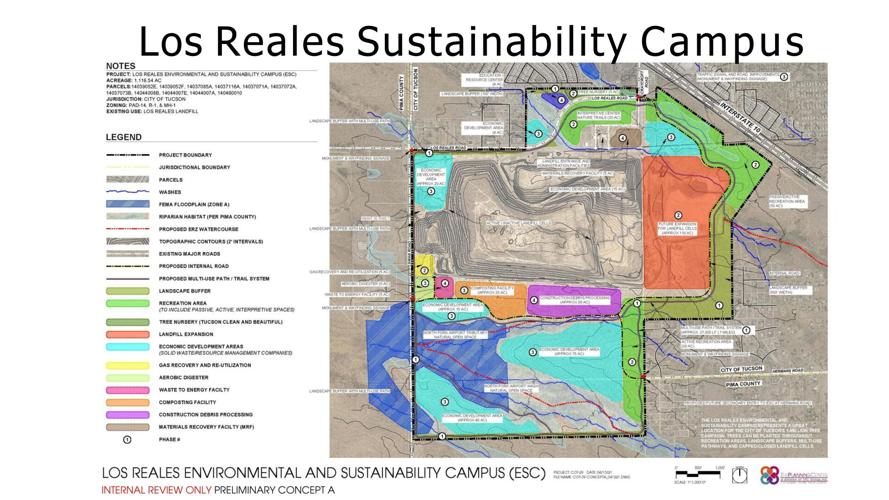
The preliminary concept for the sustainability campus includes 110 acres to expand the dumping portion of the landfill and about 350 acres for economic development and sustainability projects around the perimeter of the landfill.
City staffers are proposing building sports fields, trails and open community space for educational centers and recycling boutiques.

The preliminary concept for the Los Reales Sustainability Campus includes 110 acres to expand the dumping portion of the landfill and about 350 acres for economic development and sustainability projects.
“Typically, we wait until landfills are closed before we start using the landfill as an open space,” de la Torre said. “We want to make sure that we start doing that now, rather than to wait until the landfill is closed.”
The goal is to turn the facility into an educational space where residents can learn about what happens to their trash while being able to give discarded items a second chance for use at last-chance stores.
“We’re trying to change the mindset, because if we don’t see it, we don’t understand it,” de la Torre said. “Once we put that waste in the bin, we have to assume responsibility for that waste for its entire life. We need to have the mindset that whatever we generate, it doesn’t go away by the fact that somebody hauled it away.”
While making the landfill more accessible to its surrounding community, the revamp of Los Reales also includes many sustainability programs including a tree nursery, a processing center for construction debris and a material recovery facility to siphon off recyclables from waste dumps.

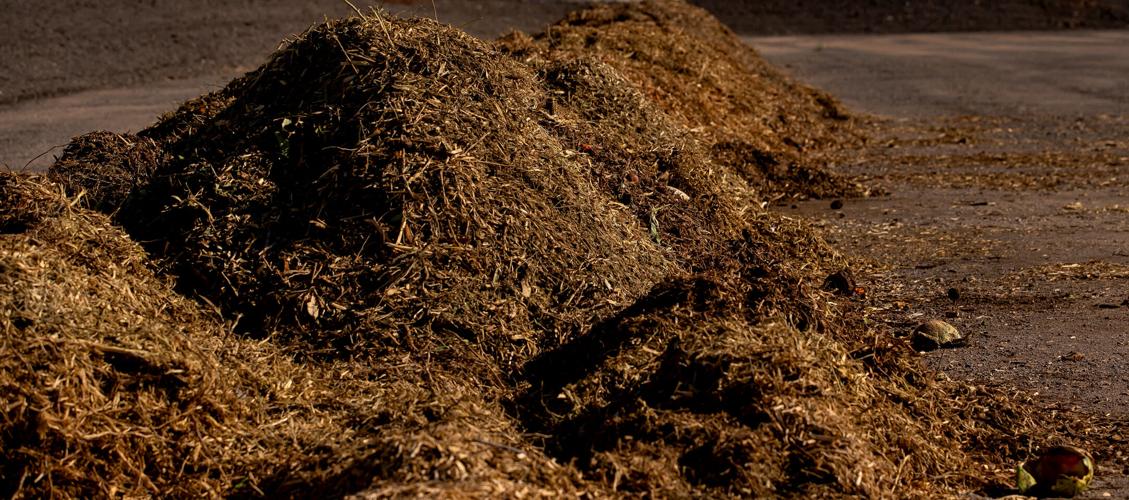
Compost at Los Reales Landfill. Of the waste the city’s recycling program receives, only about 17% is actually recycled. Managers envision a multi-pronged strategy of diverting waste to raise this number to 40%.
The cost
But the wide array of proposed programs comes with a price tag, although an exact cost has yet to be determined. De la Torre says the planning process will include extensive community input, but ultimately, most of the expenses will be “generated from user fees.”
For example, local contractors bringing construction debris to the facility will be charged more for processing the material into a second use material instead of dumping it in the landfill.
Sifting through the city’s waste may also involve deploying a “dirty material recovery facility,” or a sorting plant that takes in all waste and sorts out the different types of materials for their respective reuses.
The city currently contracts with Republic Services to sort through recyclables. In the future, de la Torre says, residents may only have one bin to discard their waste, which will be sorted at Los Reales. The change would likely mean an increase in Tucson’s residential trash collection bills.
“We used to look at the bottom line in terms of the financial component. Now, we have to look at a macro view on how impactful our operations are and what difference we can make,” he said. “It requires investment, it requires a shift in terms of how we’re doing business today, and it’s really testing the willingness from all of us as residents to be able to cope with that change.”
At this point, the proposed methods of transforming Los Reales from a last-stop for waste to grounds for sustainable reuse and public participation are only ideas. Community outreach and guidance from mayor and council will move the plan further along.
City staffers will come back to the City Council on Aug. 10 with a road map depicting how to achieve the landfill’s zero waste goal. If approved, most projects wouldn’t begin until September to December, with the final zero waste plan set to be finalized within a year.
“It’s still very conceptual, but it’s a good starting point in terms of putting a lot of those programs or strategies in motion,” de la Torre said. “This is going to be a paradigm shift for how we view waste here in Tucson.”
 'We basically gave this guy a death sentence,' sheriff says of inmate's COVID death
