


Sabino Canyon has ranger talks, nature walks and educational programs just like state and national parks — but they are all powered by volunteers.
Volunteer naturalists offer conservation education programs daily at Sabino January through March, serving 87 Tucson elementary schools, nearly 2,000 students and 787 teachers and chaperones last year. A kindergarten program runs October through April on Tuesdays and Thursdays, which last year reached 56 schools, 1,524 students and 386 teachers and chaperones.
“The buses come in every day and you should see the kids’ faces,” said Jo Eaton, president of Sabino Canyon Volunteer Naturalists (SCVN). Urban kids may start out scared, unsure about “bad things in the desert,” she said. “By the time they leave they say, ‘it’s the best day ever.’”
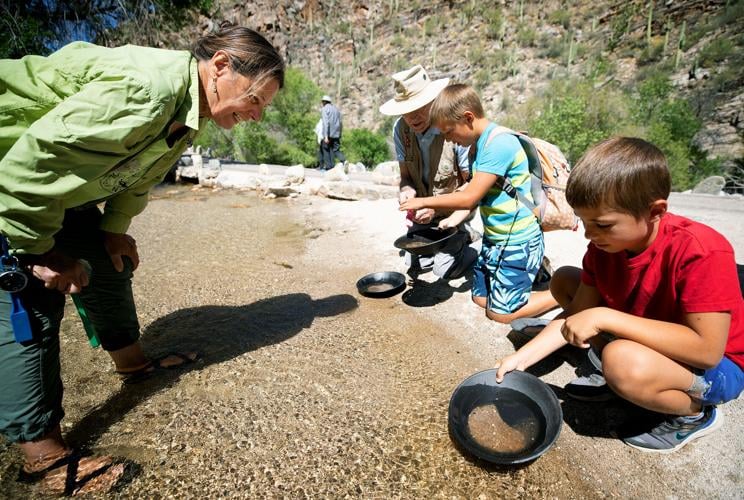
SCVN volunteers also work almost year-round offering various table displays, stories for children, Panning for Garnets, Lizard Walks, cellphone photo walks and guided hikes at Sabino. They also lead summer nature hikes on Mount Lemmon.

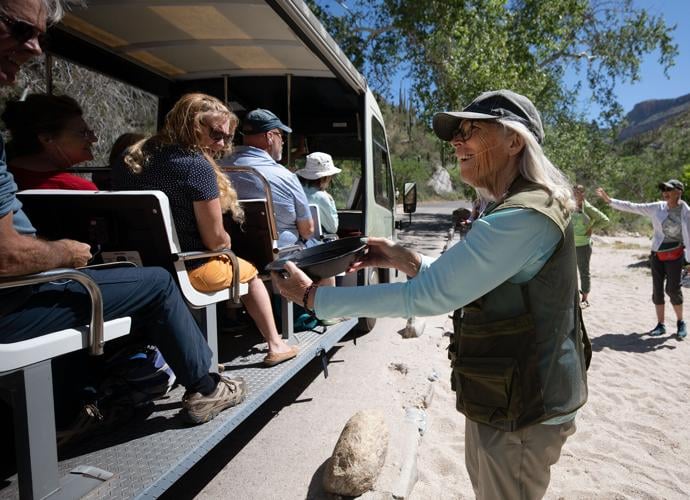
Bev Burger, a Sabino Canyon Volunteer Naturalist, displays garnets to riders on the shuttle in Sabino Canyon.
Those combined efforts totaled 20,770 volunteer hours in fiscal year 2023, a value of $660,486 to the U.S. Forest Service, according to SCVN’s required yearly report.
With 160 volunteer naturalists and 20 more in training, SCVN is one of several large volunteer groups serving Coronado National Forest.
Others include Tucson Off-Road Cyclists and Activists (TORCA) which claims 300 members and has been heavily involved helping repair fire-damaged trails and helping design and build new mountain bike trails in the Santa Catalinas.
Santa Catalina Volunteer Patrol, which provides public contact and information on the ground in the Santa Catalinas, had about 180 patrollers in 2023 — down from 240 in 2019.
The Coronado National Forest webpage on volunteers lists 16 “partner volunteer organizations” including statewide groups like Wild Arizona, Arizona Trail Association and Arizona Site Stewards (protecting cultural resources), as well as groups specific to each ranger district.
“Volunteers are crucial to the daily operations of the Forest Service,” according to the site which notes the forest’s unique year-round volunteer opportunities in Southern Arizona.
Volunteers “are an extension of the Forest Service,” said Starr Farrell, Coronado public affairs officers. “Volunteer groups allow us to do more than we could do.”
All hands on deck approach
Volunteers augment forest staffing. The Coronado employs 108 full-time and 22 temporary employees; with 30-40 full-time and seasonal employees on the Santa Catalina Ranger District which administers Sabino Canyon, the Santa Catalina mountains, and part of the Rincon mountains including Redington Pass north and northeast of Tucson.
The Forest Service’s national database shows about 1,700 volunteers annually on the Coronado with largest numbers on the Santa Catalina (880) and Nogales (537) ranger districts. Both districts benefit from active retirees and winter residents in Tucson and Green Valley.
The total number of people who volunteer is larger — perhaps 2,500 forest-wide and 1,600 on Santa Catalina — but is harder to count accurately as this includes people participating in large group events like the twice annual Redington Pass cleanup.
Of 154 national forests in the U.S., the Coronado has one of the top totals of volunteer hours. The volunteer service database showed about 110,000 volunteer and service hours contributed on the Coronado for 2023, according to Catherine McRae, national press officer in Washington D.C. Only the National Forests in North Carolina had a slightly larger total — about 111,000 hours.
Coronado volunteers battle invasive species (Buffel Grass Slayers), organize big cleanups (Friends of Redington Pass), rescue lost hikers (Southern Arizona Search and Rescue Association), publish hiking guides, and run visitor centers. Many groups help maintain or even help design and build trails.

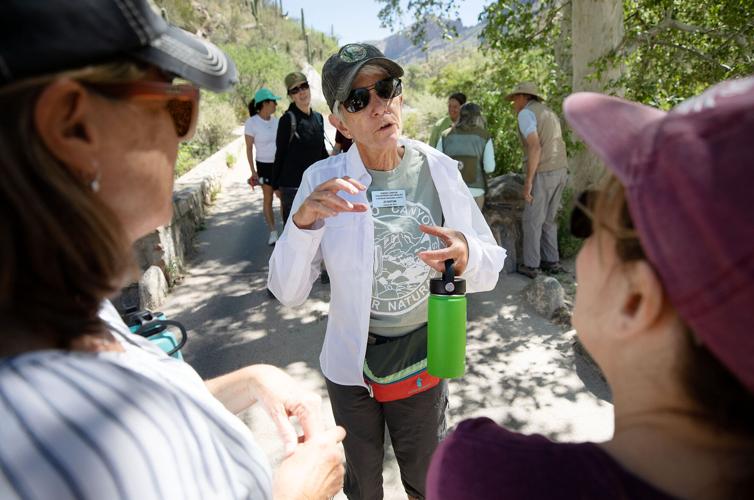
Jo Eaton, the Sabino Canyon Volunteer Naturalists president, talks to two hikers after they saw a snake in Sabino Canyon.
Wild Arizona, a conservation group, has two paid crews of young people for heavy trail work across the forest. It also runs a six-week youth conservation corps program in the Chiricahuas (north of Douglas and southeast of Willcox) for students ages 15-17. Volunteer coordinator Nizhoni Baldwin, who is Navajo, is doing outreach to Native communities and has garnered several applications from Natives for the youth conservation corps program. The Forest Service funds this program; Wild Arizona recruits for and runs it from the Rucker Canyon fire station.
Larger partners such as Arizona Trail Association, which maintains the Arizona Trail through the state — have some paid staff but do a lot of work through volunteer events and trail stewards. ATA has agreements with every public land entity the Arizona Trail crosses, said Wendy Lotze, director of volunteer programs.
“It’s actually unique not only on every forest but on every district,” she said. “We have written agreements on some districts, handshake agreements with other districts.” Some district staff or rangers want to manage volunteers, others prefer that ATA run its own events.
‘A serious workforce’
“Volunteers are not free,” Lotze said. “They are lower cost than an employee but you need to invest time and resources in them.”
ATA offers the Trails Skill Institute for volunteers (its own and others) with modules on trail monitoring and maintenance, stonework, layout and construction for new trails and trail mitigation. “Since 2015 we’ve trained 225 people,” Lotze says. She added that “this increase in (volunteer) capacity has been a response to decrease in capacity with the Forest Service.”
“It’s a serious workforce,” she added. “The upside is having these people whose blood, sweat and tears are in the landscape who are going to invest in its future.”
Public affairs officer Farrell says the Forest Service values volunteer contributions at $27 an hour. The Independent Sector, an organization for nonprofits, values volunteer time at $31.80.
The Forest Service manages volunteer groups through volunteer agreements, ideally renewed every year, which spell out liabilities, protection, rights, responsibilities and limits on authority. The agency also requires specific reporting by volunteer groups on hours and accomplishments.
Every district has a collection of unique volunteer groups and partnership arrangements to augment its recreation work. For Nogales, Friends of Madera Canyon maintain trails and offer trail guides; Mount Wrightson Wilderness Volunteers have cleared all wilderness trails.
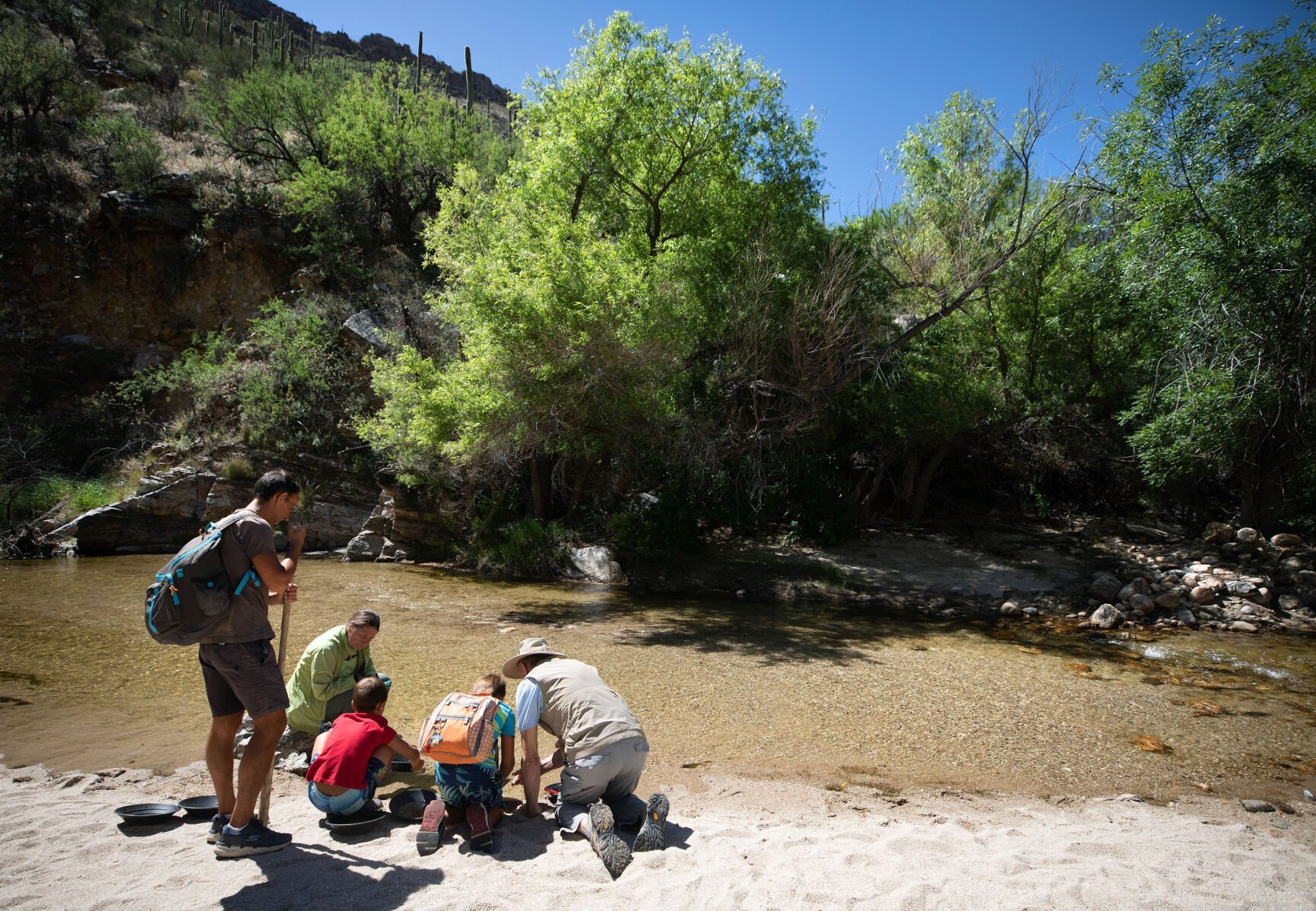
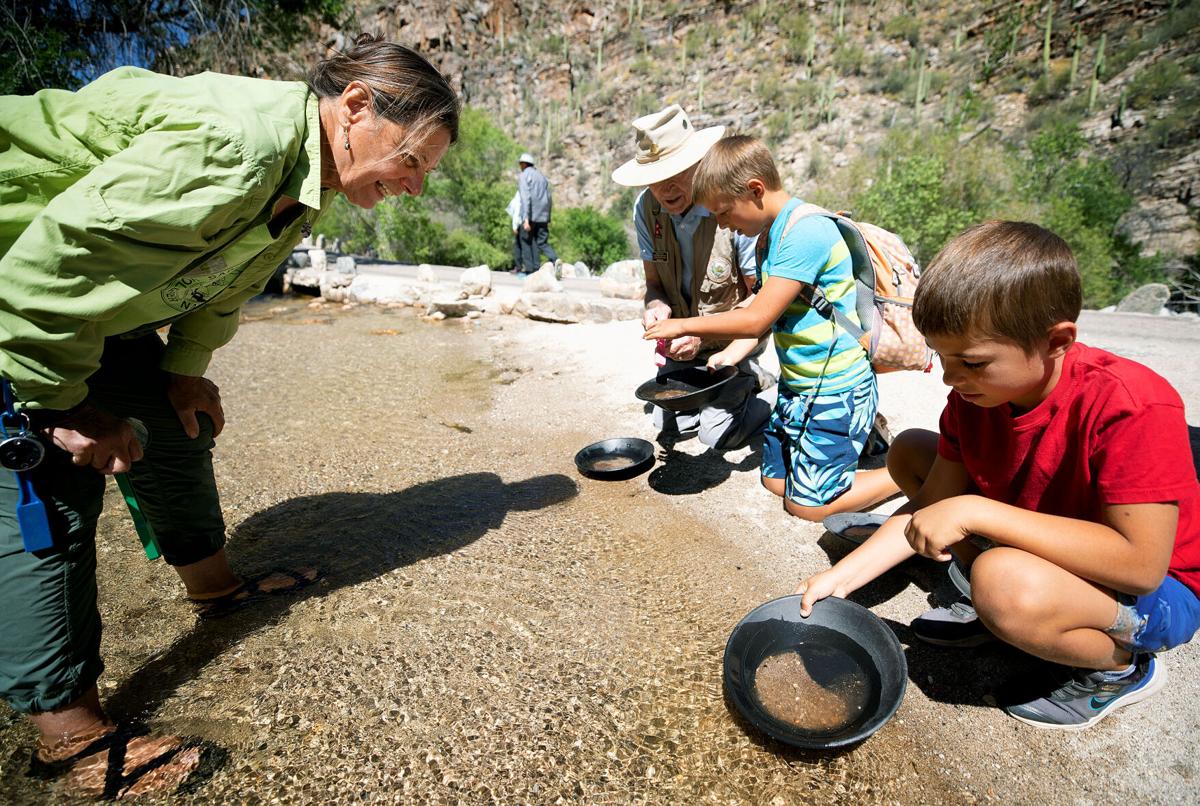
“Panning for Garnets” is one of the many activities hosted by the Sabino Canyon Volunteer Naturalists.
On the Sierra Vista district, Friends of the Huachuca Mountains maintain the historic Carr house on weekends April through December.
Douglas Ranger District draws two national groups yearly to work on Chiricahua Wilderness trails along with a local trails group from Portal. The district provides logistics support to haul in camps and water with its pack train; crews also stay in forest facilities. Friends of Cave Creek run a year-round visitor center.
Other public entities besides the Forest Service rely on volunteers. Saguaro National Park, which has units on the northeast (Rincon Mountains) and west (Tucson Mountains) side of Tucson, had 671 volunteers last year offering almost 24,000 volunteer hours. Many work under the Park Service’s national program, Volunteers in the Parks. The field contacts are similar to the Forest Service’s “volunteer patrol.”
“Our recurring volunteers, such as those you see providing information on trails, wear volunteer uniforms that include a Volunteers in the Parks logo,” said Beth Hudick, Saguaro National Park’s interpretation, education and outreach manager. “Many…are there to provide visitors with orientation and safety information or what we call PSAR, Preventative Search and Rescue.”
Volunteers put on pause
The Forest Service does not have a similar national volunteer program. Instead, the Santa Catalina Volunteer Patrol is entirely local. It was founded in 1997 by Tucson citizens and Forest Service employees concerned about budget cuts and limited personnel impacting public service in Sabino Canyon, according to a comprehensive history of the Santa Catalina Volunteer Patrol compiled by several SCVP members.
But in January, the patrol group quit patrolling for the first time in its 27-year history.
The SCVP “stood down” from Jan. 9 through Feb. 17 during the busiest season for public recreation in the area. A new SCVP president said the “voluntary stand-down” was aimed to improve patroller safety in difficult visitor interaction. The president said the time-out allowed for retraining all patrollers in new visitor interaction techniques required by the Forest Service.
Email posts from previous SCVP leadership to members indicated more controversy. The group’s former president wrote that he was resigning after a “another tumultuous meeting with the ranger” and said he needed to leave to maintain group operations.
During the stand-down, several patrollers and other volunteers wrote letters to the editor, decrying or defending Forest Service management. Another volunteer group has showed up on weekends at Sabino, protesting its termination by the ranger over a trail spat with another group.
The ousted volunteer group wrote a letter of concern in late January to Coronado Forest Supervisor Kerwin Dewberry, the ranger’s boss, but did not receive a reply.
Watch: Sabino Canyon is a great spot to cool down or watch the rains come in. Over the years, it has seen Tucsonans come and go for hiking, picnics and scenic rides. Here is a glimpse into Sabino Canyon's past. Video by Pascal Albright/ Arizona Daily Star

