




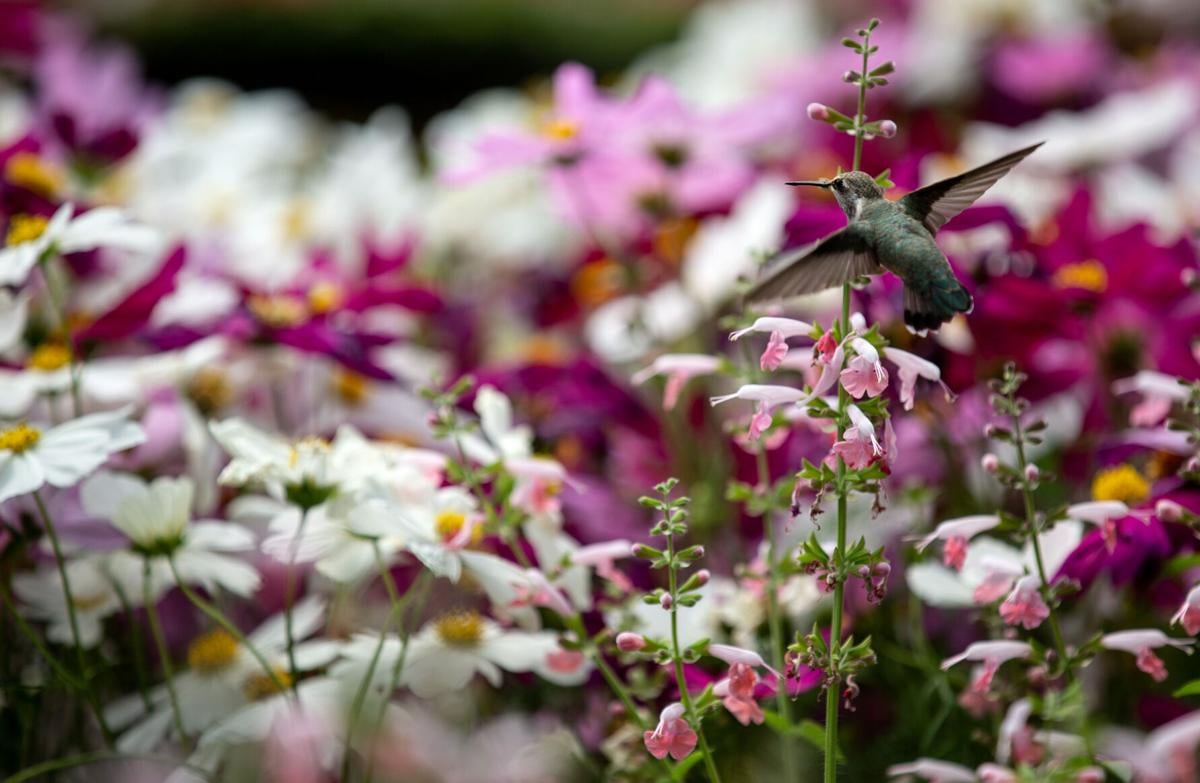
There’s nothing more charming than a hummingbird. Their spectacular colors, tiny size and big attitude make them one of the most popular — and easily identifiable — birds. We have nine species in the Tucson area, some of whom overwinter here.
Hummingbirds have such a fast metabolism that they have to eat pretty much all the time. They need to eat an amazing two or three times their body weight per day in nectar and tiny flies. This requires lots of nectar-producing flowers so they get plenty of calories — about the equivalent of 155,000 calories per day at human scale.
If you’re hoping to attract these incredible little flying jewels to your yard, here are a few easy-to-grow plants you can try. These particular plants are some of my favorites, but if you want to learn more, check out the book "Hummingbird Plants of the Southwest" by Marcy Scott, which has lots of information and 120 plants and profiles. For more information about our local hummingbirds, head to the Paton Center for Hummingbirds, run by our local chapter of the Audubon Society.
Mexican honeysuckle (Justicia spicigera) has lovely tubular bright orange flowers and fresh green oval leaves. It’s evergreen and can bloom all year round, depending on conditions. It’s easy to grow and low maintenance.
Sages (Salvia spp.): These small to medium perennial shrubs range in color from hot pinks to muted purples. They tend to like part-shade and need a bit more water than other natives, but they’re well worth it. As a bonus, their foliage gives off a sweet, complex refreshing scent.
Penstemon (Penstemon spp.): Like the salvias, you have a wide selection of penstemon species to choose from. They mostly flower in the pink and red spectrum, and many can handle full sun quite happily. If they like your yard, they will spread, which I personally consider a bonus. They are perennial plants, and grow anywhere from 1-3 feet tall but don’t take up much horizontal space.
Pink fairy duster and Baja fairy duster (Calliandra spp.): These aptly named plants have unique, feathery flowers that look a bit like feather dusters. The Baja variety is bright red and can grow up to 4-5 feet tall; the local fairy dusters are low-growing, reaching at most 2 feet in height but with a lot of spread. They both can handle full sun.
Chuparosa (Justicia californica): A relative of the Mexican honeysuckle, this rounded shrub is very sun and drought tolerant and has reddish orange tubular flowers. It’s extremely low-maintenance once established, and only requires pruning if frost-damaged. It can look a bit dry without water, but if given a bit of supplemental water through the summer it will look great.
Desert willow (Chilopsis linearis): One of my favorite native trees, the desert willow is winter-deciduous, and has beautiful orchid-like flowers whose color depends on the variety. You can get anything from a very pale, almost white pink to a deep wine burgundy and everything in between. The foliage is light green and lush. The tree is small and its roots shouldn’t bother your hardscaping, so it’s a very useful and beautiful landscape tree. It can also handle full sun and even reflected heat.
Arizona yellow bells and orange bells (Tecoma spp.) These lovely shrubs are natives to our area and have beautiful fresh green, lush foliage. The best part is their spectacular bell-shaped flowers, which can be a bright lemon yellow or various shades of orange, depending on the variety. Their roots are cold tolerant but their stems may freeze and die during cold winters if temperatures drop below about 22 F. However, they grow back very quickly in the spring and by summer can be large bushes again. They love full sun and can even grow in reflected heat.
Think of spring while looking at these hummingbirds. The photos were shared by Star readers over the years.

