

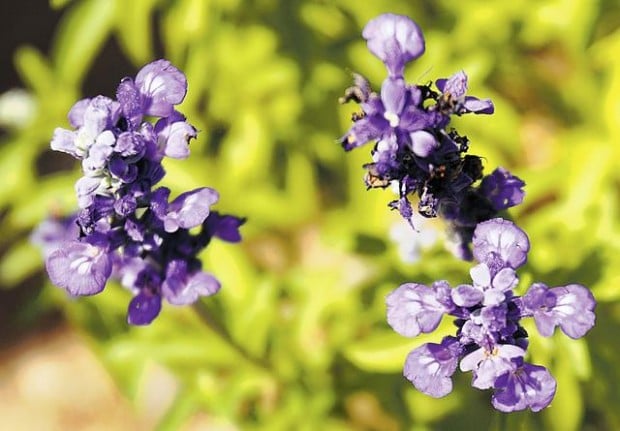
Probably the best known genus of flowers worldwide, at least in terms of garden culture, is Salvia.
Also referred to as sages, there are more than 900 species and many more cultivated varieties. Most are not well suited to our desert climate, but we do have a number of excellent desert-adapted perennial salvias. Many are native to the Chihuahuan Desert. All are heat tolerant and water thrifty. They come in a range of sizes and colors, including red, purple, blue and white.
If you have limited space or are in need of colorful plants to fill in at the base of taller shrubs, consider mealy cup sage, Mexican blue sage or red Chihuahuan sage. All can be maintained under 3 feet in height.
Red Chihuahuan sage is probably the most commonly used desert sage. It's a standard for most landscapers so you may already have it in your yard. Red sage is tough as nails in terms of drought and cold tolerance. Its short, red to purplish-red flower spikes are set atop dark green foliage. Plants are commonly 2 feet tall and wide. Flowers are most abundant in the spring, but the sage will bloom sporadically through the summer and into autumn. Red sage benefits from periodic pruning to keep it full and flowering.
Mealy cup sage is the smallest of the sages, just a foot tall. Depending on the variety, mealy cup sage comes in several colors, including, white, blue and violet-blue. Plants are compact with dense flower spikes sitting above attractive silvery-green foliage. This is a great plant to use as an edging, border or ground cover.
Mexican blue sage, another small sage, grows to a height and spread of 2 feet and has small blue flowers scattered on spikes set above small but dense silvery-green foliage. Most of the blossoms appear in spring and fall, but flowering can be extended into the summer with regular irrigation.
If you have space for the larger growing sages, consider Cleveland sage, purple sage or Mexican bush sage. These are perennial shrubs that will typically reach a height and spread of 4 feet. They can be used to soften construction features such as fences and walls, as background planting for smaller shrubs or in foundation plantings around the house.
Cleveland sage is a mounding plant 3 to 4 feet high and up to 6 feet wide. It has blue-violet flowers, arranged in a tiered effect on tall upright spikes. The flowers, most abundant in spring and early summer, are long lasting and hold up well in dried flower arrangements. The leaves of this sage are green and aromatic and can be used to make tea.
Purple sage is similar in size to Cleveland sage, but it has pinkish-purple flowers that dot the flower spike every few inches in round clusters of tubular flowers. This sage should be cut back heavily in the winter to promote spring flowering.
Mexican bush sage grows about the same height as the two previously mentioned Salvias but has a more upright form, not growing quite as wide. Mexican bush sage has attractive gray-green foliage and arching purple-on-white or purple-on-pink flower spikes. Since flowering occurs only on new growth, Mexican bush sage should be cut back to near the ground in the winter to encourage new growth in the spring.
● John P. Begeman is the urban horticulture agent for the University of Arizona-Pima County Cooperative Extension. If you have questions, call 626-5161 to reach a master gardener.

