



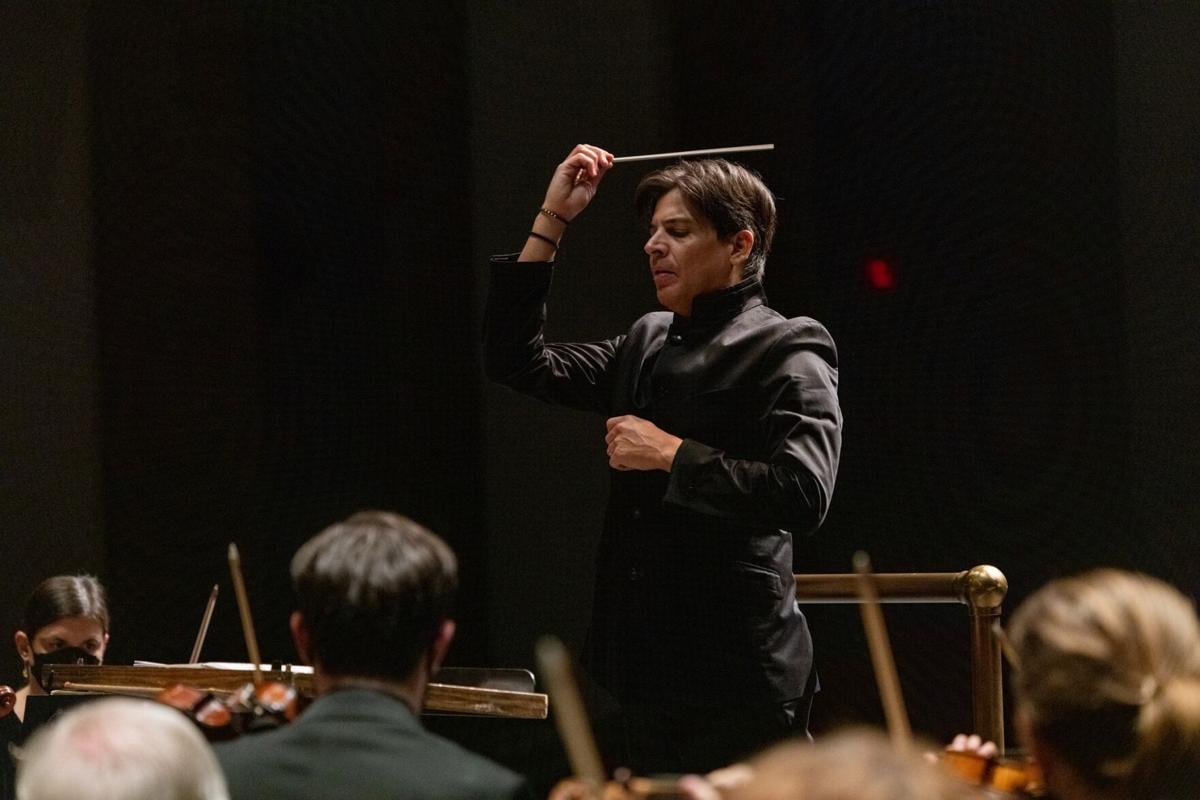
José Luis Gomez performed Mahler's Sixth Symphony a number of times when he was an orchestra violinist early in his career.
But this weekend, he will perform the behemoth piece from the podium for the first time.
"The advantage of that first time is that it gives you kind of a little bit of, at least for me, the excitement of the unknown," said Gomez, the Tucson Symphony Orchestra music director. "So with all the baggage that I have, meaning that all the experience that I have when I looked at it from the score point of view, then I just started from scratch. I use some of the baggage, I use some of experience, but mostly I let the music speak to myself directly."
Gomez and the TSO will perform Mahler's Sixth twice this weekend at Linda Ronstadt Music Hall.
Mahler's Sixth is called "Tragic," but not for reasons we usually associate with tragedy.
"It's more tragic in what the old masters of the classicism used to use, which means the 'Sturm und Drang,' this kind of more passionate movements that they had," Gomez said. "It's a very uplifting symphony because it's very passionate in many ways."
"Sturm and Drang" (storm and stress), a style found in a lot of Mozart and Haydn works, employs minor keys and sudden emotional shifts in the music as well as dramatic intensity.
Mahler composed the Sixth during a happy period of his life in 1903-04. He had married Austrian composer and socialite Alma Schindler, and during the course of writing the symphony, had welcomed his second daughter.
But he also experienced excruciating tragedy — which could explain the symphony's nickname — not long after the work's Vienna premiere in January 1907. That summer, both of his daughters fell ill with scarlet fever and the oldest, Maria, died. Not long afterwards, Mahler learned he had a defective heart valve that eventually contributed to his death at age 50 in 1911.
As for the origin of the work's nickname, it wasn't the composer's idea, according to some music scholars, although others believe the name likely was associated with the three thunderous blows of fate delivered at the end. The composer wanted the sound of what's often referred to as the Mahler hammer to be brief and mighty, yet dull in resonance. Some modern-day orchestras achieve that by using a wooden mallet (or sledgehammer) on a wooden surface.
Mahler dispatched a plethora of percussion for the piece from double timpani to bass and snare drums, cymbals, tam-tams, glockenspiel, xylophone, untuned bells and cowbells. The Sixth is an 80-minute "tour-de-force" requiring a large-scale orchestra, where every detail, from the smallest, gentlest moment to the largest crash of the hammer is intensely thought through," according to TSO program notes.
Gomez is not the only one this weekend experiencing a "first" with Mahler's Sixth, which the orchestra last performed in late 2002 under Gomez's predecessor, George Hanson.
"Mahler Six is a great addition to my personal repertoire, but also for the orchestra," Gomez said. "They played it once, a long time ago, but many players that are here now, they've never played it before."
The orchestra will perform it at 7:30 p.m. Friday, Feb. 20, and 2 p.m. Sunday, Feb. 22, at Music Hall, 260 S. Church Ave. Tickets are $16.90-$109.30 through tucsonsymphony.org or by calling the box office at 520-882-8585.

