



At the tail end of Handel’s Concerto Grosso No. 10 in D minor on Sunday, Ruckus bass player Douglas Balliett added a little 21st century electric bass to the German composer’s 18th century work.
The interruption of the deep-voiced bass guitar was subtle, sounding almost like a cello, but the distinction was notable.

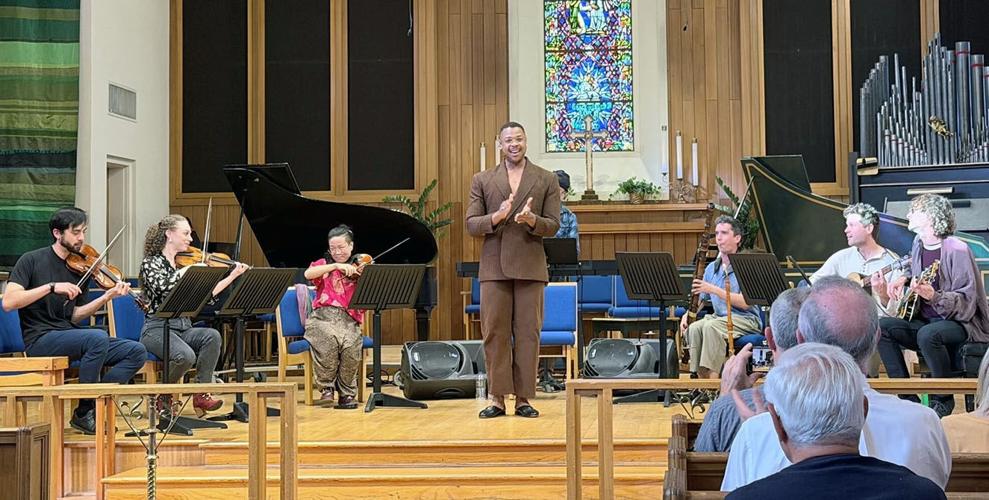
Bass-baritone Davóne Tines, center, got the audience to clap and sing along to his self-penned "What is my hand in this?" during his concert Sunday with the early music ensemble Ruckus — from left, Keir GoGwilt, Shelby Yamin, Manami Mizumoto, Elliott Figg (behind Tines), Clay Zeller-Townson, Paul Morton and Douglas Balliett.
The seven-member shapeshifting Ruckus, which founder Clay Zeller-Townson describes as a baroque continuo that acts like a modern-day jazz rhythm section, brings centuries-old music into the modern day, playing Baroque-era instruments including violin, harpsichord and guitar, alongside electric keyboards and electric bass.
At Grace St. Paul's Episcopal Church on Sunday, the ensemble and bass-baritone Davóne Tines wrapped that music around a decidedly 21st century message in their new collaboration “What is your hand in this?”
Tucson is one of the first cities to get the concert, which had its world premiere Jan. 28 in Washington, D.C. Arizona Early Music hosted the ensemble as part of the 2026 Tucson Desert Song Festival.
The program of original songs and Balliett’s and Tines’ arrangements of 18th century songs, some written by former enslaved people, challenged the notion of America being the home of the free. The concert comes as the country embarks on the 250th anniversary of its founding this summer.
The arrangements added a contemporary feel to centuries-old words that still resonate today. Tines, a vocalist of immeasurable talent and range, laced Stephen Foster’s quintessential parlor ballad “Beautiful Dreamer” with the contemporary and harsh realities of Balliett’s “The Four Fs” from his self-penned “The Compassion Preludes.” In the song’s finale, Tines almost rapped those four f's: “We fight, We flee, We feed and we Find a way to keep reproducing.”
“What is your hand in this?” was not a concert of songs strung together for 75 minutes; it was a narrative led by Tines, whose commanding baritone took us on a journey through time, from founding father John Dickinson’s “The Liberty Song” — the 18th century celebration of colonial America’s freedom from England written by a man who owned slaves — to Joshua Simpson’s lambast “To the White People of America” that challenged Dickinson’s notion of freedom nearly 100 years later.
These were America’s first protest songs and their messages, delivered in Tines lyrical and soulful baritone with Ruckus’s impeccable and contemporary flourishes, resonated with Sunday’s audience.
“Raise your hand if things are weird today,” Tines said at one point, and the audience quickly obliged; some people raised both hands.

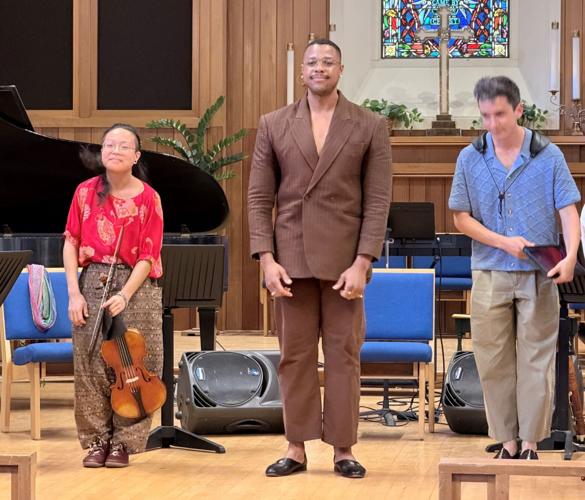
Bass-baritone Davóne Tines, center, takes a bow with, from left, Ruckus violist Manami Mizumoto and Ruckus founder and bassoonist Clay Zeller-Townson.
There’s no easy solution, he said, “but action is needed.” What that action will look like depends on the individual, he added, and will come from asking ourselves, “What’s my hand in this.”
Tines then sang his self-penned song of the same name that challenged listeners “While you listen to this song / Will you try to right your wrong, asking / What is my hand in this?”
With little prompting, the audience sang those words with Tines and Ruckus.
Sunday’s concert was arguably one of the most daring of Arizona Early Music’s 44 years and one of the season’s best sellers, Executive Director Dominic Giardino said as concertgoers leaving the church praised the performance.

