


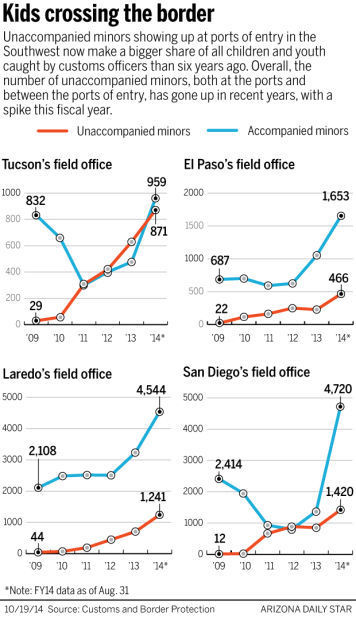
One in five kids caught at the ports of entry in the Southwest — and nearly half in Arizona — tried to cross without a parent or legal guardian, Customs and Border Protection data show.
That’s a stark contrast from five years ago, when the majority of children and youths were accompanied by an adult.
In fiscal year 2009, about 6,000 minors were caught at the ports of entry — sea, land and airports — of the four Southwest field offices: El Paso, Laredo, San Diego and Tucson. Of those, only 107 were unaccompanied.
Last fiscal year, as of Aug. 31, nearly 16,000 minors were deemed inadmissible at the ports of entry; nearly 4,000 of them were unaccompanied.
Inadmissibles can include people who don’t have legal documents when they present themselves at the border or have previously lied.
The number of minors trying to cross the border, at the ports and in between the ports had steadily increased, with a spike last year that led to what some referred to as a humanitarian crisis.
The Border Patrol apprehended more than 68,000 unaccompanied minors and about the same number of single parents crossing with at least one child last fiscal year — a 77 percent and 360 percent increase, respectively.
While the numbers showing up at ports of entry is much smaller, it nearly doubled in just one year from 8,545 in fiscal year 2013 to nearly 16,000 last fiscal year.
The increase of unaccompanied minors and families, primarily from Honduras, Guatemala and El Salvador, was due to a combination of factors including entrenched poverty, family reunification and gang violence. Persistent rumors that the U.S. government was letting women who crossed with their children and unaccompanied minors stay also contributed to the jump.
The Arizona Daily Star requested port of entry data for the Southwest in June. The newspaper published a story about the increase of minors coming through Tucson-area ports this summer, but did not receive any other data.
Customs and Border Protection denied a request for an interview and did not explain why it hadn’t responded to the full request. After two months and multiple emails to the Department of Homeland Security and to CBP’s headquarters in Washington, D.C., the agency provided the rest of the data.
Experts say they are not surprised that the number of children and families presenting themselves at the ports of entry has increased as well, since many of them were turning themselves in to Border Patrol agents.

