


JEFFERSON CITY • Missouri voters would be asked to raise the state sales tax by a penny to rebuild a 200-mile stretch of Interstate 70 and finance other transportation projects under a measure that cleared the state Senate on Thursday.
The Republican-controlled chamber needed some help from Democrats to pass the tax increase on a vote of 24-10. In an unusual alliance, 14 Republicans joined 10 Democrats in favor. Ten Republicans opposed it.
Under the proposal, the state sales tax rate would climb to 5.225 percent from 4.225 percent. The current rate includes a 3 percent tax for general revenue and 1.225 percent for conservation and other projects.
The increase, which would be on the November 2014 statewide ballot, would raise an estimated $8 billion. It would expire in 10 years unless renewed by voters.
Supporters said Missouri can’t take care of its 33,000 miles of highways, the seventh-largest system in the nation, without an infusion of money. A strong transportation system will boost the state’s economy and result in thousands of construction jobs, they said.
Opponents said the tax would result in bigger government and impose a burden on working Missourians. In the sharpest criticism, Sen. John Lamping, R-Ladue, credited “special interests and the lobbyists they hire,” including former House Speaker Steve Tilley, for the plan’s passage.
Tilley is a lobbyist for Fred Weber Inc. of Maryland Heights, a major builder of roads and bridges.
The measure now heads to the Republican-controlled House, where the reception from Speaker Tim Jones, R-Eureka, was cool. He said GOP members would prefer to offset any sales tax increase with an income tax cut.
Given Republicans’ limited appetite for tax increases and debt, the highway measure could compete with a House proposal for $1.2 billion in bonds for state buildings and a separate Senate-approved bill that would increase the sales tax by a half-cent to offset an income tax cut.
The transportation tax was among the last measures passed by the Senate before legislators left town for a weeklong spring break. The sponsor, Sen. Mike Kehoe, R-Jefferson City, touted the estimated 270,000 construction jobs that the building boom would provide.
Missouri Department of Transportation officials have been warning for years that the agency was approaching a funding cliff.
Since the state’s fuel tax is based on a set rate per gallon, tax receipts have been dropping as cars become more efficient and motorists buy less gas. Also, bond revenue and federal stimulus money have dried up.
As a result, the state’s road-building budget has shrunk from $1.2 billion a year ago to about $700 million.
The agency says if the sales tax is approved, it would use $100 million a year of the proceeds to fund a $1.5 billion to $1.7 billion bonding program for the I-70 project. The highway would be widened to three lanes in each direction from Wentzville to Independence.
The state’s motor fuel tax would be frozen at its current level of 17 cents per gallon and new toll roads and bridges would be prohibited while the penny sales tax was in place.
The department would publish a specific project list before voters decided on the tax. Afterward, annual updates would be provided to legislators. After the sixth year, legislators could withhold funding if a promised project had been dropped.
Cities and counties would get 10 percent of the money generated by the new tax. But that isn’t assuaging some local officials’ concerns.
Traditionally, MoDOT has relied on user fees — the motor fuel tax, the vehicle sales tax and vehicle registration and drivers license fees — for its state funding.
Earmarking a general sales tax for roads would represent “a pretty big change in public policy, which we don’t agree with,” said Tim Fischesser, who lobbies for the St. Louis County Municipal League.
Cities, counties and other governmental entities depend on sales taxes. With the proposed increase for the state, the total rate would top 10 percent in some areas. St. Louis city sales taxes are nearly 10.5 percent in some neighborhoods now.
That could drive people to make purchases through the Internet, thus avoiding sales taxes, Fischesser said.
Jones, the House speaker, also had concerns.
“The House (Republican) Caucus has been very concerned about raising any taxes the last few years, especially during these challenging economic times,” he said.
Other critics said sales taxes are hardest on low-income people, who spend a higher percentage of their income to purchase essential items.
Kehoe responded that Missouri’s sales tax is not applied to “basic necessities,” such as groceries. He also said the funding would help low-income people because cities could use it to improve all modes of transportation, including mass transit.
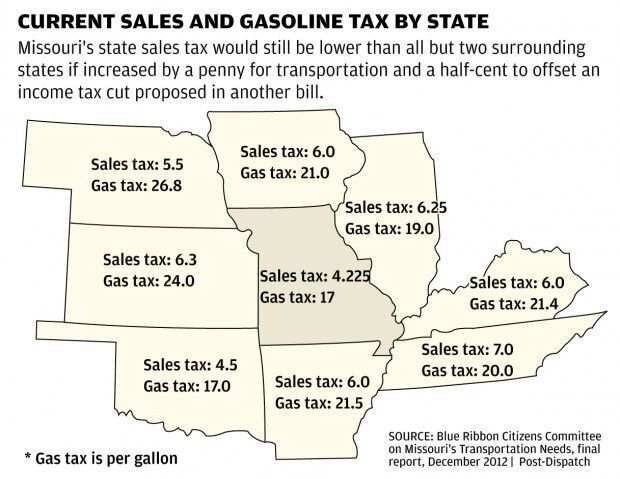
At 5.225 percent, Missouri’s state tax rate would continue to be lower than all but one of the eight bordering states — Oklahoma, which has a tax of 4.5 percent.
Even if Missouri legislators added an additional half-cent sales tax — as has been proposed in another bill — Missouri’s tax would still be lower than all but two surrounding states — Oklahoma and Nebraska.
(The constitutional amendment is SJR16.)

