


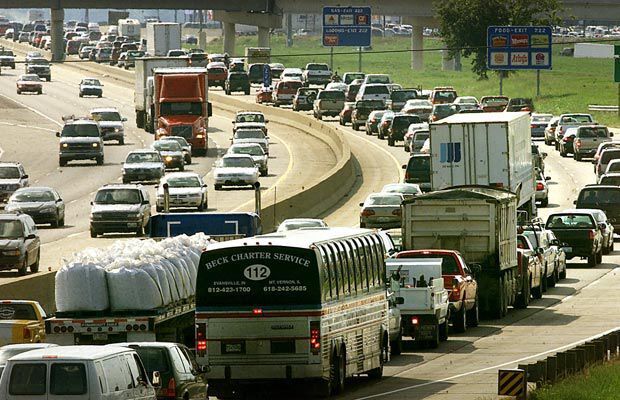
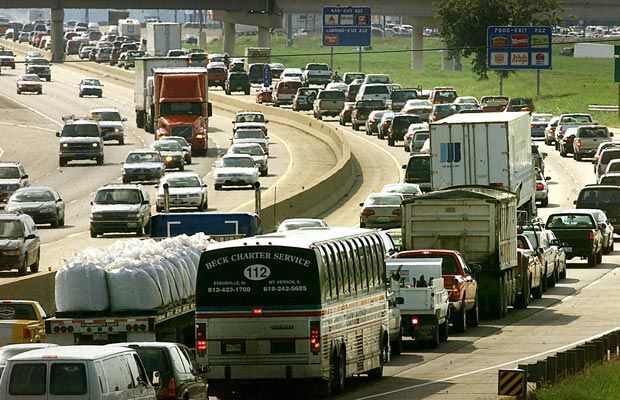
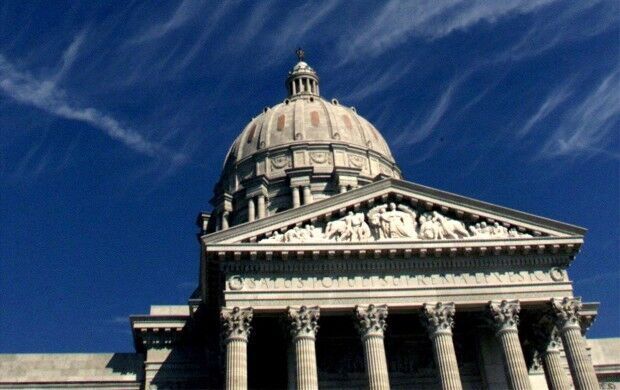
JEFFERSON CITY • The chairman of the Missouri Highways and Transportation Commission on Thursday called for state legislators to seek voter approval of a 1-cent sales tax for transportation.
Chairman Rudy Farber of Neosho said the tax increase would “get at the heart of the problem,” which is the need to supplement gas tax receipts that are dwindling as cars become more fuel-efficient.
“Now is the time for us to put oil in the engine,” Farber said.
If approved by state voters, the tax increase would generate nearly $8 billion before it would expire in 10 years.
Of that total, $1 billion would be earmarked for rebuilding 200 miles of Interstate 70, from Wentzville to Independence, and widening it to six lanes.
About $5.15 billion would be divvied up by a regional formula. The St. Louis area, for example, could see $1.76 billion spent on its roads, bridges, aviation projects or other priorities.
The rest would fund MoDOT’s operating budget, provide matching funds to draw federal money, and beef up payments to cities and counties for “transportation-related activities.”
The proposal will be introduced in the Senate by Sen. Mike Kehoe, R-Jefferson City. Kehoe and two Republican House members, Reps. Dave Schatz of Sullivan and Dave Hinson of St. Clair, attended Farber’s news conference Thursday and lent their support.
While the Republican-controlled Legislature has adamantly opposed all tax increases, Schatz and Hinson said they are optimistic that their colleagues will approve this proposal.
“There’s a great understanding, if we’re going to have job-creation growth … this is part of that,” Schatz said.
Former Sen. Bill McKenna, a Democrat from Jefferson County, has worked on transportation tax options for several years. He said the sales tax is the fairest way to fund roads because people will “all be paying, but they’ll all be benefiting.”
Though critics say that sales taxes are hardest on low-income people because a higher percentage of their income goes toward buying essential items, McKenna noted that the state sales tax of 4.225 percent is not applied to groceries or prescription drugs.
According to Farber’s handout, MoDOT’s construction budget has shrunk to $700 million from $1.2 billion in the last year. Officials say that’s not enough to keep up with the needs of Missouri’s highway system, which covers more than 33,000 miles and is the seventh-largest system in the nation.
If the tax increase passes, MoDOT would use its existing bonding authority to issue about $1.6 billion in bonds for the I-70 project. The department would earmark $100 million a year — of the $790 million generated each year from the tax increase — for bond payments. If the sales tax wasn’t renewed in 10 years, other funds would be used to make the remaining payments.
The proposal, a constitutional amendment, would go on the November 2014 general election ballot unless Gov. Jay Nixon called an earlier, special election to consider it. Nixon has not weighed in on the issue but could do so Monday, when he delivers his “State of the State” address.
Raising money for highways is one of the marquee issues in a legislative session that, in a seeming contradiction, also includes a heavy dose of talk about cutting taxes.
Hours before Farber made his announcement at a local hotel as part of a transportation conference, a Senate committee weighed various tax-cut ideas.
One proposal, sponsored by Sen. Eric Schmitt, R-Glendale, would phase in a 50 percent tax cut for all businesses in Missouri — 10 percent a year for five years.
Another plan, sponsored by Sen. John Lamping, R-Ladue, would reduce individual income taxes to 4 percent from 6 percent, raise the cigarette tax by 26 cents per pack, and increase the sales tax by a half-cent and dedicate that money to transportation.
Retired St. Louis investor Rex Sinquefield has been pushing for several years to eliminate the state’s income tax. The movement seems to be picking up steam this year, in part, because Kansas eliminated its income tax on businesses that report company income on owners’ personal tax returns.
Kansas also lowered individual income tax rates, for example, reducing the top rate to 4.9 percent from 6.45 percent.
A parade of witnesses said Thursday that if Missouri doesn’t follow suit, many small businesses will bolt across the state’s western border.
“We need to do something here in Missouri to avoid being left behind,” said Ray McCarty, who lobbies for Associated Industries of Missouri.
Lamping said the middle class would benefit from his tax cut. But the bill would cause a projected $1.1 billion loss to state general revenue, which opponents say would require drastic cuts in education and other services.
Democrats on the committee said they’d like proof of the positive economic benefit. They pointed out that Kansas is facing a huge budget hole.
“We see the Kansas cut, and now they can’t fund their schools,” said Sen. Paul LeVota, D-Independence.
Committee Chairman Will Kraus, R-Kansas City, said the panel will hold a work session on the issue next week. He said he wants to forward a tax cut to the full Senate for debate.
Lamping’s bill is SB31. Schmitt’s bill is SB11.

