



A draft action plan to improve on an ongoing initiative aimed at addressing an assortment of public safety issues across Tucson was recently released, and city officials provided updates on its efforts so far.
The "Safe City Initiative" launched in October by Tucson Mayor Regina Romero was in response to "palpable frustration" residents and officials voiced about ongoing homelessness, drug and crime. It aims to put the city and other local jurisdictions' efforts under one umbrella, identify gaps in local crime-fighting efforts and "leverage" law enforcement action and treatment options to address those gaps.
Romero, Assistant Police Chief Stacie Schaner, Assistant City Manager Liz Morales and members of the city's Safe City Task Force met with reporters Thursday to give updates on the city's efforts under the initiative.
New draft plan
The "Safe City Initiative" draft plan centers on six priorities.
"Together, they address the interconnected challenges of homelessness, behavioral health, violence, and community safety through prevention, intervention, collaboration, transparency, and engagement," the plan says.
The six priorities are:
• "Increasing Resource Access for Unsheltered People and Families," with actions such as optimizing shelter use and expanding housing opportunities;
• "Improving Coordination for People with Mental Health and Substance Use Disorders," through strengthening specialty court programs and city coordination with behavioral health providers, among other actions;

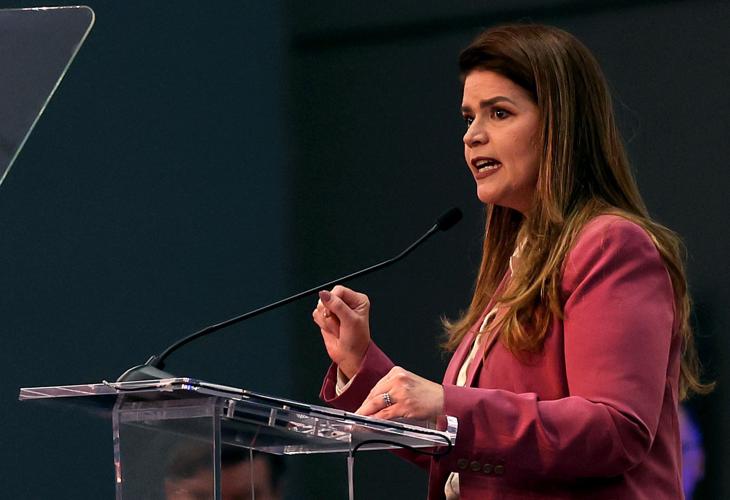
Mayor Regina Romero says making Tucson a safer place to live will taken a "team" approach using local, state and federal resources.
• "Strengthening Violence Prevention and Intervention" through publishing a "public-facing gun-crime dashboard" and establishing a "focused deterrence program," to name a few actions;
• "Strengthening Regional and Community Collaboration" by aligning regional housing placement by aligning efforts with the Tucson Pima Collaboration to End Homelessness, for example;
• "Advancing Data and Technology Accessibility" by using methods of real-time data and "interdepartmental coordination" to improve emergency response times, among other actions;
• "Expanding Community Outreach and Engagement" by convening public meetings with groups such as the Safe City Task Force or neighborhoods, among other possible actions.
The city is also setting measurable targets for each of the priorities.
According to the draft plan, which city leaders stressed is a "living document," some of the targets given are: having 65% of clients staying at city-owned shelters exit with a "positive" housing placement; increase the number of people who accept treatment as opposed to jail by 20% by the end of the year, compared to last year; improve the "service acceptance rate" of individuals contacted through regular outreach, encampment decommissioning, and targeted enforcement by 10% by the end of the year, compared to last year; among others.
"I often say that creating a safe city and a good quality of life takes a team. It's a team sport. No one can do it alone, and I'm very lucky to be able to have such an amazing partnership with our city manager and his office ... with our Tucson Police Department, our Housing and Community Development Department," Romero told reporters Thursday. "We have been working on the safety and security of our city since I became mayor . . . The goal is to connect individuals to resources that they need."
The Safe City Initiative is a call to action on other jurisdictions, such as Pima County, Romero said. She stressed the need for the state legislature and the federal government's help, despite the uncertainty of their willingness.
"I believe that the federal government, the state government and Pima County government have a responsibility to invest in Tucson," she said. "The federal government, under Biden, was investing billions of dollars into prevention, intervention, work, gun violence reduction, mental behavioral health, substance use disorders, and I think that there are still, even under the Trump administration, there's still opportunities that our police department can apply to, so we're going to continue doing that."
"Really, my job as mayor, is to go to my elected colleagues on every level of government and say, 'this is what's happening, and this is what we need your help and investment in,' because we pay taxes on every level of government . . . it is my, my job not to take no for an answer."
Former Tucson Mayor Tom Volgy, a member of the Safe City Task Force told reporters this isn't his "first rodeo" when it comes to dealing with homelessness or safety issues, but what has changed since his 1987 to 1991 mayoral term is the "enormous amount of collaboration" between the city, nonprofits and local jurisdictions like Pima County.
But there's a hitch, Volgy said: that Tucson "doesn't exist on it's own."
"It's not living in isolation. There are headwinds blowing in from Washington, headwinds blowing in from Phoenix, and they put enormous amounts of pressure on cities like ours, they're not wealthy cities," he said. "When they sneeze, we catch the flu, and it may be that another round of flu is coming very soon, and it's going to take even more heroic activity on the part of the city and the county to deal with those headwinds."
Police deployments, STAR Village effective
Tucson police have so far conducted 13 "focused deployments," Morales told reporters Thursday, in which officers have made contact with 363 people resulting in 328 arrests, most of which were cite-and-release.
Officials have been able to place 29 people into shelters, get 26 people to accept detox services and give 15 more medically-assisted treatment referrals, Morales said, and the city was able to clear 53 encampments through the process.
"I do feel strongly that people may not know that these Safe City deployments are really about, what's the best pathway for each individual person," Morales said Thursday. "The officers, the outreach workers, they're talking to them individually (about their situation) and they're able to make some assessments on site."
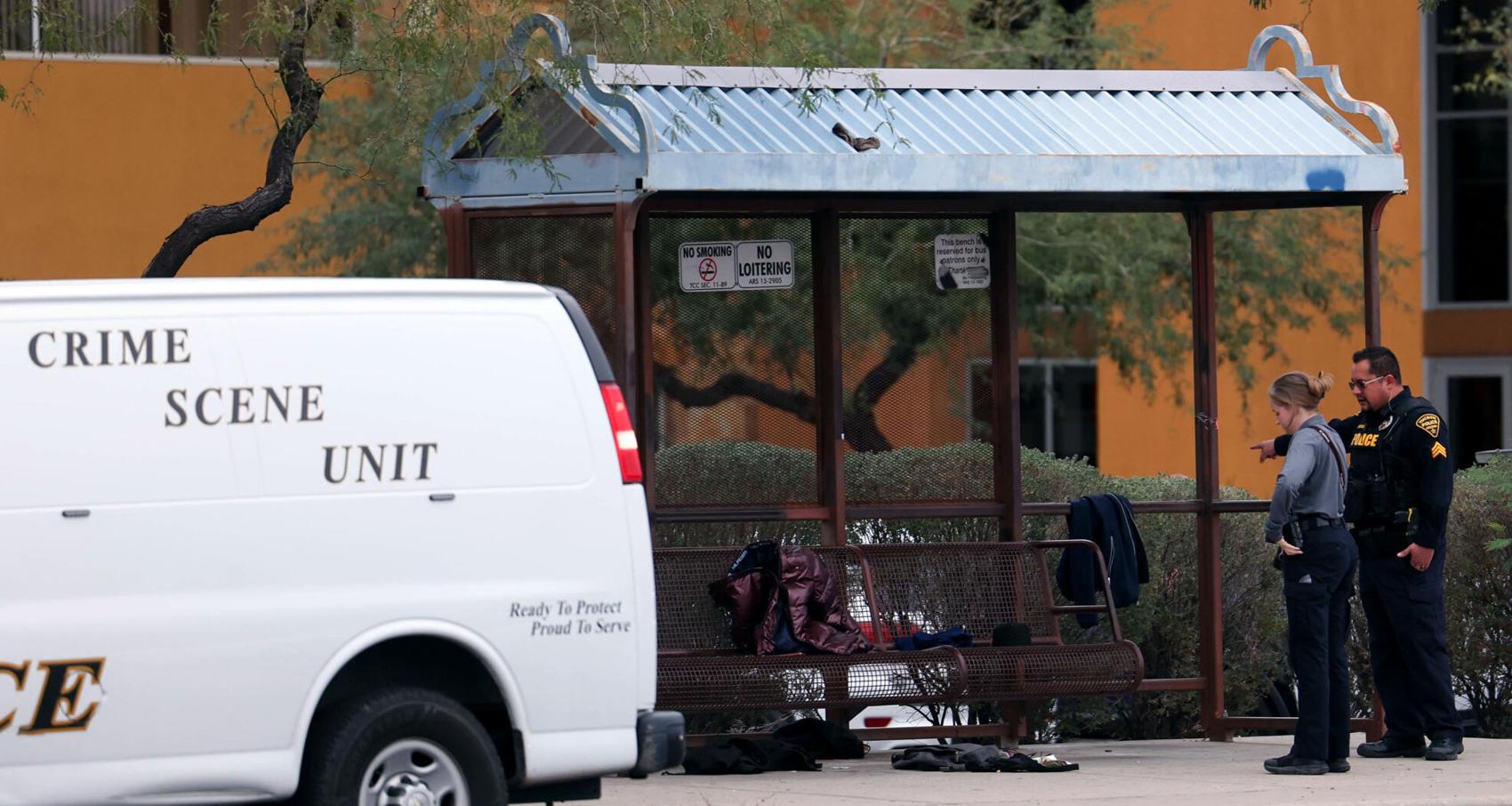
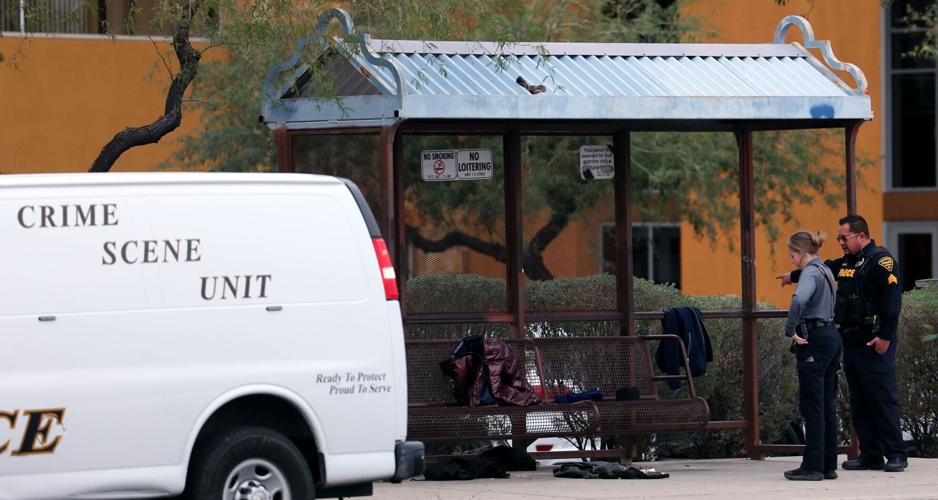
Tucson Police Crime Scene Unit and TPD officers gather at the scene of a stabbing on New Year's Eve. City leaders have released a draft action plan to improve on an ongoing initiative aimed at addressing public safety issues.
Up until last October, when the Safe City Initiative started, Tucson police's Community Outreach, Resource and Engagement (C.O.R.E.) Unit have been able to do about 95 "deflections," assistant chief Schaner said. Since then, the unit has completed 188 deflections, assistant chief Schaner said Thursday.
The deflection program, which began in 2018, is a pre-arrest opportunity to connect individuals to treatment when they are "in possession of personal use narcotics or paraphernalia, or they're involved in a crime that has an underlying substance-use disorder nexus to it," she said.
One pilot program that's started since the introduction of the Safe City Initiative is STAR Village, a safe sleeping site along Grant Road in midtown that opened in October for women and non-binary people.
Before STAR Village opened, there was concern from many nearby residents on the potential for negative impact that could occur. But the year-long pilot has already shown promising results, Morales said.
According to the most recent monthly report received by Primavera Foundation, the site has about 21 people in it at any one point in time, and in January, a total of 26 people were served, but "well over" 75 people served since the year-long pilot program opened in October, she said.
About 7% of those who used STAR have gotten into permanent housing while 4% have been moved into temporary housing.
"We're seeing a real positive impact. We said, when we would go into this neighborhood, we wanted to add value to it," Morales said. "In the very early stages, we are seeing that impact."
An evaluation done by the city of the four months before and after STAR Village's opening showed that the number of "incidents" reported to Tucson police in a one-mile radius around the safe sleeping site dropped by 35%, which tracked with statistics from similar programs that Tucson officials touted when it was announced, Schaner said Thursday.
"We know that those incidents are not related to STAR Village alone. We're just talking about overall crime ... (but) we have seen a reduction in calls for service and incidents in that area," Schaner said. "At the site itself, there has been virtually no criminal impact to us. We've responded to assist with basically a missing person and some resource needs, so very little impact there ... we've had a positive impact on that area."
The goal is to expand STAR Village efforts in the future, but the city will first have to find a dedicated funding source, Morales said, as it's only a pilot program intended to last until October. The hope is to have similar sites in several areas, helping as many people as possible, she said.
Transit, traffic safety a priority
In December, the City Council approved spending $500,000 to fund "phase one" of the plan.
About $350,000 of that allocation, Schaner said, will go toward a "special off-duty program" that will send Tucson police officers to "data-identified corridors" with higher rates of criminal activity, loitering at bus stops or open-air drug use. The remaining $150,000 will for transit infrastructure improvements, she said.
Officers will be able to sign up for those off-duty shifts so as to not take away from on-duty resources or the department's ability to respond to calls, Schaner said.
"We will dedicate two-person units, three days a week for five-hour shifts to be present and engaged in those corridors," she said. "And obviously, enforcement and addressing criminal behavior is one of the things that will be expected, but it will also be (an opportunity) to interact positively with the users of the transit system, to help improve their sense of safety and security and really learn from what we're seeing, and how we can make changes."

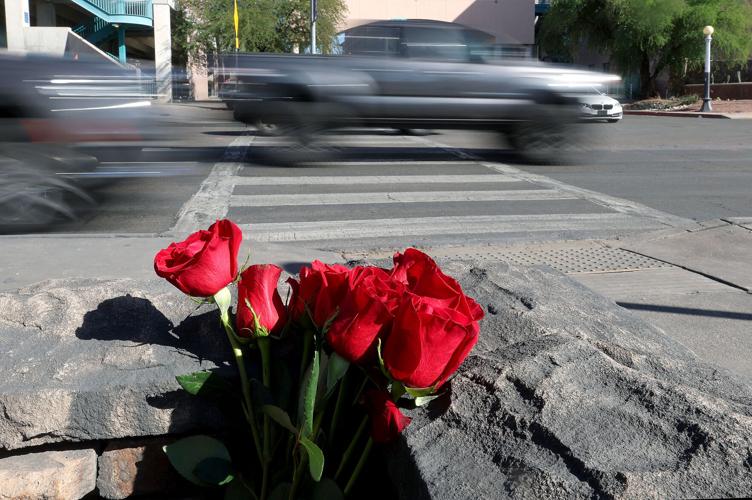
Roses are left at the scene of a crash last October near the University of Arizona campus that killed three students who were struck as they crossed the street. Upgrades at the intersection at North Euclid Avenue and East Second Street are expected to be completed in May.
"It might be adding landscaping or rocks or something that makes it more difficult to loiter, it might be improving lighting systems so that people aren't able to hide what they're doing, and so that users of the transit system feel safer," Schaner said. "We're very appreciative of that investment in these near-term strategies to make a positive environment."
When the Safe City Initiative started in October, "we weren't necessarily" including traffic safety when it comes to pedestrians or cyclists, Morales said, which has been added since.
But that addition is not a "Johnny-come-lately type of thought" the council had, Romero said. She pointed to Proposition 411, which she said the City Council "were very intentional" of allocating 20% of tax revenues going towards pedestrian and bicycle safety improvements.
In November, three University of Arizona students were killed in a hit-and-run at the intersection of North Euclid Avenue and East Second Street. That Prop. 411 share, Romero said, made it possible for improvements at that intersection to be expedited as part of a larger package of projects.
Work on the intersection upgrades began earlier this month, and the city announced that work is expected to be completed by early May. Overall, 60 new signaled crosswalks will be installed by the city "in the next several years."

