




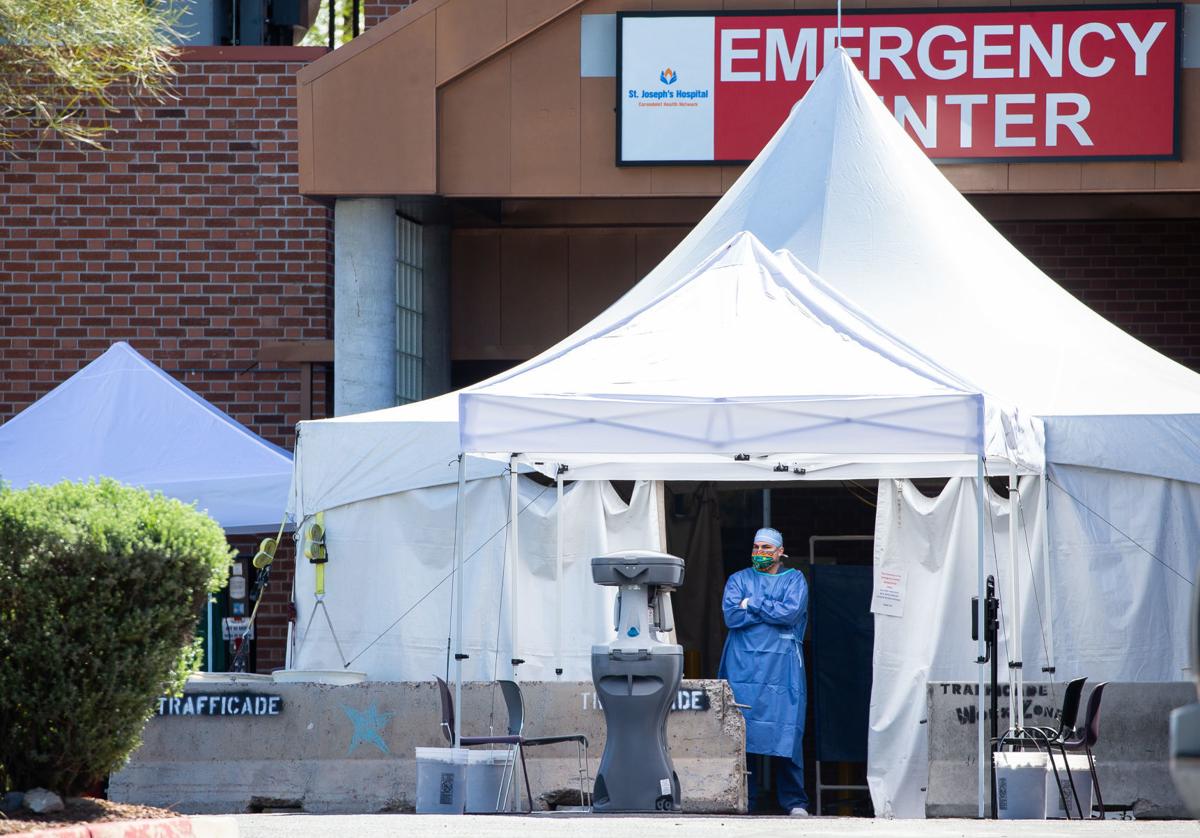
Arizona hospitals appear to have enough beds and ventilators to handle an anticipated surge in COVID-19 patients, new data and analysis shows.
Since Arizona began to see its first infections from the virus that causes COVID-19 in March, the public’s concern has been mostly about whether the state has enough hospital beds and ventilators for patients that might need them.
It’s information that’s been hard to come by until this week, when both the Arizona Department of Health Services and a medical researcher with the University of Arizona’s College of Public Health delivered this promising message: We should be OK.
This is a shift from late March, when Arizona Gov. Doug Ducey ordered the state’s hospitals to come up with plans to increase bed capacity by 50% within the next month, and to have half of those new beds ready by April 10.
Ducey’s executive order came a day after state health director Dr. Cara Christ said the number of hospital beds at the time was unlikely to meet the anticipated need of this first surge, expected to come toward the end of April.
The state at that time also did not know how many ventilators were in circulation because reporting by hospitals was not mandatory. At one point earlier in March, Christ said there were only 172 ventilators known to the state, with 100% of those in use at the time.
Christ announced on Wednesday, April 15, that of the 1,500 ventilators they now know are in Arizona’s hospitals, 75% are available, with COVID-19 patients accounting for 50% of the ones that are currently in use.
This is considerably more reassuring, she said. However, depending on the surge and how many people become seriously ill, more ventilators may still be needed.
Christ said that’s something the state is monitoring regularly.
A new statewide hospital reporting dashboard shows the number of beds available and in use by day, the number of ventilators available and in use by day, and other hospitalization data specific to COVID-19.
With more data available and a better grasp on how the virus is spreading here based on emergency-room visits and hospital admissions, predictions about hospital capacity are also more positive.
Dr. Joe K. Gerald, an associate professor with the UA’s Zuckerman College of Public Health, has been analyzing related data from the Institute for Health Metrics and Evaluation (IMHE) and, in recent days, found Arizona’s bed capacity adequate.
There are a couple of reasons for that, he explains.
“We got off the exponential growth train fairly early,” he said, adding that Arizona’s head start was partly luck, with the outbreak starting later here, and partly due to beginning social distancing in time.
The result, he said, is that Arizona’s surge will likely be more like walking up a hill than ascending a sharp mountain peak.
“I think we’re getting close to the worst of it,” he said, adding that it’s “still important to practice social distancing.”
The IHME estimates Gerald used show that approximately 1,460 beds will be needed during the surge here while there are 6,017 hospital beds available in the state. In addition, there are 508 ICU beds of which 293 are estimated to be needed during Arizona’s peak.
“These projections align reasonably well with our hospitals’ self-reporting of their own utilization and capacity,” Gerald said, referring to data on the state’s health department site.
Based on the data he’s been studying, Gerald predicts hospitalizations will peak here April 26 or 27, although the state’s health agency is predicting it may be closer to the very end of the month.
Will Humble, director of the Arizona Public Health Association, wrote about Gerald’s findings in a blog post Tuesday.
“These models assume that we continue to maintain our social distancing efforts over the coming weeks,” he wrote.
It’s a point Humble emphasized because, according to Gerald’s analysis, the lag between new infections and hospitalizations and ICU admissions means that the pace of these outcomes will increase for the next one to three weeks before slowing.
“Over the next two weeks, hospitals should prepare for a continued increase in admissions until a peak around April 27th,” Humble wrote, “The strain is likely to be greater in critical care settings than general floor beds, but there appears to be adequate capacity to meet demand.”
Christ said the data on inpatient beds and ICU beds shows that over 25% of both ICU beds and inpatient beds statewide are currently available. With the governor’s order for surge capacity factored in, that increases to 40% availability for inpatient beds and up to 50% for ICU beds.
Currently, COVID-19 patients occupy only 15% to 18% of the ICU beds in use statewide and less than 10% of the inpatient beds, she said.
There has also been a “downward trend” in patients with coronavirus-like illness — fever, dry cough, shortness of breath — coming into both emergency rooms and inpatient settings, Christ said.
“This is encouraging data, but it does not indicate that we have stopped the outbreak,” she said. “Everyone needs to remain vigilant about being physically distant.”
Photos for April 11: Tucson gets by during Coronavirus Pandemic
Tucson in photos, coronavirus pandemic
Updated
Susan Hillman chats with her mother Betty Hillman via telephone, April 9, 2020, Tucson, Ariz. Eighty-five year old Betty Hillman is in long term skilled care and Susan is unable to visit due to COVID-19 restrictions on nursing home facilities.
Tucson in photos, coronavirus pandemic
Updated
Susan Hillman chats with her mother Betty Hillman near a photo of Betty and her husband, Susan's dad, Bill, circa 2105, April 9, 2020, Tucson, Ariz. Eighty-five year old Betty Hillman is in long term skilled care and Susan is unable to visit due to COVID-19 restrictions on nursing home facilities.
Tucson in photos, coronavirus pandemic
Updated
Ben Forbes, left, owner of Forbes Meat Company, helps Jeronimo "Mo" Madril, right owner and executive chef of Geronimo's Revenge, wrap up tortilla's for to-go carnitas for Forbes Meat Company and Geronimo's Revenge's "Carnitas for the community" at Thunder Canyon Brewery, 220 E. Broadway Blvd., in Tucson, Ariz., on April 6, 2020. Forbes Meat Company and Geronimo's Revenge partnered to help the restaurant community by offering free carnitas to those affected by the Coronavirus Disease (COVID-19). They will be making to go carnitas every Monday in April starting at 2pm until all the to go packs, roughly 60, are all gone. Forbes wanted to find a way to help out the restaurant community. "They are struggling and my business is exploding," said Forbes.
Tucson in photos, coronavirus pandemic
Updated
David Clark, left, out of work bartender, and Jeronimo "Mo" Madril, owner and executive chef of Geronimo's Revenge, practice social distancing while waiting to give out carnitas for Forbes Meat Company and Geronimo's Revenge's "Carnitas for the community" at Thunder Canyon Brewery, 220 E. Broadway Blvd., in Tucson, Ariz., on April 6, 2020. Forbes Meat Company and Geronimo's Revenge partnered to help the restaurant community by offering free carnitas to those affected by the Coronavirus Disease (COVID-19). They will be making to go carnitas every Monday in April starting at 2pm until all the to go packs, roughly 60, are all gone.
Tucson in photos, coronavirus pandemic
Updated
Steve Tracy, Thunder Canyon Brewery co-owner and brewer, fills up 16oz bottles of locally made hand sanitizer at Thunder Canyon Brewery, 220 E. Broadway Blvd., in Tucson, Ariz., on April 6, 2020. Thunder Canyon Brewery, along with a few other local distilleries, are making United States Food and Drug Administration approved hand sanitizer for hospitals, first responders and the public in response to Coronavirus Disease (COVID-19). "Whatever I have, I am turning into hand sanitizer," said Tracy. "We are going to keep making it as much as we can."
Tucson in photos, coronavirus pandemic
Updated
Steve Tracy, Thunder Canyon Brewery co-owner and brewer, fills up 16oz bottles of locally made hand sanitizer at Thunder Canyon Brewery, 220 E. Broadway Blvd., in Tucson, Ariz., on April 6, 2020. Thunder Canyon Brewery, along with a few other local distilleries, are making United States Food and Drug Administration approved hand sanitizer for hospitals, first responders and the public in response to Coronavirus Disease (COVID-19). "Whatever I have, I am turning into hand sanitizer," said Tracy. "We are going to keep making it as much as we can."
Tucson in photos, coronavirus pandemic
Updated
David Sbarra, a psychology professor at the University of Arizona, points his webcam at his children Margot, 9, and Mateo, 12, as he begins his introduction of his office hours for a class he now conducts over Zoom in his living room while teaching from home, on April 7, 2020.
Tucson in photos, coronavirus pandemic
Updated
Ben Elias, manager at Westbound, center, helps Dustin Schaber with his pickup order on April 8, 2020. Due to the coronavirus disease (COVID-19) only two customers are allowed in the shop, located at the MSA Annex, at the same time and all orders are to-go.
Tucson in photos, coronavirus pandemic
Updated
Laura Tanzer, a local fashion designer, posted on Facebook that she will make masks for $5.00 each on April 5. Tanzer thought she would receive a couple of dozen orders, but, within 24 hours she heard from over 200 people. Tanzer is now working out of her shop in downtown Tucson making masks that also has a filter sowed into them. Tanzer is wearing one of her masks as she sows on April 8, 2020.
Tucson in photos, coronavirus pandemic
Updated
Oro Valley Hospital chief administration officer Erinn Oller talks with Fang, a local organizer with the Chinese-American COVID-19 Relief AZ group, which donated 6,000 masks, on April 9, 2020. Additional mask donations are planned as soon as shipments arrive.
Tucson in photos, coronavirus pandemic
Updated
Healthcare workers line up for their 2 free Sonoran hot dogs and a drink from BK Carne Asada & Hot Dogs in the parking lot of St. Mary's Hospital on April 10, 2020. The owner, Benny Galaz, is giving free food to healthcare workers at Tucson area hospitals for the next several weeks as a way to say thank you for their hard work during the coronavirus disease (COVID-19) outbreak.
Tucson in photos, coronavirus pandemic
Updated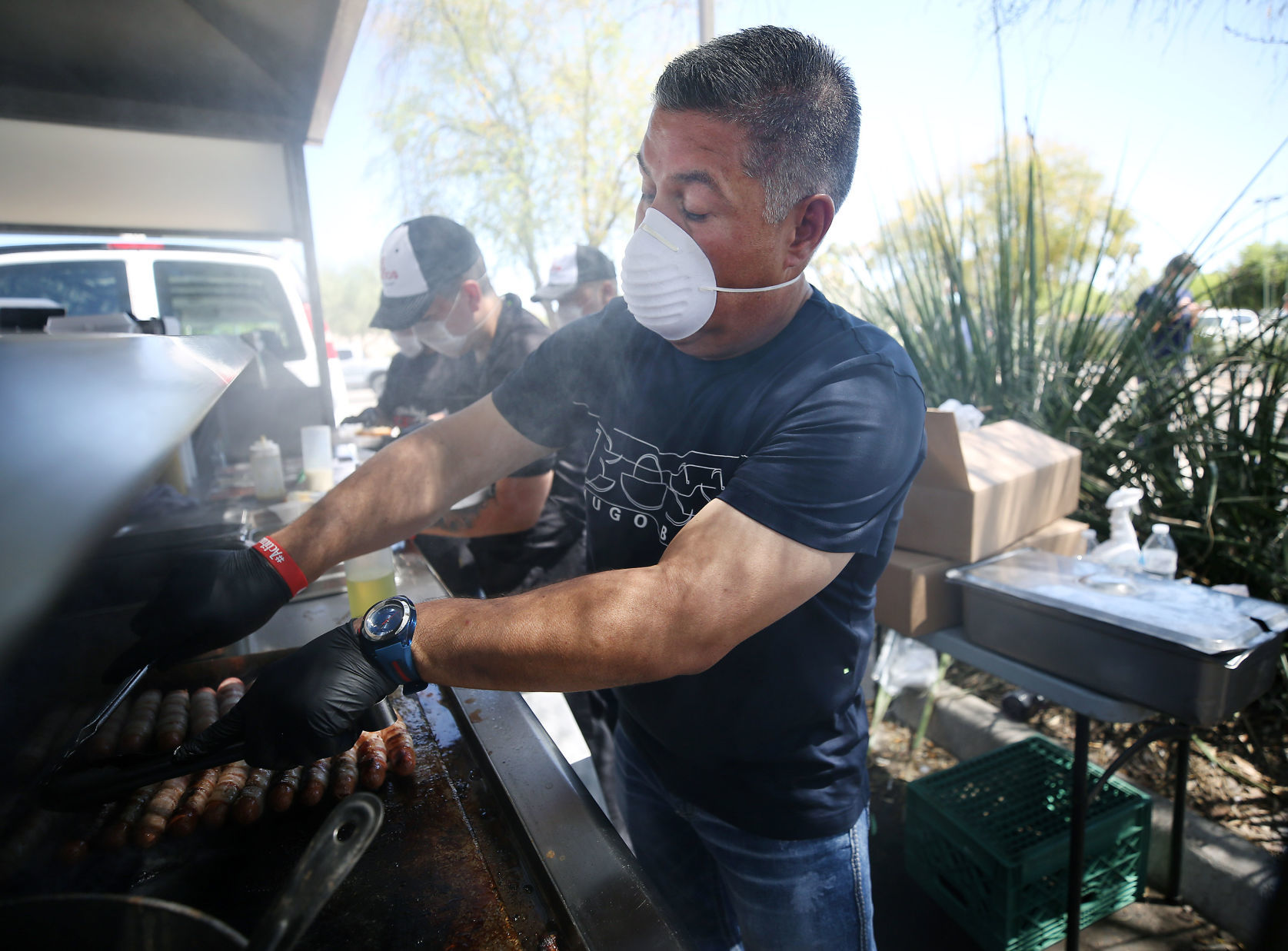
Benny Galaz, owner of BK Carne Asada & Hot Dogs, cooks up Sonoran hot dogs in the parking lot of St. Mary's Hospital on April 10, 2020. Galaz is giving free food to healthcare workers at Tucson area hospitals for the next several weeks as a way to say thank you for their hard work during the coronavirus disease (COVID-19) outbreak.
Tucson in photos, coronavirus pandemic
Updated
Healthcare workers line up for their 2 free Sonoran hot dogs and a drink from BK Carne Asada & Hot Dogs in the parking lot of St. Mary's Hospital on April 10, 2020. The owner, Benny Galaz, is giving free food to healthcare workers at Tucson area hospitals for the next several weeks as a way to say thank you for their hard work during the coronavirus disease (COVID-19) outbreak.
Tucson in photos, coronavirus pandemic
Updated
A man uses the taped off exercise station in Reid Park as an anchor for his band workout, April 8, 2020, Tucson, Ariz.
Tucson in photos, coronavirus pandemic
Updated
Alicia Roseanna, 9, fourth grader at Esperanza Elementary School, grabs a sheet of paper while listening to her teacher, Rachel Watson, and her classmates inside her home in Tucson, Ariz. during Watson's online class on April 7, 2020. Due to the Coronavirus Disease (COVID-19) closing down schools and universities, teachers and students have been forced to schedule and participate in classes online for the remainder of the school year.
Tucson in photos, coronavirus pandemic
Updated
COVID-19 survivor, Glen Reed, poses for a photo looking out from the room he's using for isolation from his family in his home, April 10, 2020, Tucson, Ariz. Reed spent nearly a month in the hospital including weeks in ICU on a ventilator.
Tucson in photos, coronavirus pandemic
Updated
ER and EMS workers run through a drill practicing how to process an incoming patient experiencing a respiratory emergency at the Tucson Medical Center's Emergency Room, on April 10, 2020.
Tucson in photos, coronavirus pandemic
Updated
Tucson Fire Paramedic personnel prepare to run a drill at the Tucson Medical Center's Emergency Room, on April 10, 2020.
Tucson in photos, coronavirus pandemic
Updated
The CDC recommends Americans wear a facial covering when out in public, part of an effort to reduce the spread of the virus that causes COVID-19. Above, shopping for spring blooms at Tucson’s Green Things Nursery.
Tucson in photos, coronavirus pandemic
Updated
Coronavirus disease (COVID-19) signs taped onto dorms at the Babcock Dorms. The rooms located at 1717 E Speedway Boulevard may be used to house hospital workers from Banner - University Medical Center if they need to be quarantined due to COVID-19.
Tucson in photos, coronavirus pandemic
Updated
Alex Swain, a member of Beloved in the Desert - Tucson's chapter of the Episcopal Service Corps, packs the trunk of his housemate's SUV in the parking lot of Fry's on 2480 N Swan Road after grocery shopping for an elderly man, on April 3, 2020. Swain and his housemates have volunteered to shop for elderly and at risk populations as people quarantine and stay at home during the Coronavirus (COVID-19) pandemic.
Tucson in photos, coronavirus pandemic
Updated
Julisa Montano, a bus driver with Sunnyside Unified School District, gathers up the last few meals to hand out to students outside of Gallego Primary School, on April 7, 2020. The school district is distributing meals and has wifi available for students to use for school.
Tucson in photos, coronavirus pandemic
Updated
A table is taped off at Fred Enke Golf Course, 8251 E. Irvington Rd., in Tucson, Ariz., on April 5, 2020 due to Coronavirus Disease (COVID-19). With a rise in the amount of people participating in golf, due to Coronavirus Disease (COVID-19), Tucson City Golf is taking extra measures to keep people safe such as sanitizing golf carts after each use and social distancing.
Tucson in photos, coronavirus pandemic
Updated
Rich DelVecchio, a Fred Enke Golf Course employee, sanitizes a golf cart. Course revenues at Tucson’s city-owned golf properties are up nearly 28% from the same period last year.
Tucson in photos, coronavirus pandemic
Updated
Golfers practice social distancing while on the driving range at Fred Enke Golf Course, 8251 E. Irvington Rd., in Tucson, Ariz., on April 5, 2020. With a rise in the amount of people participating in golf, due to Coronavirus Disease (COVID-19), Tucson City Golf is taking extra measures to keep people safe such as sanitizing golf carts after each use and social distancing.

