




After the coronavirus shuttered Tucson schools and turned traditional classroom instruction upside down, state and local education officials are now tasked with planning for the upcoming school year as the pandemic rages on.
Planning for how and when schools will reopen is a complicated question that hinges on the state’s ability to curb the spread of new cases, the availability of testing and other factors.
Most Tucson school districts said they don’t yet have a contingency plan for next school year, having spent all their time and resources on managing the present crisis of shifting to remote learning in a matter of days with virtually no training or extra financial support. One district, however, is planning for the possibility that the virus will still be prevalent when the new school year is slated to begin.
One consideration by the Vail School District is having students attend on a staggered schedule, trading off in-person instruction and livestreaming classes from home. Such a plan would allow for social distancing if smaller class sizes were required and would also accommodate parents who are nervous about sending their kids back to school, said district spokeswoman Darcy Mentone.
Vail has the technology in place to livestream classes, however, staggering attendance is only an idea at this point and would require state lawmakers changing the way schools are funded, Mentone said. Schools are funded based on in-person enrollment during the first 100 days of the school year.
Southern Arizona’s largest school district, Tucson Unified, has started the conversation about how and when to resume in-person instruction but is still focusing its efforts on finishing the school year.
“Due to the labor-intensive effort of managing the closure of the district and planning for summer school, we have yet to begin planning for fall,” said TUSD Superintendent Gabriel Trujillo.
Because Vail operates on a year-round schedule with students scheduled to return in mid-July — weeks earlier than other local schools, the district has been meeting virtually to determine what the future could hold.
“We’ve just been trying to predict the best we can, and we have no idea if we’re anywhere close,” Mentone said.
What things will look like in July and beyond is a hot topic of discussion, with rapidly updated information and recommendations by scientists and experts that everyone is trying to digest. In other words, how and when to reopen schools and everything else for that matter “is a moving target,” said Dr. Bob England, director of the Pima County Health Department.
He outlines critical things that need to happen before general life can resume: ample testing to gain accurate numbers on infected people; a steep decline in the number of new infections; a system in place for efficient “contact tracing” to identify anyone who may have come in close contact with an infected person; and a hearty health-care system in case of a resurgence, with plenty of personal protective equipment, beds, ventilators and health-care professionals.
“The worst possible thing that could happen is we have paid all this cost and endured as much social disruption as we have and open it up too fast and overwhelm the health-care system — meaning we didn’t get anything out of all this,” England said.
Testing capabilities will likely be readily available in the near future, and the hospitals have done a great job expanding their available capacity, although there is still a shortage of personal protective equipment, he said. But flattening the curve — a steep decline in the number of new infections — isn’t there yet.
Michael Worobey, head of the department of ecology and evolutionary biology at the UA, said that without contact tracing and communitywide testing, it’s premature to assume that things will be back to normal in the fall.
“If we could get on top of these things we need to get on top of, that’s the only way that we can think about being able to open schools,” he said.
Arizona schools chief Kathy Hoffman is having discussions with stakeholders, including the Department of Health Services and the Arizona School Nurse Association, about how and when schools can resume in-person instruction, asking for recommendations on policies, procedures and proper equipment for ensuring students, teachers and staff workers can safely return.
“What I’m hearing from educators is they’re very fearful of returning if there’s still a spread of COVID-19,” she said. “They’re worried about putting their own lives at risk, or putting their families’ lives at risk, and we need to be very clear about how schools should be keeping everyone safe or else educators will not feel comfortable returning to teaching.”
She said stakeholders are in the beginning stages of deciding what type of professional development educators need to follow best safety practices, what kinds of resources are needed in school health offices and what additional accommodations will be required in classrooms with students who have medically complex needs.
The Department of Education will continue to meet with health-care professionals to put together recommendations and training for schools to be prepared for when they do reopen. The department will be drafting guidance over the coming weeks to incorporate into a bigger plan on how to safely reopen schools, which Hoffman hopes to have ready by the end of this school year.

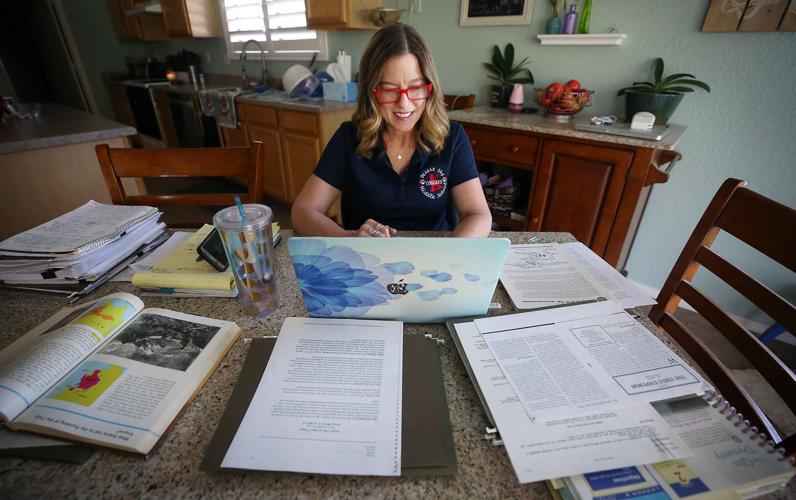
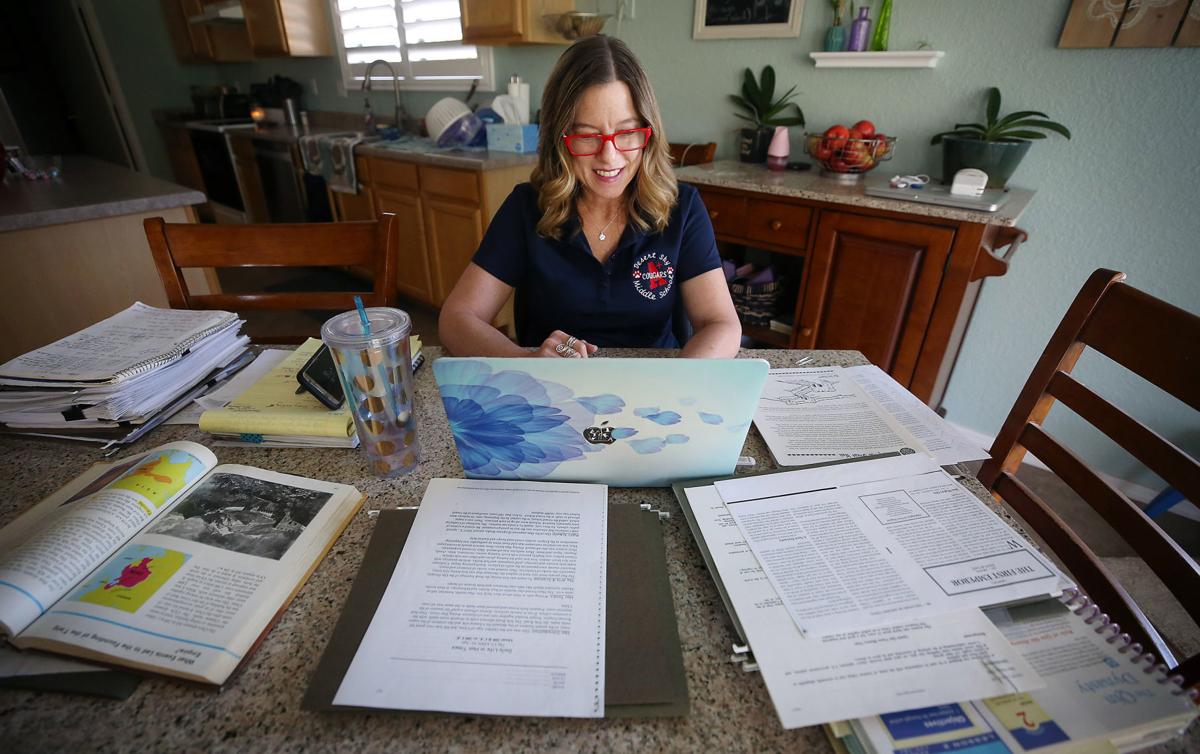
Hall adorned her vehicle with a message and the names of her students when she participated in a car parade to say hello to the students.
IMMEDIATE NEEDS
Whether and in what capacity schools will have summer classes, camps and programs is even more pressing than plans for next school year because of the time factor, Hoffman said. Many districts across the state, including TUSD, are already planning to do online summer school.
The Department of Education is working closely with the Governor’s Office and Health Department to quickly offer the guidance schools are asking for.
Like TUSD, Vail officials said it’s unlikely, with the current state of the pandemic, that they’ll be able to offer in-person summer school, Mentone said.
“We’re actually getting really good at this Zoom instruction. So just to be on the safe side, we would most likely offer it through this same format that we’re using now,” she said.
Tucson’s second-largest school district, Sunnyside, intends to have summer school but doesn’t know what that will look like until it gets guidance from the state, said spokeswoman Marisela Felix.
The Tanque Verde Unified School District will provide online summer school options for its high school and will discuss options for K-8 summer school at an administrators meeting on Tuesday.
Flowing Wells will offer summer school to its high schoolers through its digital campus. The district is operating under the assumption that it will not offer normal, in-person summer programs, which include instruction in literacy, science and physical education that prepares pre-K through eighth-grade students for school instruction, said Superintendent David Baker.
“As we get more guidance on social distancing, if we can bring smaller groups of kids back on campus, we will look for opportunities to bring those programs back,” he said. “We are planning for summer; we just don’t know if we’ll be able to bring 100 kids back on campus or if it has to be limited to 10.”
A GRADUAL RETURN
Although information about how the coronavirus impacts children is somewhat limited, data suggest they may only have mild symptoms but can still pass it on to others, according to the Centers for Disease Control and Prevention.
England, with the Pima County Health Department, said if data show that younger children are the least susceptible, it could be safest to open elementary schools before reopening high schools.
This could be beneficial because in many ways remote instruction is harder for younger children. It necessitates working parents to find child care, and digital inequity may be greater in the lower grades because students are less likely to have a school-issued laptop. Many local districts, including Flowing Wells, Sunnyside and Vail, issue computers to older students but not typically to those in the lowest grades.
England said it’s plausible schools could resume in August if all the critical measures he outlined are in place. He said reopening society has to be gradual — not all at once and not too soon because of political pressure.
“I’m afraid we do it too fast and we’re back where we started from, probably worse because we’ll be starting from a much higher level of infection then we were when we started this whole thing, and that would be a real shame,” he said. “Boy, if we squander all the heartache that has been going on as we tried to control this over the last couple of months here and wind up not having gotten any real benefit, that’ll be awful.”
Photos for April 11: Tucson gets by during Coronavirus Pandemic
Tucson in photos, coronavirus pandemic
Updated
Susan Hillman chats with her mother Betty Hillman via telephone, April 9, 2020, Tucson, Ariz. Eighty-five year old Betty Hillman is in long term skilled care and Susan is unable to visit due to COVID-19 restrictions on nursing home facilities.
Tucson in photos, coronavirus pandemic
Updated
Susan Hillman chats with her mother Betty Hillman near a photo of Betty and her husband, Susan's dad, Bill, circa 2105, April 9, 2020, Tucson, Ariz. Eighty-five year old Betty Hillman is in long term skilled care and Susan is unable to visit due to COVID-19 restrictions on nursing home facilities.
Tucson in photos, coronavirus pandemic
Updated
Ben Forbes, left, owner of Forbes Meat Company, helps Jeronimo "Mo" Madril, right owner and executive chef of Geronimo's Revenge, wrap up tortilla's for to-go carnitas for Forbes Meat Company and Geronimo's Revenge's "Carnitas for the community" at Thunder Canyon Brewery, 220 E. Broadway Blvd., in Tucson, Ariz., on April 6, 2020. Forbes Meat Company and Geronimo's Revenge partnered to help the restaurant community by offering free carnitas to those affected by the Coronavirus Disease (COVID-19). They will be making to go carnitas every Monday in April starting at 2pm until all the to go packs, roughly 60, are all gone. Forbes wanted to find a way to help out the restaurant community. "They are struggling and my business is exploding," said Forbes.
Tucson in photos, coronavirus pandemic
Updated
David Clark, left, out of work bartender, and Jeronimo "Mo" Madril, owner and executive chef of Geronimo's Revenge, practice social distancing while waiting to give out carnitas for Forbes Meat Company and Geronimo's Revenge's "Carnitas for the community" at Thunder Canyon Brewery, 220 E. Broadway Blvd., in Tucson, Ariz., on April 6, 2020. Forbes Meat Company and Geronimo's Revenge partnered to help the restaurant community by offering free carnitas to those affected by the Coronavirus Disease (COVID-19). They will be making to go carnitas every Monday in April starting at 2pm until all the to go packs, roughly 60, are all gone.
Tucson in photos, coronavirus pandemic
Updated
Steve Tracy, Thunder Canyon Brewery co-owner and brewer, fills up 16oz bottles of locally made hand sanitizer at Thunder Canyon Brewery, 220 E. Broadway Blvd., in Tucson, Ariz., on April 6, 2020. Thunder Canyon Brewery, along with a few other local distilleries, are making United States Food and Drug Administration approved hand sanitizer for hospitals, first responders and the public in response to Coronavirus Disease (COVID-19). "Whatever I have, I am turning into hand sanitizer," said Tracy. "We are going to keep making it as much as we can."
Tucson in photos, coronavirus pandemic
Updated
Steve Tracy, Thunder Canyon Brewery co-owner and brewer, fills up 16oz bottles of locally made hand sanitizer at Thunder Canyon Brewery, 220 E. Broadway Blvd., in Tucson, Ariz., on April 6, 2020. Thunder Canyon Brewery, along with a few other local distilleries, are making United States Food and Drug Administration approved hand sanitizer for hospitals, first responders and the public in response to Coronavirus Disease (COVID-19). "Whatever I have, I am turning into hand sanitizer," said Tracy. "We are going to keep making it as much as we can."
Tucson in photos, coronavirus pandemic
Updated
David Sbarra, a psychology professor at the University of Arizona, points his webcam at his children Margot, 9, and Mateo, 12, as he begins his introduction of his office hours for a class he now conducts over Zoom in his living room while teaching from home, on April 7, 2020.
Tucson in photos, coronavirus pandemic
Updated
Ben Elias, manager at Westbound, center, helps Dustin Schaber with his pickup order on April 8, 2020. Due to the coronavirus disease (COVID-19) only two customers are allowed in the shop, located at the MSA Annex, at the same time and all orders are to-go.
Tucson in photos, coronavirus pandemic
Updated
Laura Tanzer, a local fashion designer, posted on Facebook that she will make masks for $5.00 each on April 5. Tanzer thought she would receive a couple of dozen orders, but, within 24 hours she heard from over 200 people. Tanzer is now working out of her shop in downtown Tucson making masks that also has a filter sowed into them. Tanzer is wearing one of her masks as she sows on April 8, 2020.
Tucson in photos, coronavirus pandemic
Updated
Oro Valley Hospital chief administration officer Erinn Oller talks with Fang, a local organizer with the Chinese-American COVID-19 Relief AZ group, which donated 6,000 masks, on April 9, 2020. Additional mask donations are planned as soon as shipments arrive.
Tucson in photos, coronavirus pandemic
Updated
Healthcare workers line up for their 2 free Sonoran hot dogs and a drink from BK Carne Asada & Hot Dogs in the parking lot of St. Mary's Hospital on April 10, 2020. The owner, Benny Galaz, is giving free food to healthcare workers at Tucson area hospitals for the next several weeks as a way to say thank you for their hard work during the coronavirus disease (COVID-19) outbreak.
Tucson in photos, coronavirus pandemic
Updated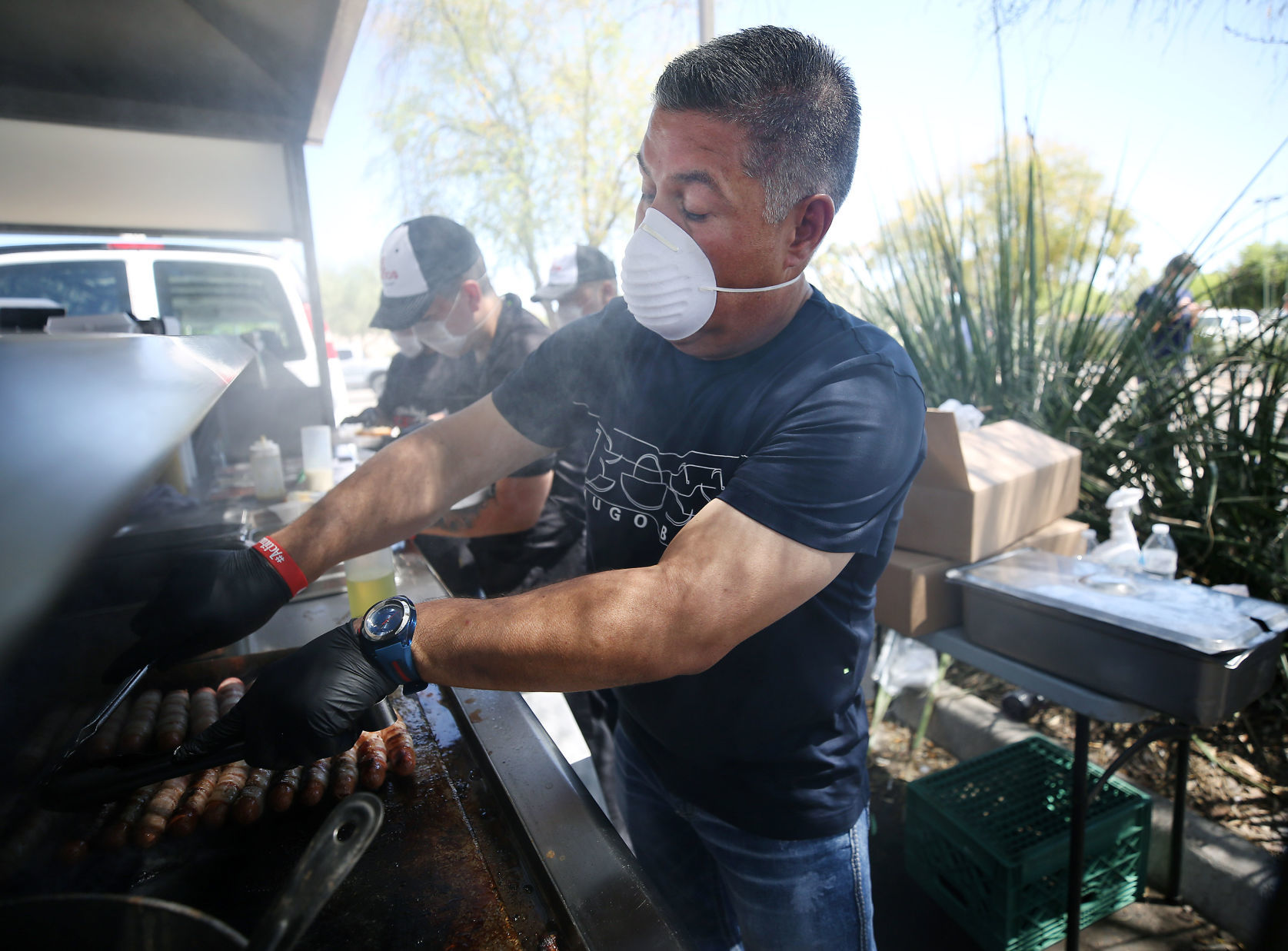
Benny Galaz, owner of BK Carne Asada & Hot Dogs, cooks up Sonoran hot dogs in the parking lot of St. Mary's Hospital on April 10, 2020. Galaz is giving free food to healthcare workers at Tucson area hospitals for the next several weeks as a way to say thank you for their hard work during the coronavirus disease (COVID-19) outbreak.
Tucson in photos, coronavirus pandemic
Updated
Healthcare workers line up for their 2 free Sonoran hot dogs and a drink from BK Carne Asada & Hot Dogs in the parking lot of St. Mary's Hospital on April 10, 2020. The owner, Benny Galaz, is giving free food to healthcare workers at Tucson area hospitals for the next several weeks as a way to say thank you for their hard work during the coronavirus disease (COVID-19) outbreak.
Tucson in photos, coronavirus pandemic
Updated
A man uses the taped off exercise station in Reid Park as an anchor for his band workout, April 8, 2020, Tucson, Ariz.
Tucson in photos, coronavirus pandemic
Updated
Alicia Roseanna, 9, fourth grader at Esperanza Elementary School, grabs a sheet of paper while listening to her teacher, Rachel Watson, and her classmates inside her home in Tucson, Ariz. during Watson's online class on April 7, 2020. Due to the Coronavirus Disease (COVID-19) closing down schools and universities, teachers and students have been forced to schedule and participate in classes online for the remainder of the school year.
Tucson in photos, coronavirus pandemic
Updated
COVID-19 survivor, Glen Reed, poses for a photo looking out from the room he's using for isolation from his family in his home, April 10, 2020, Tucson, Ariz. Reed spent nearly a month in the hospital including weeks in ICU on a ventilator.
Tucson in photos, coronavirus pandemic
Updated
ER and EMS workers run through a drill practicing how to process an incoming patient experiencing a respiratory emergency at the Tucson Medical Center's Emergency Room, on April 10, 2020.
Tucson in photos, coronavirus pandemic
Updated
Tucson Fire Paramedic personnel prepare to run a drill at the Tucson Medical Center's Emergency Room, on April 10, 2020.
Tucson in photos, coronavirus pandemic
Updated
The CDC recommends Americans wear a facial covering when out in public, part of an effort to reduce the spread of the virus that causes COVID-19. Above, shopping for spring blooms at Tucson’s Green Things Nursery.
Tucson in photos, coronavirus pandemic
Updated
Coronavirus disease (COVID-19) signs taped onto dorms at the Babcock Dorms. The rooms located at 1717 E Speedway Boulevard may be used to house hospital workers from Banner - University Medical Center if they need to be quarantined due to COVID-19.
Tucson in photos, coronavirus pandemic
Updated
Alex Swain, a member of Beloved in the Desert - Tucson's chapter of the Episcopal Service Corps, packs the trunk of his housemate's SUV in the parking lot of Fry's on 2480 N Swan Road after grocery shopping for an elderly man, on April 3, 2020. Swain and his housemates have volunteered to shop for elderly and at risk populations as people quarantine and stay at home during the Coronavirus (COVID-19) pandemic.
Tucson in photos, coronavirus pandemic
Updated
Julisa Montano, a bus driver with Sunnyside Unified School District, gathers up the last few meals to hand out to students outside of Gallego Primary School, on April 7, 2020. The school district is distributing meals and has wifi available for students to use for school.
Tucson in photos, coronavirus pandemic
Updated
A table is taped off at Fred Enke Golf Course, 8251 E. Irvington Rd., in Tucson, Ariz., on April 5, 2020 due to Coronavirus Disease (COVID-19). With a rise in the amount of people participating in golf, due to Coronavirus Disease (COVID-19), Tucson City Golf is taking extra measures to keep people safe such as sanitizing golf carts after each use and social distancing.
Tucson in photos, coronavirus pandemic
Updated
Rich DelVecchio, a Fred Enke Golf Course employee, sanitizes a golf cart. Course revenues at Tucson’s city-owned golf properties are up nearly 28% from the same period last year.
Tucson in photos, coronavirus pandemic
Updated
Golfers practice social distancing while on the driving range at Fred Enke Golf Course, 8251 E. Irvington Rd., in Tucson, Ariz., on April 5, 2020. With a rise in the amount of people participating in golf, due to Coronavirus Disease (COVID-19), Tucson City Golf is taking extra measures to keep people safe such as sanitizing golf carts after each use and social distancing.

