

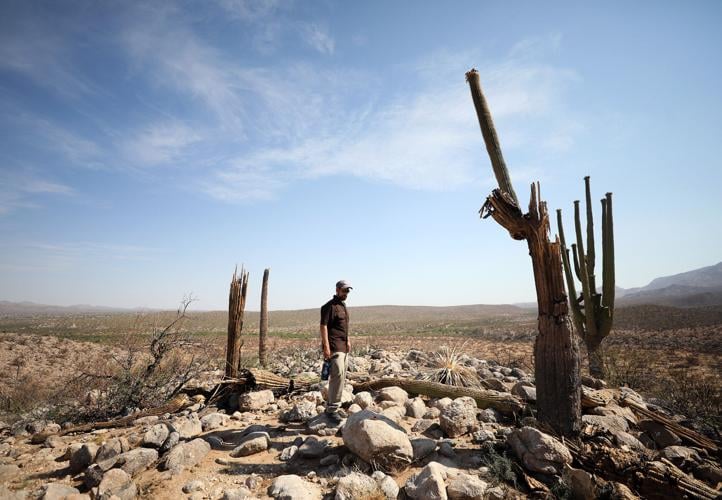

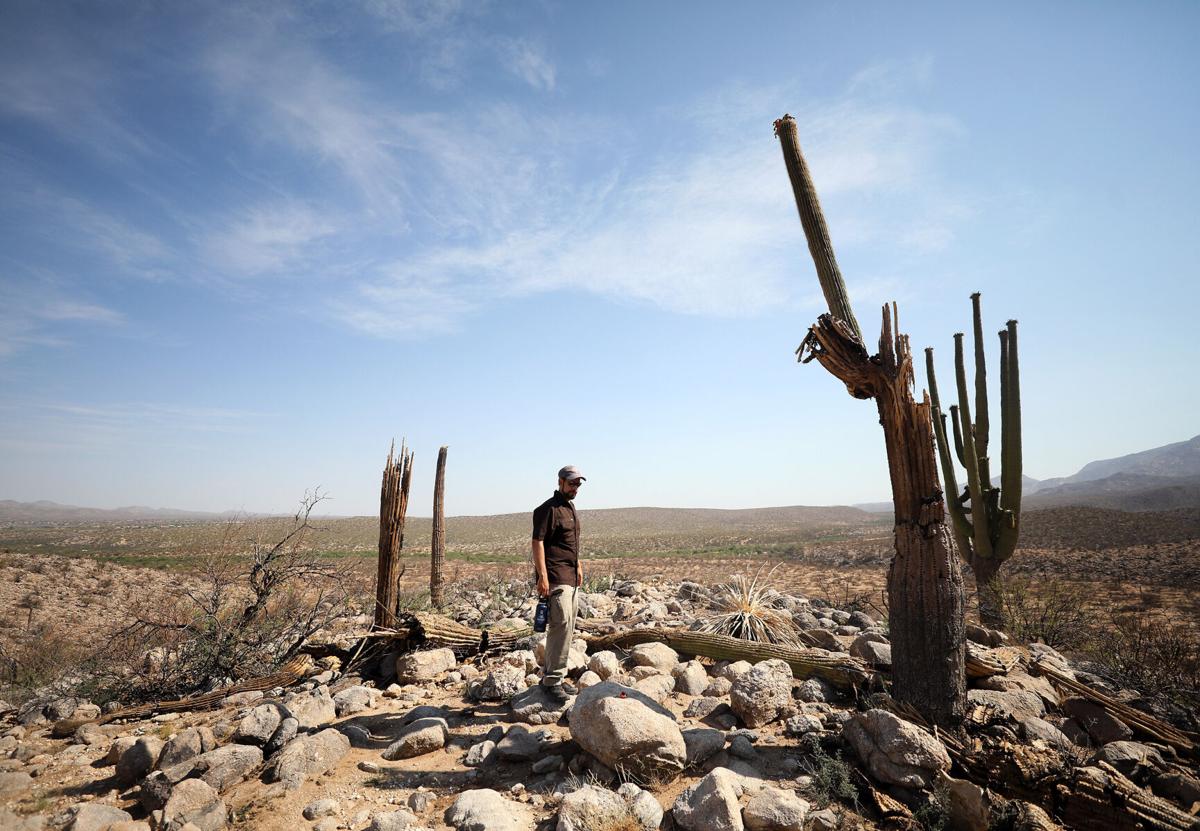
On a rocky foothill about a mile from the main road at Catalina State Park, desert ecologist Ben Wilder steps carefully around fresh signs of life in a scorched landscape.
Tiny green shoots of fairy duster dot the ground amid the charred skeletons of mesquites, prickly pears and palo verdes. Some of the burned trees were sawed down by firefighters one year ago last week to slow the spread of the Bighorn Fire.
It’s 8 a.m. Wednesday and already pushing 100 degrees as Wilder hikes to one of 20 new scientific plots set up in the 5,500-acre park to measure the effects of the fire.
Researchers hope to determine what kinds of vegetation fueled the flames and which plants will grow back — or move in — to replace the ones that burned.
One year after the Bighorn Fire, the scars are still easy to see at Catalina State Park, but so are the signs of recovery. Video by Henry Brean/Arizona Daily Star
“The biggest overall question is, how does the desert respond to fire?” says Wilder, director of the University of Arizona’s Desert Laboratory on Tumamoc Hill. “We have really little data about that, because (desert fires) have been such rare events. I don’t really know what to predict, to be honest.”
The vegetation plots were set up last fall, under the direction of ecologist and recent UA graduate Maya Stahl.
Ten of the 50-by-50-foot squares were staked out in patches of desert and grassland burned by the fire. The other 10 were placed nearby, in similar habitat types untouched by the flames.
This summer, the research team plans to install automated sensors at each site to measure temperature, soil moisture and solar intensity.

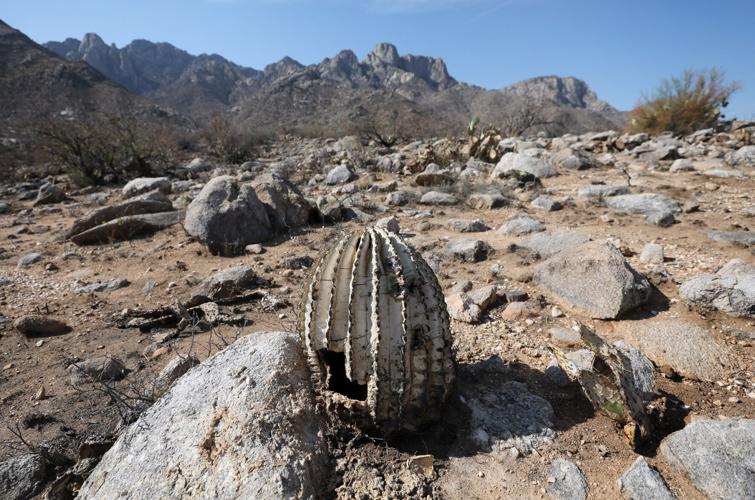
A burned barrel cactus sits in the 50-by-50-foot study plot set up by Ben Wilder in Catalina State Park.
Then, sometime after monsoon season, they will conduct their first detailed annual survey to count every plant, catalog every species and determine how much of the ground is covered by new growth.
Wilder says they will continue to check on the plots periodically after that, hopefully for decades to come.
“We have to know what’s going on, because this (fire) is likely not a one-off event,” he says.
‘Pretty shocking’
Almost a third of Catalina State Park burned in the lightning-sparked Bighorn Fire, which torched part of a mesquite forest and swept across hillsides speckled with saguaros.
The scars are still obvious a year later, but park manager Steven Haas also sees encouraging signs of the recovery to come.
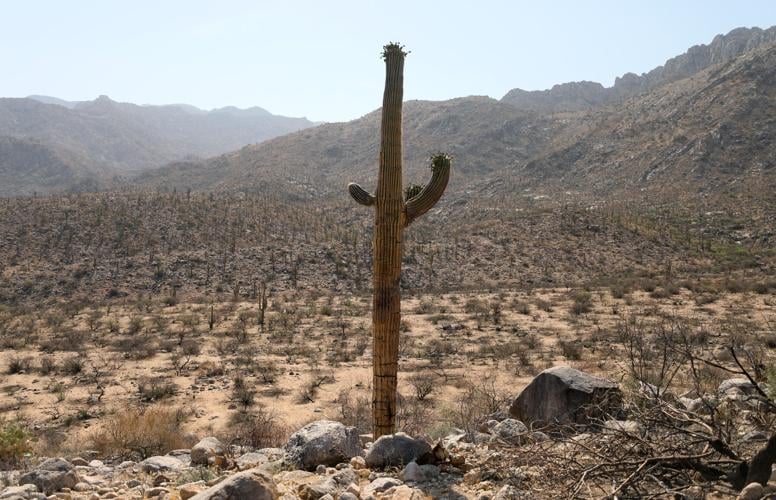
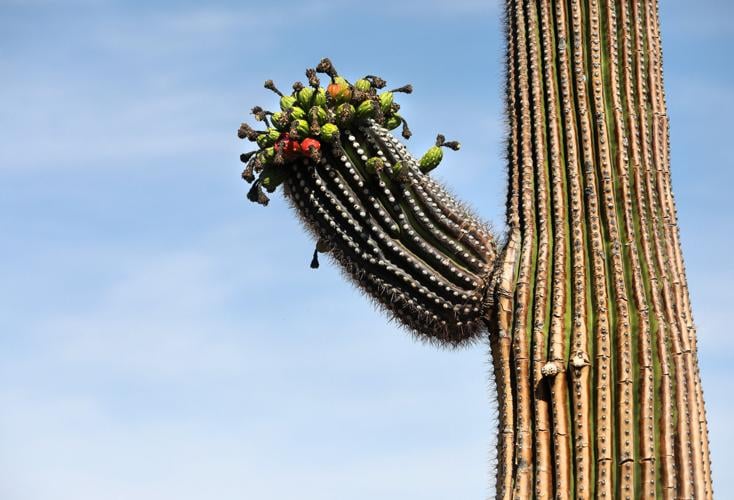
Along the park’s Birding Trail, bright green suckers grow from the bottoms of blackened mesquites and catclaw acacias. “And some of these saguaros I thought were dead or burned pretty badly are now producing flowers” and fruit, Haas says.
Wilder says it’s “pretty shocking” to see such resiliency, at least so far, from a desert landscape thought to be poorly equipped to survive large-scale fires.
He stops to point out a fishhook barrel cactus he says is “very much alive,” despite its brown, fire-scarred skin. Only the very top of the three-foot cactus is still green, but it continues to produce nectar from tiny red bumps to attract the ants it relies on to control more damaging insects.
Other nearby barrels weren’t so lucky. Those closest to the flames got hot enough to boil their insides, causing them to explode. All that remains a year later are dried husks with holes punched through the sides.

But just a few feet away, native shrubs Wilder thought would be wiped out by the blaze are rebounding instead in unexpectedly high numbers. In some plots, he says, as much as 90% of the limber bush is already growing back.
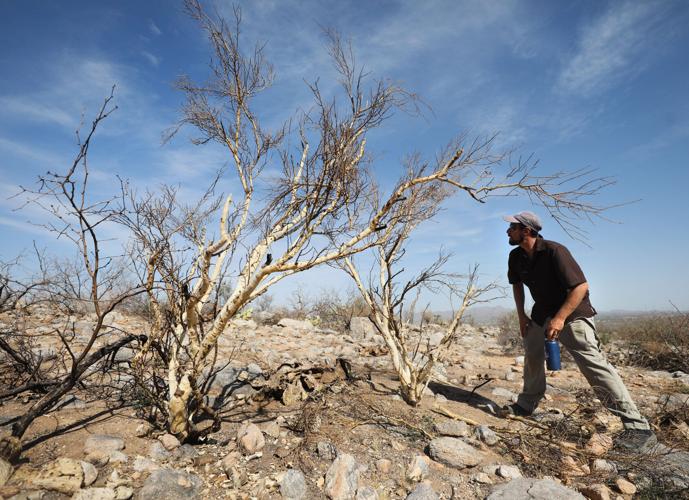
Even some of the charred palo verdes have begun to re-sprout in their signature spring green.
Weeds and weather
All of this is happening despite one of the hottest, driest stretches of weather ever recorded in Southern Arizona.
“Everything has just been made extra challenging because there has been almost no rain since the fire,” Wilder says. “This is kind of the extreme of the extreme. Hopefully, it doesn’t get worse for these species.”
But it very well could.
The concern among Wilder and others is that once-rare wildfires are becoming a new regime in the Sonoran Desert, as climate change brings rising temperatures and more frequent droughts to a landscape increasingly plagued by invasive weeds like red brome and buffelgrass.
The explosion of buffelgrass in the Catalinas is especially worrisome because the savanna grass from Asia and Africa doesn’t just help fires spread but readily expands into areas scorched by the flames.
Left unchecked, Wilder says, the plant could one day form an unbroken carpet of fuel that not only jeopardizes entire groves of saguaros but allows high-mountain fires to race down into the foothills and lower-elevation fires to climb their way to the summit.
Fire-adapted grass- and shrublands can survive — even thrive — under such conditions. Tucson’s iconic saguaro and palo verde ecosystem might not, Wilder says.
“How much stress can these desert species take? I don’t think they can take multiple fires,” he says.

Ben Wilder, director of the University of Arizona’s Desert Laboratory on Tumamoc Hill, takes a closer look at a palo verde tree that died as a result of the Bighorn Wildfire that burned nearly a third of Catalina State Park.
Lucky firebreak
So why didn’t buffelgrass play a bigger role in the Bighorn Fire?
Dumb luck mostly, according to Jim Malusa, research scientist with the UA School of Natural Resources and the Environment.
After the fire, he, Wilder and others hiked through the lower reaches of the Catalinas to assess the damage. What they discovered — and later documented with 12 fellow researchers in a wide-ranging paper now undergoing scientific review — was a surprising combination of factors that kept the flames away from some of the biggest patches of buffelgrass in Pima Canyon and elsewhere.
“There was enough buffelgrass to make a catastrophic fire, but it never happened,” Malusa says. “It did burn some, but the role of the buffelgrass was very limited.”
The reason: When the fire reached those areas, it was largely burning downhill with little to no wind driving it, so even small breaks in the buffelgrass — a hiking trail or a narrow path tamped down by wildlife — were enough to stop the flames from advancing.
“The next time we might not be so lucky,” Malusa says.
That hints at a possible management strategy: Perhaps some future fire could be stopped in its tracks with a few, well-maintained firebreaks through the worst of the grass. They don’t even have to be very big, Malusa says. “I’m not talking about running a bulldozer over the mountain.”
Buffelgrass is already so widespread that some experts have surrendered hope of ever eliminating it completely from the Catalinas. Wilder, though, thinks $10 million could go a long way toward seriously reducing its threat.

Despite burns from the Bighorn Fire last year, fruit bristles from the arm of a saguaro cactus in Catalina State Park.
If that seems like a lot of money, he says, consider the cost to replace a dozen or so mansions built high in the foothills, right at the wildland’s grassy edge.
“The big takeaway is: The Bighorn Fire was a near miss. A near miss, but a troubling forecast,” Wilder says.
Just add water
Catalina State Park doesn’t have much of a buffelgrass problem, at least not yet, but other invaders can be found there.
During Wednesday’s hike to the vegetation plots, Wilder points out numerous patches of red brome poking up through the native grasses. So far, though, the fire-friendly weed from Europe hasn’t managed to overrun the burn area.
That’s something researchers hope to learn more about as they track the changes to their study plots over the next few years and beyond: After a fire, what comes back, what gets replaced and how long does the process take?
With any luck, Wilder says, the monsoon should provide them with their first set of answers in the coming months.
“What it looks like when we add water, hopefully this summer, will be really telling,” he says. “Just add water and let’s see.”
A look back at the Bighorn Fire in photos
Bighorn Fire in the Santa Catalina Mountains, 2020
Updated
A DC-10 air tanker or VLAT (Very Large Air Tanker) dumps thousands of gallons of retardant on the Bighorn Fire burning along Pusch Ridge in Coronado National Forest east of Rams Canyon subdivision on June 6, 2020.
Bighorn Fire - Arizona
Updated
A Chinook heavy lift helicopter passes smoke from the Bighorn Fire burning along Pusch Ridge in Coronado National Forest north of Tucson on June 6, 2020.
Bighorn Fire in the Santa Catalina Mountains, 2020
Updated
Smoke from the Bighorn Fire shrouds granite formations of Pusch Ridge in Coronado National Forest north of Tucson on June 6, 2020.
Bighorn Fire - Arizona
Updated
People watch the aerial ballet of helicopters and air tankers on the Bighorn Fire from the safety of Oro Valley Marketplace on June 7, 2020.
Bighorn Fire - Arizona
Updated
A DC-10 air tanker spreads a line of retardant high atop Pusch Ridge as fire managers tried in vain to keep the the Bighorn Fire confined to the West end of the Santa Catalina Mountains in Coronado National Forest north of Tucson on June 6, 2020.
Bighorn Fire - Arizona
Updated
The Bighorn Fire burning above Catalina State Park in the Santa Catalina Mountains in Coronado National Forest north of Tucson on June 7, 2020.
Bighorn Fire - Arizona
Updated
Dark smoke from the Bighorn Fire in the upper elevations of Pima Canyon obscures the rising sun above the Santa Catalina Mountains in Coronado National Forest north of Tucson on June 9, 2020.
Bighorn Fire in the Santa Catalina Mountains, 2020
Updated
A helicopter dips into Rose Canyon Lake for water while fighting the Bighorn Fire still burning in the west end fo the Santa Catalina Mountains on June 9, 2020.
Bighorn Fire - Arizona
Updated
The Bighorn Fire consumes thick vegetation in crags above Pima Canyon within the Santa Catalina Mountains in Coronado National Forest north of Tucson on June 9, 2020.
Bighorn Fire in the Santa Catalina Mountains, 2020
Updated
A Chinook helicopter drops a load of water on the Bighorn Fire as is moves into the top of Finger Rock Canyon and up Mount Kimball, on June 10, 2020.
Bighorn Fire in the Santa Catalina Mountains, 2020
Updated
The Bighorn Fire burns up into juniper, mesquite and heavier fuel as it approaches Mt. Kimball in the Santa Catalina Mountains, Tucson, Ariz., June 10, 2020.
Bighorn Fire - Arizona
Updated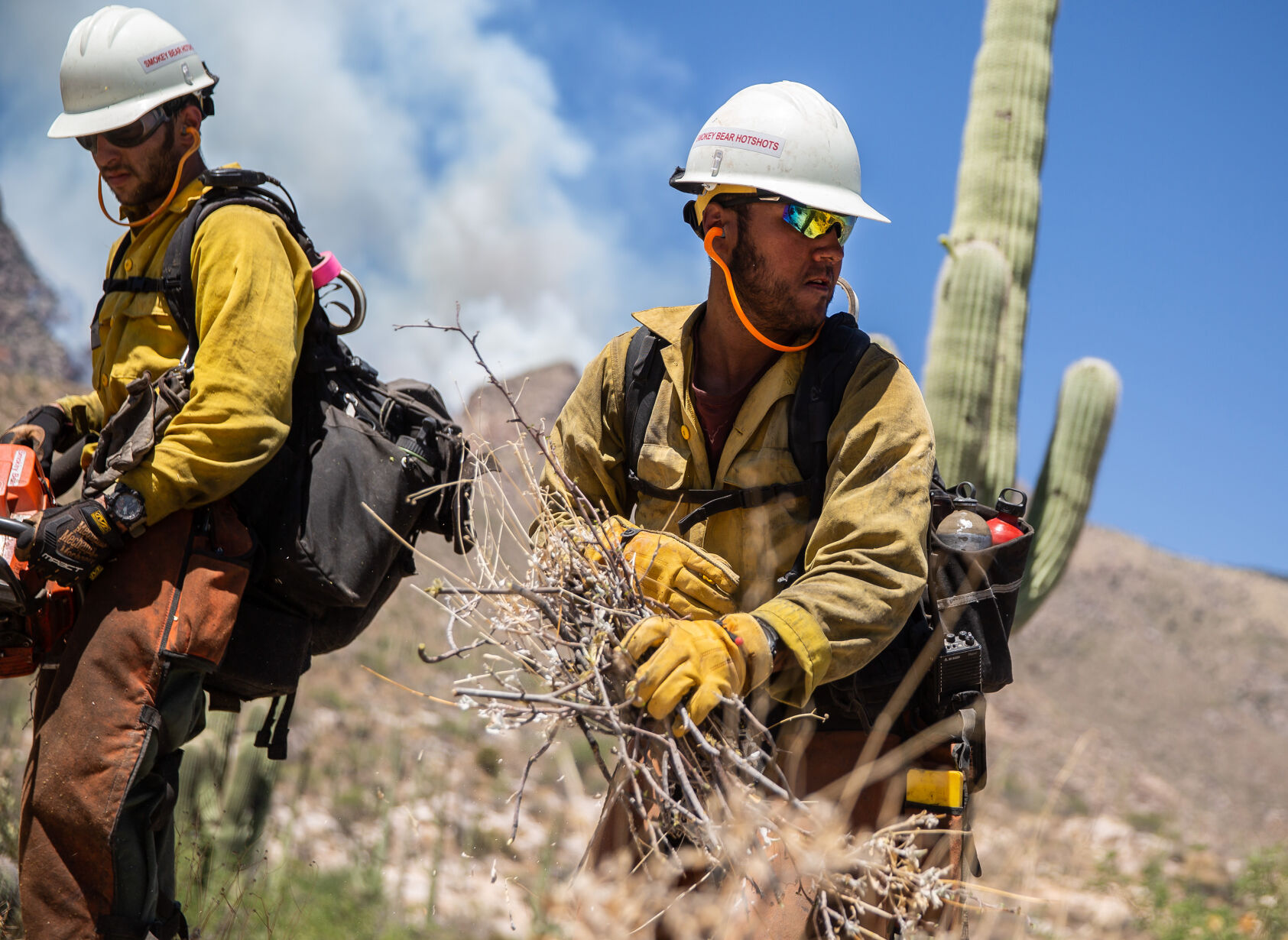
Adam Hutton with the Smokey Bear Hotshots of Ruidoso, New Mexico tosses away brush being cut near the mouth of Finger Rock Canyon as a precaution against the growing Bighorn Fire being fought in the Santa Catalina Mountain Range, on June 10, 2020.
Bighorn Fire in the Santa Catalina Mountains, 2020
Updated
The Bighorn Fire breaks onto the southern slopes of the Santa Catalina Mountains and burns over a pair of homes in the foothills just west of the Finger Rock Trailhead, Tucson, Ariz., June 10, 2020.
Bighorn Fire - Arizona
Updated
The Bighorn Fire churns through brush, creating a smoky mess in Pima Canyon and Finger Rock Canyon in the Santa Catalina Mountains north of Tucson on June 11, 2020.
Bighorn Fire in the Santa Catalina Mountains, 2020
Updated
A DC-10 air tanker (VLAT) drops fire retardant behind homes in the Cobblestone Estate during the Bighorn Fire in the Santa Catalina Mountains on June 11, 2020.
Bighorn Fire in the Santa Catalina Mountains, 2020
Updated
Residents watch a Neptune Aviation air tanker drop fire retardant behind the Santa Catalina foothills north of Tucson, Ariz. on June 11, 2020.
Bighorn Fire - Arizona
Updated
A hot shot fire crew hikes a ridge near Finger Rock Canyon in the Santa Catalina Mountains during the Bighorn Fire on June 11, 2020.
Bighorn Fire in the Santa Catalina Mountains, 2020
Updated
Keith Lencke of the Blue Ridge Hotshots watches the air attack on the Bighorn Fire in the Cobblestone Estates neighborhood in the Santa Catalina foothills on June 11, 2020.
Bighorn Fire in the Santa Catalina Mountains, 2020
Updated
Qin Chen talks with Tom Lemmons of the Pima County Sheriff's Office Auxiliary, about "Go" orders given to evacuate her home in the Cobblestone Estates neighborhood due to the Bighorn Fire in the Santa Catalina Mountains on June 11, 2020.
Bighorn Fire in the Santa Catalina Mountains, 2020
Updated
A Chinook helicopter dumps water on a slope during the Bighorn Fire in the Santa Catalina Mountains on June 11, 2020. Pinkish-red fire retardant coats the rock faces of the mountain range.
Bighorn Fire - Arizona
Updated
A DC-10 air tanker (VLAT) drops a line of retardant on a ridge above homes east of Pima Canyon in the Santa Catalina foothills during the Bighorn Fire on June 11, 2020.
Bighorn Fire in the Santa Catalina Mountains, 2020
Updated
A DC-10 VLAT makes a final drop in the fading light over the homes in the area between Swan and Alvernon during the daylong struggle to keep the Bighorn Fire out of the neighborhoods of the Santa Catalina Mountain foothills, Tucson, Ariz., June 11, 2020.
Bighorn Fire in the Santa Catalina Mountains, 2020
Updated
People watch from Oracle Road just north of the entrance to Catalina State Park as Chinook helicopters drop water on the Bighorn Fire which is burning for its seventh day in the western Santa Catalina mountain range, on June 12, 2020.
Bighorn Fire in the Santa Catalina Mountains, 2020
Updated
Smoke billows from the Bighorn Fire burning in the Pusch Ridge Wilderness, on June 12, 2020.
Bighorn Fire in the Santa Catalina Mountains, 2020
Updated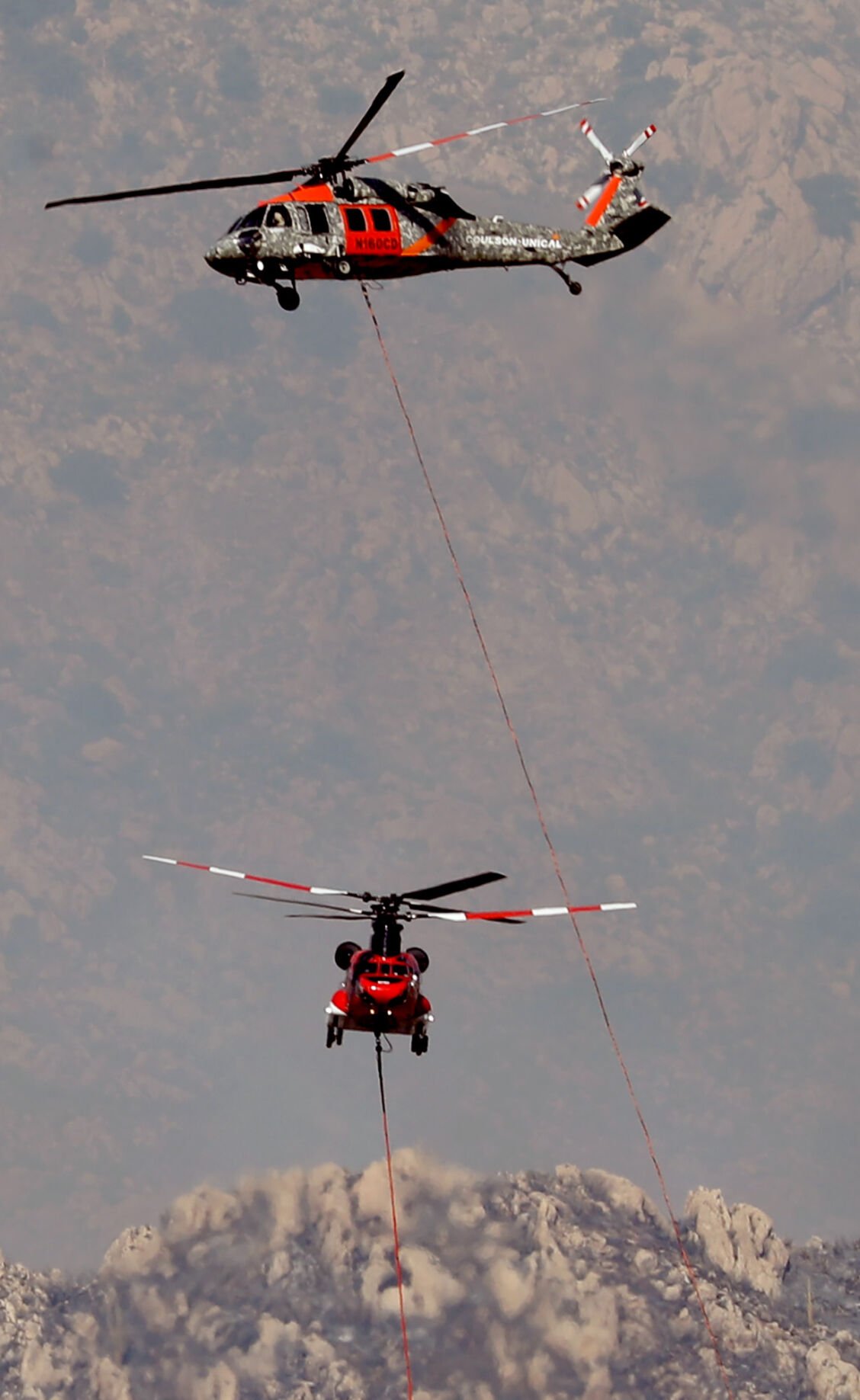
Two firefighting helicopters maneuver around one another while recharging at a dip site as the battle moves to the north to keep the Bighorn Fire from spreading, Oro Valley, Ariz., June 11, 2020.
Bighorn Fire in the Santa Catalina Mountains, 2020
Updated
A DC-10 VLAT drops below the ridge line as the aerial battle moves to the northwest and crews work to keep the Bighorn Fire from spreading through Catalina State Park, Oro Valley, Ariz., June 11, 2020.
Bighorn Fire in the Santa Catalina Mountains, 2020
Updated
A Chinook helicopter drops water on the line of flames advancing through grasslands at the northwestern foot of the Santa Catalinas as crews work to keep the Bighorn Fire from spreading through Catalina State Park, Oro Valley, Ariz., June 11, 2020.
Bighorn Fire in the Santa Catalina Mountains, 2020
Updated
The Bighorn Fire's northwestern front looms over homes as it burns into the central Santa Catalina Mountains, Oro Valley, Ariz., June 13, 2020.
Bighorn Fire in the Santa Catalina Mountains, 2020
Updated
A group of friends hangout on a high rock at Windy Point Vista while smoke from the Bighorn Fire flows over Mount Lemmon north of Tucson, Ariz. on June 14, 2020.
Bighorn Fire in the Santa Catalina Mountains, 2020
Updated
A Pima County Sheriff Auxiliary Volunteer motions for a four-wheel drive Type 3 fire engine from Three Points FD to proceed to Mount Lemmon on the Catalina Highway on June 15, 2020..
Arizona Wildfires
Updated
A DC-10 air tanker drops fire retardant along Samaniego Ridge just west of Mt. Lemmon Sky Center during the Bighorn Fire burning west of Mt. Lemmon in the Santa Catalina Mountains north of Tucson on June 16, 2020.
Bighorn Fire in the Santa Catalina Mountains, 2020
Updated
A Sikorsky firefighting helicopter drops water along a ridge top as the flames from the Bighorn Fire work their way onto the northern slopes of the Santa Catalina Mountains, Tucson, Ariz., June 16, 2020.
Bighorn Fire in the Santa Catalina Mountains, 2020
Updated
The same wind whipping the flags outside the Fairfield Inn & Suites on Oracle Road is whipping up the flames and smoke of the Bighorn Fire, Oro Valley, Ariz., June 17, 2020.
Bighorn Fire in the Santa Catalina Mountains, 2020
Updated
Flames break through the smoke as a finger of the Bighorn Fire scorches its way through a canyon on the west side of the Santa Catalina Mountains above Oro Valley on June 17, 2020.
Bighorn Fire in the Santa Catalina Mountains, 2020
Updated
People use a wildlife exit along Oracle Road to get a view of the Bighorn Fire churning through heavy fuels like Ponderosa pines below Summerhaven on June 17, 2020.
Bighorn Fire in the Santa Catalina Mountains, 2020
Updated
The Bighorn Fire became of machine of heat and wind, consuming incinerating large stands of trees on June 17, 2020.
Bighorn Fire in the Santa Catalina Mountains, 2020
Updated
A firefighting helicopter flies over a smoke filled canyon as it shuttles water to a line between the Bighorn Fire and Oracle, Tucson, Ariz., June 18, 2020.
Bighorn Fire in the Santa Catalina Mountains, 2020
Updated
The Bighorn Fire burning in Ventana Canyon in the Santa Catalina Mountains as the fire became a daily spectacle, viewable from nearly anywhere in Tucson, on June 18, 2020.
Bighorn Fire in the Santa Catalina Mountains, 2020
Updated
Traffic on Sabino Canyon Road drives under the glow of he Bighorn Fire as it claims Ventana Canyon on the south slopes of the Santa Catalina Mountains on June 19, 2020.
Bighorn Fire in the Santa Catalina Mountains, 2020
Updated
Flames on the outer eastern walls of Ventana Canyon as the Bighorn Fire continues burning the Santa Catalina Mountains on June 20, 2020.
Bighorn Fire in the Santa Catalina Mountains, 2020
Updated
Smoke would lay-in over the city on days with calm winds as the Bighorn Fire methodically progressed through he Santa Catalina range. Photo taken on June 21, 2020 from "A" Mountain.
Bighorn Fire in the Santa Catalina Mountains, 2020
Updated
Flames from the Bighorn Fire climb over a ridge near Esperero Canyon, silhouetting a stand of Saguaros as the blaze marches east on June 23, 2020.
Bighorn Fire in the Santa Catalina Mountains, 2020
Updated
Smoke from the Bighorn Fire clings to the foothills of the eastern slopes of the Santa Catalina and Rincon mountains and the cottonwood-willow forest and mesquite bosque running along the San Pedro River Valley, Cascabel, Ariz., June 30, 2020.
Bighorn Fire in the Santa Catalina Mountains, 2020
Updated
Bighorn Fire scar area: Cañada del Oro basin looking south at Sanmaniego Ridge in the Santa Catalina Mountains north of Tucson on July 1, 2020. The summit of Mt Lemmon is at left.
Bighorn Fire in the Santa Catalina Mountains, 2020
Updated
Bighorn Fire scar area: Looking from East Ski Run toward Oracle Ridge, left, and Sanmaniego Ridge, right, in the Santa Catalina Mountains north of Tucson on July 10, 2020.
Bighorn Fire in the Santa Catalina Mountains, 2020
Updated
Summerhaven sits like an island surrounded Bighorn Fire scar and Aspen Fire scar from 2003 in these aerial photos from July 15, 2020. The Mt. Lemmon Fire Station and control road jut out from a U-shaped turn of Mt. Lemmon Highway at upper left.
Bighorn Fire in the Santa Catalina Mountains, 2020
Updated
Bighorn Fire scar area: Charred debris from the Bighorn Fire moves down the Cañada del Oro Wash after a monsoon storm on July 15, 2020.
Bighorn Fire in the Santa Catalina Mountains, 2020
Updated
A burned section of the Catalina Mountains seen near Aspen Vista Point, on Aug. 1, 2020.
Bighorn Fire in the Santa Catalina Mountains, 2020
Updated
Deymo Fernandez, left, and Sara Hernandez, look at a burn scar from the Bighorn Fire on the North side of Mount Lemmon outside the Iron Door Restaurant in Mount Lemmon on August 2, 2020..
Bighorn Fire in the Santa Catalina Mountains, 2020
Updated
The burn scar from the Bighorn Fire on a portion of the North side of Mount Lemmon, as seen from the Mount Lemmon Fire Station on August 2, 2020.
Bighorn Fire in the Santa Catalina Mountains, 2020
Updated
Gregg Sasek, dispersed recreation manager for the Coronado National Forest Santa Catalina Ranger District, demonstrates how ground along the Palisade Trail has been burnt out making it easy for hikers to sink a leg into the soil, on Aug. 12, 2020. Various dangers are still being accessed throughout the Coronado National Forest as a result of the Bighorn Fire.
Bighorn Fire in the Santa Catalina Mountains, 2020
Updated
A sign at the entrance to the Pima Canyon Trail warns hikers of dangers after the Bighorn Fire damages hiking areas on September 30, 2020.
Bighorn Fire in the Santa Catalina Mountains, 2020
Updated
Snow covers a burn scar from the Bighorn Fire in the Santa Catalina Mountains outside of Summerhaven, Ariz. on Nov. 9, 2020. The Mt. Lemmon General Store in Summerhaven got about 1-2 inches of snow early Monday, according to the National Weather Service.
Bighorn Fire in the Santa Catalina Mountains, 2020
Updated
Damage from the Bighorn Fire can be seen along the Marshall Gulch Trail on Mt. Lemmon in Tucson, Ariz. on May 25, 2021.
Bighorn Fire in the Santa Catalina Mountains, 2020
Updated
Rosalind Perera walks along the Aspen Trail where damage from the Bighorn Fire can be seen on Mt. Lemmon in Tucson, Ariz. on May 25, 2021.
Bighorn Fire in the Santa Catalina Mountains, 2020
Updated
Damage from the Bighorn Fire can be seen along the Aspen Trail on Mt. Lemmon in Tucson, Ariz. on May 25, 2021.