


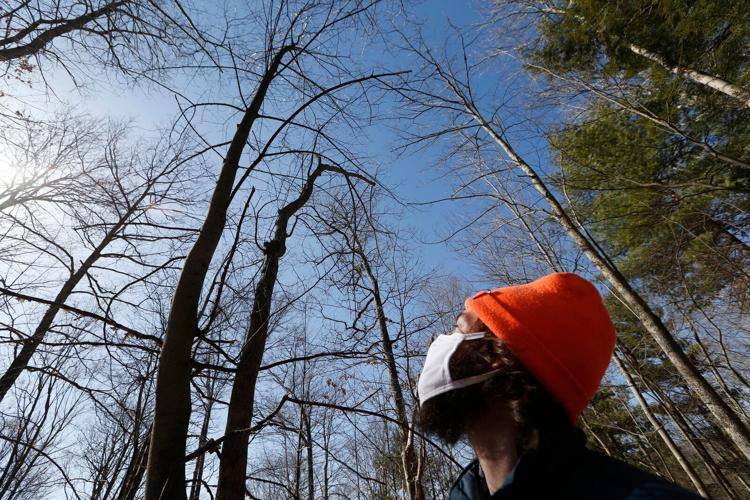
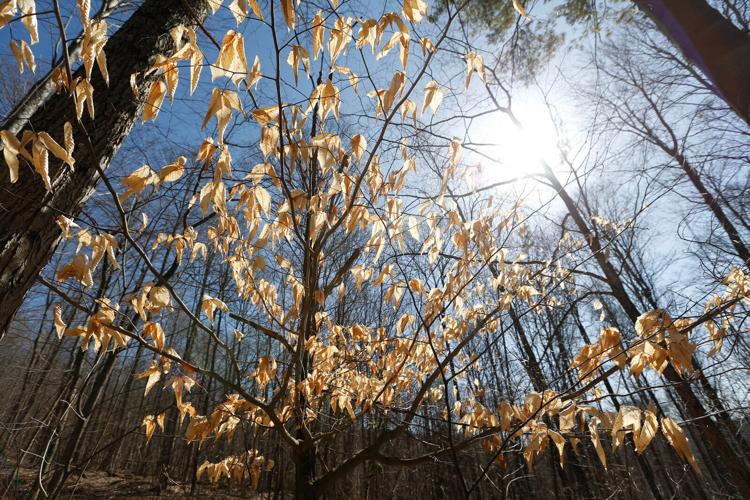
The 201-acre oak forest for sale in Cattaraugus County comes with rare American chestnut trees, native orchids, black bears and bobcats.
It's just the kind of natural place to gain attention from the Western New York Land Conservancy, which has prevented forests, wetlands and farmland from being sold or subdivided since its founding in 1991.
So the conservancy's response is a familiar one: It wants to buy and preserve the forest it calls the Allegany Wildlands, opening the land to the public.
But this project is part of a larger effort the conservancy has just begun talking about as a way to respond to the loss of wildlife and biodiversity and climate dangers.
The Allegany Wildlands fits into its plan.
The strategy aims to create a system of connected and protected forests from Pennsylvania to the Great Lakes and the Finger Lakes, from Western New York to the Adirondacks, providing a corridor for wildlife to move back and forth.
The Western New York Wildway would extend from the Allegheny Mountain Range at the Pennsylvania border northward through to the Alabama Swamps, consisting of the Iroquois National Wildlife Refuge, Oak Orchard Wildlife Management Area and Tonawanda Wildlife Management Area. It would then veer westward toward Lake Erie along Cattaraugus Creek, before heading east toward Letchworth State Park, the Finger Lakes and across the Southern Tier.
The path would touch all parts of Western New York – Allegany, Cattaraugus, Chautauqua, Erie, Genesee, Niagara, Orleans and Wyoming counties – and encompass some of the most rural areas.
"The Allegany Wildlands is the first forest we are going to protect as part of that bigger, broader Wildway concept," said Jajean Rose-Burney, the organization's deputy executive director. "We will prioritize protecting larger forests, our most climate-resilient lands, additions made to existing protected areas, and land that can connect protected areas together," he said.
The concept is expected to become a guiding principle for decades to come for the conservancy, a not-for-profit based in the Town of Wales that since 1991 has protected 96 properties totaling 7,654 acres.
Important link
The Cattaraugus County forest is located on a steep slope between Allegany State Park and South Valley State Forest. Its size is small compared to the 64,800-acre Allegany State Park, or even the 4,227-acre South Valley State Forest. But it's a critical link, said Rose-Burney, for allowing animals and plants to expand their range.
"It's a large forest," Rose-Burney said. "Adding 200 acres is as big as you can get in our region."
Almost all of New York State 15,000 years ago, during the Ice Age, was covered in giant glaciers up to 2 miles thick. But the Allegany Wildlands is in a portion of the Allegany Plateau never covered by the glaciers, making its landscape all the more rare, said Erik Danielsen, the conservancy's naturalist.
The forest was also home to massive American chestnut trees that once dominated forests in the Southern Tier, before dying off in a blight in the 1920s and '30s.
Only they didn't quite die, Danielsen said.
The root systems are actually alive underground, sending up sprouts that can live for years and even decades. But because the fungus is still present they're essentially living on borrowed time. American chestnuts are a rare sight, and three of the chestnuts in the Allegany Wildlands are flowering and seeding, which could provide important information in the effort to bring the trees back, Danielsen said.
The Allegany Wildlands also has threatened blunt-lobed grape ferns and is an important habitat for songbirds, including colorful wood warblers. The birds spend their winters in South America, Central America and the Caribbean before migrating through Western New York and nesting in forests like this one.
River otters, which are rare in Western New York and live in the reservoir, could also be in the forest's future. They can live on land and could eventually extend their range to this forest if the habitat is protected, Rose-Burney said.
'Half-Earth'
The conservancy, in embarking on the Western New York Wildway, is linking with a growing movement calling for a set amount of land and water to be set aside for a sustainable level of biodiversity.
The effort is influenced by E.O. Wilson, a biologist, conservationist and two-time Pulitzer Prize winner. In his 2016 book "Half-Earth: Our Planet's Fight for Life," Wilson warned that at the present rate most of the species on Earth will go extinct. He called for setting aside fully one-half of the world's lands and seas to protect 85% of the world's ecosystems and species from extinction.
President Biden signed an executive order Jan. 27 calling for setting aside 30% of the country's lands and waters by 2030.
The Nature Conservancy has proposed a corridor of connected lands from Western New York to the Adirondacks, with the Western New York Wildway forming part of that statewide network. Those behind the Wildlands Network envision an extensive wildlife corridor from eastern Canada to the Gulf of Mexico that includes Western New York.
The Western New York Wildway was initiated by Marisa Riggi, the Western New York Land Conservancy's conservation director.
Riggi worked on the Split Rock Wildway as conservation director for the Northeast Wilderness Trust, based in Montpelier, Vt. That project is developing a wildlife corridor to connect the high peaks region of the Adirondacks to Lake Champlain, with an expansion into Vermont.
They used modeling to better understand how large mammals move from the high peaks to Lake Champlain and the impediments they face.
The organization has formed partnerships to work on the project with other not-for-profits, local governments and private land owners, including farmers wanting to participate.
Both lessons will be used with the Western New York Wildway, Riggi said.
The exact route for the Western New York Wildway and what percentage of land the conservancy will try to set aside are still being decided. But land protected by the organization and large protected areas like Allegany State Park will be in the Wildway boundaries.
Riggi believes connecting the Western New York Wildway is doable and essential.
"Not only are we seeing this alarming extinction rate, we are also seeing frightening weather patterns and changes happening at a rate they haven't happened ever before, based on the records we have," Riggi said. "I don't think we have a choice."
Nine months
The Allegany Wildlands has been owned by one family for five generations. Rose-Burney said the owner indicated he'd prefer if the land was protected and is giving the conservancy the first chance to purchase it.
But the clock is ticking.
The environmental organization has less than nine months – until Dec. 31 – to raise $879,000. That includes the purchase price and the projected cost the organization believes will be necessary to maintain the property long into the future.
"The urgency of this project is greater than usual because it's a shorter time frame and there are other interested buyers," Rose-Burney said.
If successful, the conservancy plans to put in low-intensity trails and signage, allowing the public to hike, snowshoe and cross-country ski.
The pandemic revealed how important parks and nature trails are, Rose-Burney said.
"When everything shut down last year because of Covid in March and April, the only thing we had was nature," he said. "The pandemic showed how important protecting nature is, and that's what both of these projects do."

