



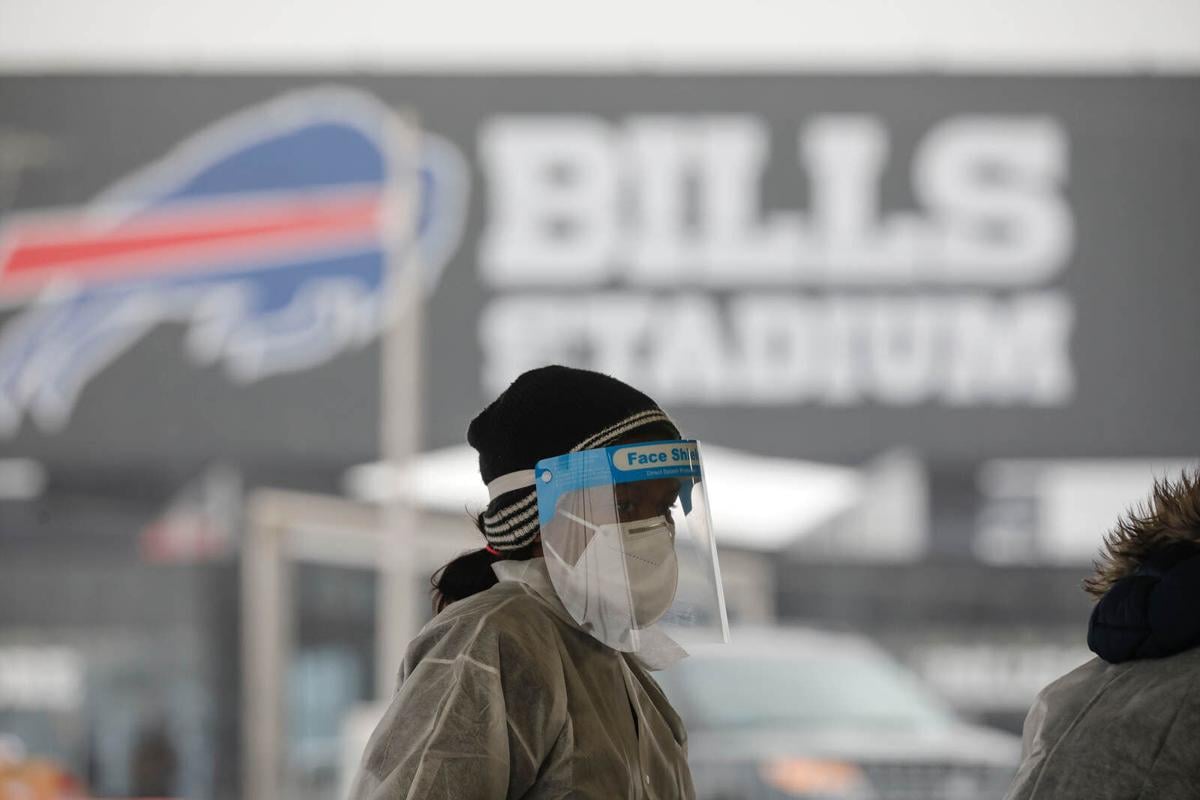
The coronavirus has crisscrossed the planet by jumping from person to person, by nose and by mouth. Its launch points include house gatherings, car rides and sit-down meals. Athletic venues are hardly immune, as the Buffalo Sabres are experiencing right now: The hockey team had four games canceled this week and four of its players placed into Covid-19 protocols after an outbreak on the roster of their most recent opponent, the New Jersey Devils.
But one arena of professional sports play has seen minimal, if any, transmission of the virus: Football fields. It's one the reasons Super Bowl LV is happening as planned this Sunday.
A report published Jan. 25 by the Centers for Disease Control and Prevention detailed how the National Football League was able to contain transmission of the coronavirus among players and team personnel. It also revealed that high-risk interactions that did result in infection tended to occur off the field, or even outside the NFL workplace altogether.
“We did not see any evidence that the virus ‘crossed the line of scrimmage,’ so to speak,” said Dr. Allen Sills, the NFL’s chief medical officer, in a call with reporters last week.
Why not – and what can the rest of us glean from it?
How effectively did the NFL contain the virus?
Fairly well. But it had a distinct advantage: the resources to offer broad and rigorous testing.
From Aug. 1 to Jan. 23, the league administered 954,830 Covid-19 tests to players and staff across its 32 teams. In all, 262 athletes and 462 staff members tested positive, for a total of 724 coronavirus cases.
That’s an average of nearly 30,000 tests and 22.6 positive cases per team. That’s from among a testing group that includes 53 active players, up to 16 more on a practice squad, and dozens of coaches and front office personnel.
The NFL’s positive test rate was .08%. For context, the University at Buffalo’s own surveillance testing of asymptomatic individuals, conducted from Aug. 29 to Jan. 22, yielded a 0.48% positive rate. This isn’t a straight comparison – the time frames and population are different, and UB’s testing sample (46,660 tests) is smaller. But it does punctuate the point: The NFL has done well.
How did the NFL keep the virus from spreading?
Strict protocols — and ones that turned tighter when Covid-19 cases were detected. In-person meetings had fewer than 15 people or were all virtual. Masks were ubiquitous and distancing was enforced. Locker room use was brief and distanced. Gatherings by players or essential personnel outside of work or travel was at first limited to three people, and later prohibited altogether.
“It’s not surprising that if you have such a rigorous program, you’re going to have less cases,” said Dr. Thomas Russo, the chief of infectious diseases at the University at Buffalo’s Jacobs School of Medicine and Biomedical Sciences. Russo, who read the NFL report, pointed out that that many workplaces likely have similar rules, but the NFL “probably executes their plan better than most other venues.”
Regular – and often daily – testing was a key part of that plan.
A negative PCR test was required for players and other personnel to report to work. A positive test resulted in what Dr. Christina Mack, the NFL’s consulting epidemiologist, called a “SWAT team” approach to contact tracing. Anyone who was found to be a high-risk contact of an infected person was put into a minimum five-day quarantine.
What did the NFL learn and how can we apply it to our lives?
Rules help – usually.
At work, NFL players had the benefit of rigorous rules, testing, medical-grade masks, meals-to-go at the ready, and a job that takes place on a vastly open, outdoor field. But when players and staff step away from work and into their personal lives, they lost those advantages – unless they chose to implement them for themselves.
Some didn’t.
In the paper published by the CDC, a sampling of high-risk interactions across the league from Oct. 15 to Nov. 21, 2020, detailed how 20 NFL personnel became infected. The most frequent forms of exposure happened outside of work, and included partial or no mask wearing, gathering indoors at parties, dining inside and sharing car rides. In each case, those people were identified as having a high-risk contact and put into quarantine. After that, they tested positive. Their teams, meanwhile, kicked in the more intensive set of Covid-19 protocols.
Mack, who is vice president of epidemiology and clinical evidence at IQVIA, a company that partners with the NFL on health data and technology, points out that schools and workplaces can institute the same two-level approach.
If a company’s break room is open as a lunch spot, for example, that’s a risk. “People are eating,” Mack said. “They’re in a smaller space.” You can mitigate that risk – somewhat – by distancing people, opening windows for ventilation, and having a HEPA air filtration system. But the stricter Covid protocols would require the 10-day shutdown of the break room if the workplace has an active Covid-19 case. “You have an additional layer of intensity and prevention in place before you go back to your standard protocol,” Mack said.
The NFL detected no on-field virus transmission. Now that scholastic sports are restarting here, does that mean my kid is safe?
Don’t read too much into that finding. The NFL is a multibillion-dollar business that can afford to hire epidemiologists, provide daily testing and conduct its own contact tracing.
Your kid's team likely can't.
The nature of the activity matters too, and football may be among the safer sports that involve close contact. Unlike hockey, for example, it's played in the open air, and tight interactions – like blocking and tackling – are quick. The NFL outfitted its players, coaches and officials with proximity-tracking devices and found "there’s actually very little interaction overall, cumulatively, in close proximity between players," said Sills, the league's medical officer.
Your kid's team can't track that data, either. But youth leagues can command masks and distancing on the sidelines and benches, as the NFL did.
Still, if someone is infected, there's a real risk. It wouldn’t be too difficult for, say, an unknowingly contagious lineman to breathe virus-filled air – or project small droplets of spit or snot – into the face of a player across the line of scrimmage, especially after the ball is snapped and bodies collide. What likely helped the NFL here was its ability to rigorously screen for the virus.
Since most schools and workplaces don’t have access to daily testing, what CAN we do?
Mack has been thinking about this point for her 10-year-old son, who is a soccer player.
“The importance of masking, the importance of ventilation, the additional protection of being outdoors, and the importance of not a lot of high-duration close contact with people during the game,” Mack said. “Considering those four pillars is really what I would use as a guidepost.”
Note: Do you have a topic or question you’d like to see explored in an upcoming installment of "Pandemic Lessons?” Send it to Tim O’Shei at toshei@buffnews.com or via Twitter (@timoshei).

