

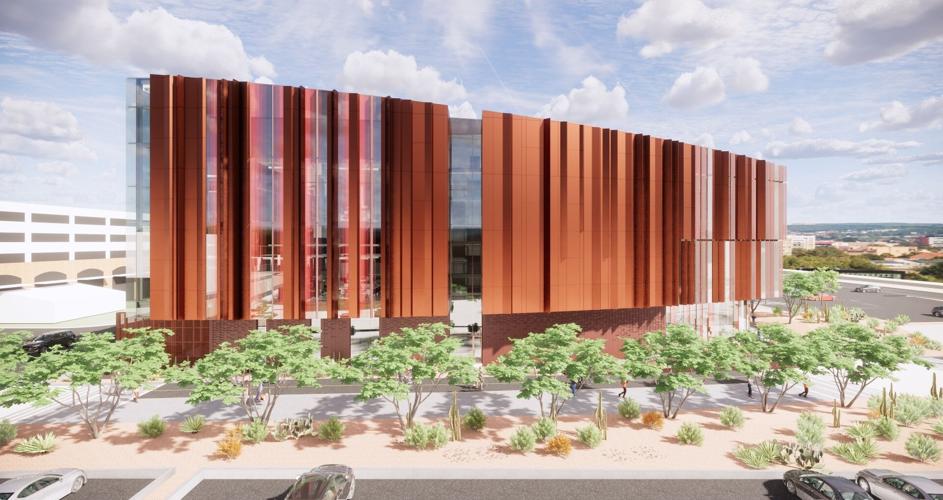
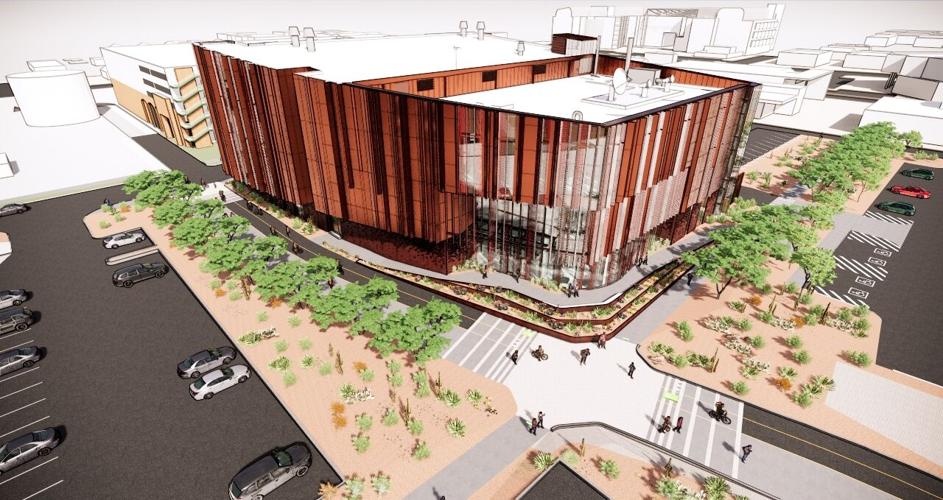

The University of Arizona broke ground on an $85 million Applied Research Building set to bring together several programs under one roof.
The three-story, 89,000-square-foot facility will house state-of-the-art equipment and technology to advance research in the applied physical sciences and engineering fields, the UA said.
Eight departments among four colleges — the College of Engineering, College of Science, the James C. Wyant College of Optical Sciences and the College of Medicine-Tucson — will have dedicated space there.
Undergraduate and graduate students in these programs, while not having classes at this location, will have access to the facility to conduct research.
It includes the university’s Imaging Technology Laboratory, which the UA calls “a world-leading supplier of advanced scientific imaging sensors” and is currently located off campus.
“Technology created by the lab is commonly used for applications such as satellite imagery and in-camera systems used on university-run telescopes,” UA said.
Now researchers within the lab will have additional space and “cross-campus” collaboration opportunities.
The facility, the UA said, will further the school’s space science research as a site for testing and integration for satellites, spacecrafts and probes.
According to UA, the building will offer a range of facilities:
Assembly areas used for constructing high-altitude stratospheric balloons and nanosatellites
A large-scale thermal vacuum chamber that simulates environmental conditions in space
A nonreflective, echo-free room called an anechoic chamber to test antennae for command, control and data relay purposes
A large, dynamic testing lab for testing the performance of a range of objects, from airplane wings to sensors
The building also will connect researchers within advanced manufacturing to help their collaboration in constructing materials for applications such as autonomous vehicles and advanced flight systems, the UA said.
The Applied Research Building will be located at the southeast corner of East Helen Street and North Highland Avenue and is set for completion in January 2023.
Construction crews also will improve the Highland Underpass to provide safe crossings for bicyclists and pedestrians crossing East Speedway as it intersects with Helen Street.

