



Not just anyone can be a marshal in America’s largest non-motorized parade. If you’re a horse, you’ve got to audition first.
On a recent Saturday morning, organizers of the upcoming Tucson Rodeo Parade put several dozen four-legged participants through a series of tests designed to see how they might handle distractions along the parade route.
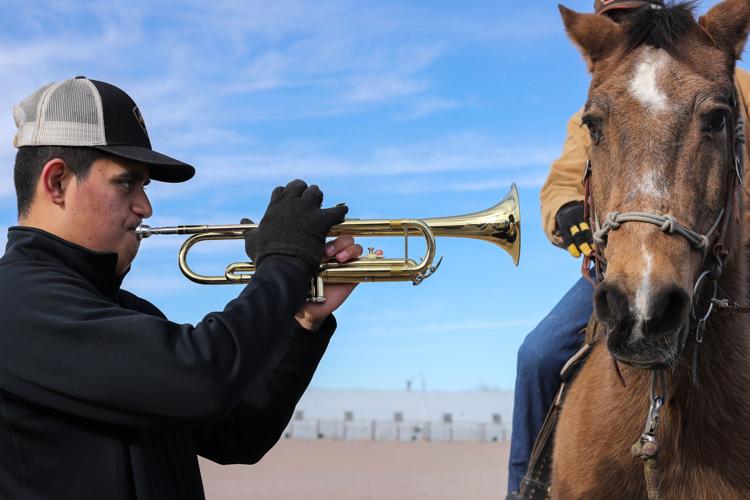
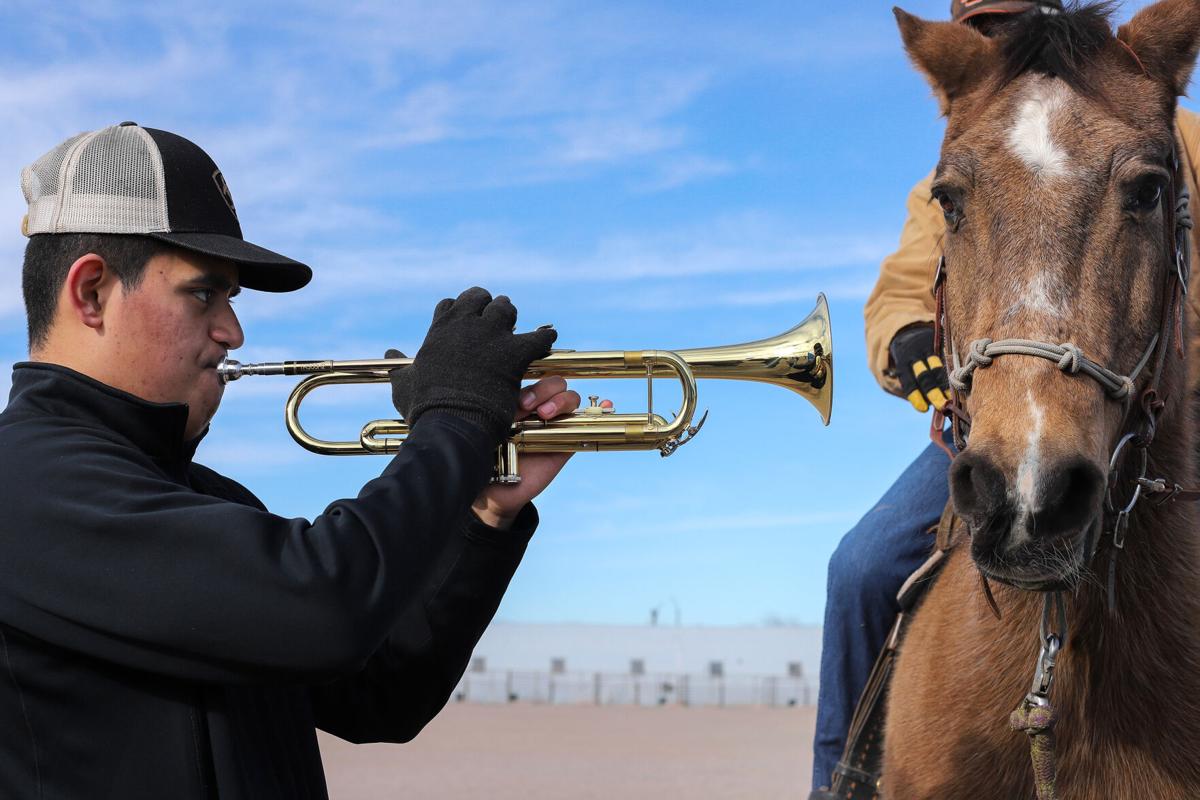
The horses and their riders squared off against such spooky obstacles as a marching band, a city bus and a decorated parade wagon being pulled around the rodeo grounds by a team of horses.
The qualification session is mandatory for the roughly 60 volunteers who will serve as marshals for the 98th annual Tucson Rodeo Parade on Feb. 23.
“Marshals who have been doing it for 20 or 30 years still come every year and qualify with their horses,” said Charly Toohey, who chairs the parade’s horse marshals committee. “If they don’t pass, they don’t ride.”
The Jan. 28 event got off to a rough start, when one of the first qualifiers of the morning bolted as the Pueblo High School marching band began to play. With its ears flat and eyes wild, the horse galloped riderless through the rows of trucks and trailers parked nearby, until a group of marshals managed to corner and calm the animal.
That turned out to be the day’s only failure. The rest of the entries passed with flying colors, even when confronted by the actual flying colors being waved around by Pueblo’s flag twirlers.
Toohey said qualifiers like this are necessary because marshals play such an important role in the parade, riding along the route on horseback to provide safety and security “for the spectators as well as the participants.”
They are there to respond to emergencies, solve problems and occasionally serve as escorts for anxious wagon teams and individual horses that might need someone calm to “buddy-up with” along the parade route, she said.
Everyone has to qualify, even the chair of the horse marshals committee. “So you might see me hit the ground because my mare is out of her mind this morning,” Toohey said. “It took me an hour to get her into the trailer.”

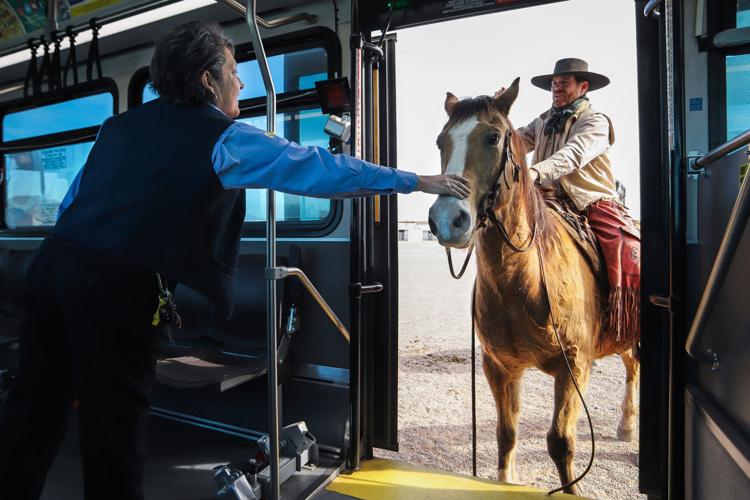
Barbara Franco on a Sun Tran bus helps comfort Travis Elliston’s horse, Trace Adkins, during training for the Tucson Rodeo Parade.
Tube man trial
Parade organizers started holding qualifiers for marshals and their horses about 20 years ago. Toohey said the test has evolved and grown since then, as other potential distractions have cropped up.
New this year was a blue inflatable tube man like the ones you might see flailing and dancing in front of a used car lot.
The horses had to walk past the tube man and stand next to it without getting spooked, even when the thing flapped in their direction or bopped them in the face.
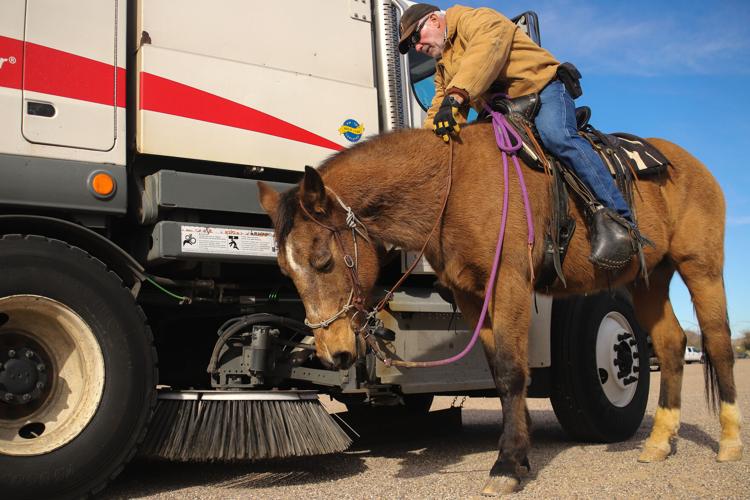
The horses were also tested around an emergency vehicle with its lights flashing and a running street sweeper like the ones brought in to clean up after the parade is over.
“They just have to be used to the noise, because when the rollers are down, it makes a racket,” Toohey said.
Potential parade marshals face spooky distractions at qualifying event.
In one test area, prospective marshals practiced leading their horses across rubber mats that are used on parade day to allow horse-drawn wagons to safely cross the railroad tracks along the route.
In another area, the horses had to prove they could comfortably step over curbs and walk on the pavement with bright road striping on it.
That might sound like no big deal, but to a ranch horse that has spent its whole life on dirt, a patch of dark asphalt can look like a giant, scary hole in the ground, Toohey said. “It’s funny the things you find that the horses just won’t do.”
Judges with clipboards were posted at each testing spot to watch how the participants behaved and mark down the results on pre-printed scorecards.
Horsing around
Seasonal resident and parade volunteer Chuck Currie was assigned to the inflatable tube man, while his wife, Donna, judged the participants from the back of the moving parade wagon.
“This is pretty different than back home in Chicago,” Chuck said, looking around with a grin.
The Curries started volunteering with the rodeo parade about five years ago, shortly after they began spending their winters in Tucson. It’s a perfect fit for Chuck, who loves anything that involves horses.
“I honestly think I was born on the wrong side of the Mississippi River about 100 years too late,” he said.
This was the second parade qualifying event for veteran Sun Tran bus driver Barbara Franco, who said she last drew the unusual Saturday assignment close to 20 years ago.
Franco spent the morning triggering the doors, windshield wipers, air brakes and wheelchair ramp on her bus as the horses and their riders filtered past. You could tell she was enjoying herself, too.
At one point, a horse leaned in through the front door so Franco could pet it on the nose. “This is fun,” the smiling bus driver said.
Though it didn’t happen this time around, a few bold participants at past qualifiers have actually climbed all the way inside the bus. Toohey said her other horse, Taco, did it one year, casually walking in through the front door and out the back in open defiance of the lighted sign that clearly said the bus was “not in service.”
“That’s way beyond qualifying,” laughed Tucson Rodeo Parade Committee chairman Marshall (yes, that really is his first name) Stewart. “We just want them to be able to stand still when the air brakes hiss.”

Alan Schlecht comforts his horse Smokey as they make their way around a City of Tucson street sweeper during training for the Tucson Rodeo Parade.
Dixie’s day off
Toohey thinks the parade wagon poses the biggest challenge for the horses. “It’s moving, it’s got flappy stuff, and it’s got people waving,” she said.
But it’s also one of the most important things for the marshals and their horses to get comfortable around. “Nine out of ten times, if there’s going to be an issue (during the parade), it’s going to be with a (wagon) team,” she said.
The rodeo parade’s current crop of volunteers includes “marshals from all walks,” from casual weekend riders to professional horse trainers and cattle ranchers, Toohey said. It’s a big commitment that takes up a lot more time than just the 8 hours or so many of them will put in on parade day.
Don Moore drove up from Tubac to qualify Nic and Alex, two registered quarter horses on which the seasoned rancher has logged close to 30,000 hours of combined saddle time.
No surprises there. Both qualified with ease.
“They’re called versatility horses,” said Moore, who has been volunteering as a parade marshal since 2019. “Basically, whatever I ask them to do, they do it.”
In the end, Toohey decided to give her mare, Dixie, the day off. The horse just seemed too agitated for a bunch of tests designed to be startling.
“I’ve already broken my leg twice in one year. I don’t need to break it a third time,” she said.
Toohey plans to bring Dixie back for the second and final qualifying session on Feb. 11, but it won’t be the end of the world if that doesn’t pan out.
Toohey said she will still be able to help out with this year’s parade. She’ll just have to do it from a golf cart instead of a saddle.
Photos: Tucson Rodeo Parade through the years

1934 La Fiesta de los Vaqueros Tucson Rodeo Parade along Congress Street.

1936 Tucson Rodeo Parade coverage in the Arizona Daily Star

Little Cowpunchers riding in the 1939 Tucson Rodeo Parade. Victor Aros is in the front, left. Pete Aros is standing in the middle, the only one without a cowboy hat.

1940 Tucson Rodeo Parade at 6th Avenue and Alameda Street

The ever-popular Budweiser Clydesdales were in town in the 1940s for the Tucson Rodeo Parade. They made a stop at Jake's Liquor Store, located at the southeast corner of Meyer and Broadway. Jake's (for Jacobs) was owned by the Jacobs family. Edward C. Jacobs is second from left, and his dad, E.A. Jacobs, is third from left.

Tucson Rodeo Parade heading north on Stone Avenue from Pennington Street in 1949. The historic Pioneer Hotel is at upper right.

Photo of the Davis Monthan Air Force Base Wives at the 1950 Tucson Rodeo Parade. Pictured in the front of the parade is Geraldine Casey.

Budd Ramsey, at right, with the bulldogs, won a prize for the most unusual entry in the 1950 Tucson Rodeo Parade. This photo was taken at Scott Avenue and 12th Street.

William Boyd as cowboy Hopalong Cassidy rode in the Tucson Rodeo Parade in 1951.

Crowds at Stone and Alameda in downtown Tucson for the 1951 La Fiesta de los Vaqueros Tucson Rodeo Parade

1953 Rodeo Queen Dianne Moore of the La Fiesta de los Vaqueros Tucson Rodeo and Parade

The 1953 St. Mary's float for La Fiesta de los Vaqueros Tucson Rodeo Parade featured nuns and nuns dressed as Native Americans.

Copy of Historic Tucson Daily Citizen. The headline reads: "Record crowd sees Tucson Rodeo Parade" on Feb. 23, 1956.

The Alice Vail Jr. High School band, which was judged best in the category, heads along West Pennington Street between Stone and Church avenues in 1959 during the Tucson Rodeo Parade.
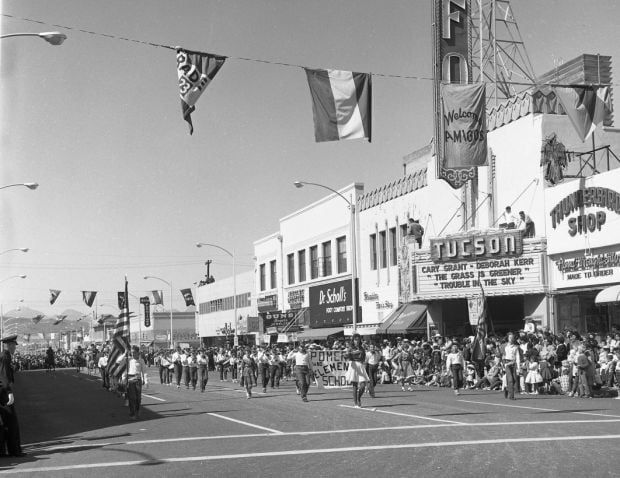
The Pomeroy Elementary School band marches along Congress Street in front of the Fox Theater during the 1961 Tucson Rodeo Parade.

Parade watchers with their 35mm rangefinder cameras and 8mm film movie cameras at the 1961 Tucson Rodeo Parade in downtown Tucson.

Parade watchers hold in the chill morning air during the 1961 Tucson Rodeo Parade in downtown Tucson.

An adult keeps a boy at a safe distance during the 1961 Tucson Rodeo Parade on Stone Avenue in downtown Tucson.
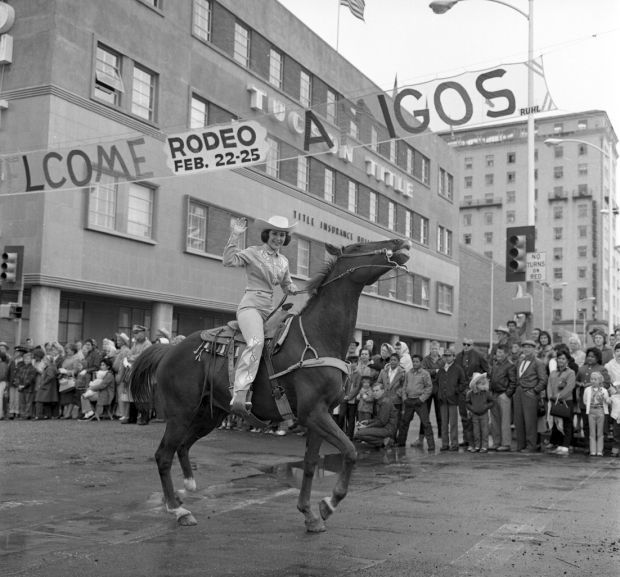
The 1962 Tucson Rodeo Parade.

The aftermath of the 1962 Tucson Rodeo Parade in downtown Tucson.

Mariachis march in the 1962 Tucson Rodeo Parade in downtown Tucson.
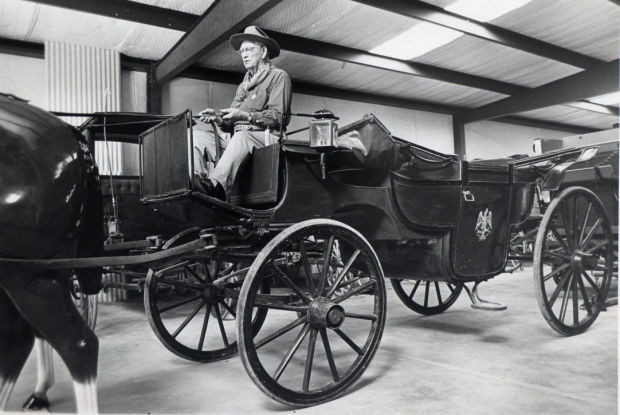
Feb. 26, 1968: Tucson Rodeo Parade equipment custodian Harry Blacklidge, 85 years old and Tucson-born, takes over the reins of the artificial horses hitched to the famous Maximilian coach as its storage site at the Parade Museum.

A young spectator blows a plastic horn as the San Xavier Women's Club entry approaches during the 1971 La Fiesta de los Vaqueros Tucson Rodeo Parade

Feb. 24, 1971: Mr. and Mrs. Otto R. Eicher (in noose) were welcomed to Tucson's Fiesta de los Vaqueros in traditional western style, as the city's Vigilantes and Barbara Bell, a rodeo princess, told them to reach for the sky on Interstate 10 and stick around for five days, courtesy of the City of Tucson and Tucson Jaycees. The Eichers, from Sandusky, Ohio, were selected at random.

Coed Quadrille precedes the University of Arizona Marching Band during the Tucson Rodeo Parade downtown in 1971.

Some things never change: These enthralled young rodeo fans were lined up along the Rodeo Parade route in 1972.

The rodeo parade snakes its way south on Church Avenue, turning east on Cushing Street in 1972. The then-new central fire station is at right. Empty lots in the upper left have been filled with the La Placita office complex and the Superior Court complex.

The Pride of Arizona, University of Arizona Marching Band, during the 1973 La Fiesta de los Vaqueros Tucson Rodeo Parade

A crowd estimated at 200,000 turned out for the 1976 La Fiesta de los Vaqueros Tucson Rodeo Parade.

Members of the U.S. 5th Calvary Troop A ceremonial regiment warms themselves by the fire before the 1976 La Fiesta de los Vaqueros Tucson Rodeo Parade

A Las Vegas Casino stage coach entry passes by the "new" La Placita Village office complex on Church Avenue during the 1977 La Fiesta de los Vaqueros Tucson Rodeo Parade.

Former Gov. Jack Williams, shown in the 1978 Tucson Rodeo Parade, is among the many dignitaries who have ridden in the "Maximilian coach." The century-old vehicle has been the subject of tall tales and controversy since it was acquired by the Tucson Rodeo Parade Committee in 1932.

It was a rainy and windy day in 1983 as the parade made its way along Pennington Street. Because of the tight quarters downtown, the route was moved to South Park Avenue in 1991.

A wagon driver of the Young Explorers School entry struggles to control spooked horses during the 1986 La Fiesta de los Vaqueros Tucson Rodeo Parade. A second wagon veered into the crowd, injuring at least one person.

The La Fiesta de los Vaqueros Tucson Rodeo Parade turns the corner from 5th Avenue to 12th Street, north of Armory Park. Note the old National Guard armory building on the left side of the park. It was demolished to make way for the senior center. Also, 5th Avenue used to pass directly in front of Safford School. It now dead ends there.

