


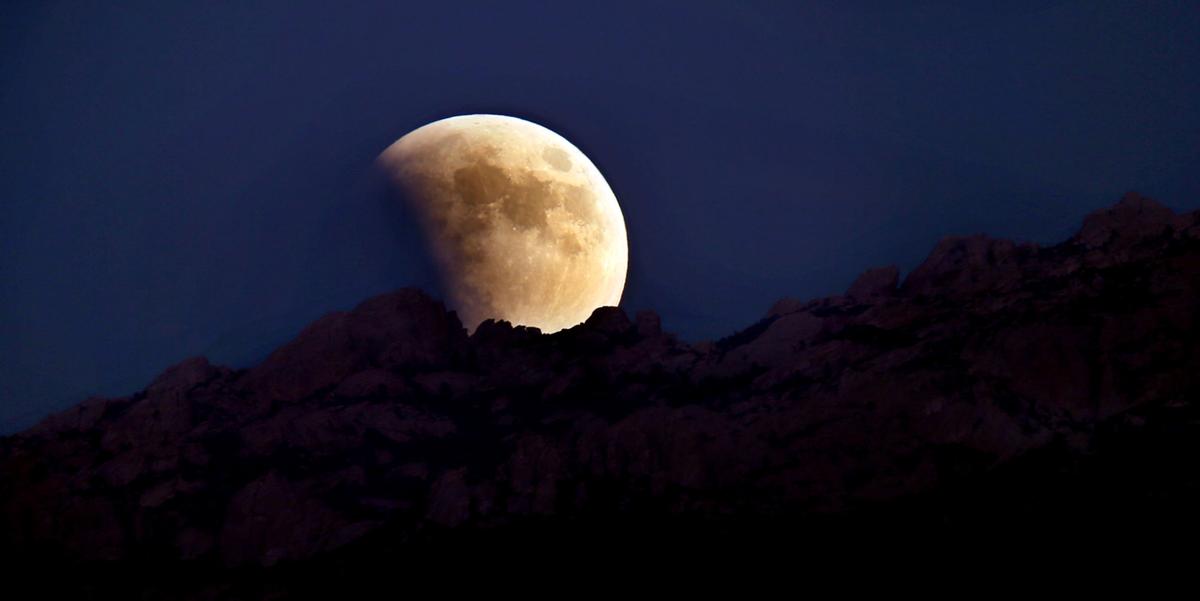
The moon is scheduled to slip into Earth’s shadow on Sunday evening.
The total lunar eclipse — also referred to as the “Super Blood Wolf Moon” by those who like take things too far — will be visible across the Americas and is the last one that can be seen from Tucson until 2021.
Tucson was able to watch last January’s total lunar eclipse right before a Monday sunrise, but this year’s, slotted for the hours just before Martin Luther King Jr. Day, should be easier to catch.
Here’s all you need to know about the total lunar eclipse.
When to look
Earth’s silhouette will begin chipping away at the moon at 8:33 p.m., as the moon rises above the Rincon Mountains.
The moon will be totally eclipsed starting at 9:41 p.m. and will steep in Earth’s dim red shadow for about an hour. The moon will begin to re-emerge at 10:43 p.m., according to timeanddate.com.
Maximum eclipse will occur at 10:20 p.m. when the moon will be about halfway between the southwestern horizon and the highest point in the sky.
There is no risk to looking directly at the moon during a lunar eclipse. You can safely look at it through binoculars or a telescope.
Onlookers can also take advantage of the dimmed moon to look at the stars.
The moon will be in the constellation Cancer at the time of eclipse.
About three-finger-widths to the left, you should be able to see the Beehive star cluster with the naked eye, but binoculars, if handy, are recommended.
The moon will fully emerge from the shadows at 11:50 p.m.
The National Weather Service is calling for partly cloudy skies in Tucson on Sunday night.
Set to music at UA
The University of Arizona’s Flandrau Science Center and Planetarium will host a “Moon Music Serenade” event from 6 to 11 p.m.
The evening includes free live music on the UA Mall courtesy of the UA Chamber Winds ensemble.
Telescopes provided by the Tucson Amateur Astronomers Association will also be available on the Mall, weather permitting. Amateur Astronomy volunteers will have smartphone adapters for their telescopes so visitors can take photos of the eclipse.
Flandrau admission is free, but it has also scheduled $5 planetarium shows to celebrate the celestial alignment.
At 7 p.m. Steve Kortencamp, UA associate professor of planetary science, will present a talk called “All About Our Moon.” Doors open at 6 p.m.
This will be followed by an 8:30 p.m. showing of “Tucson Sky: Moon Talk” and a 9:30 p.m. showing of “Pink Floyd ‘Dark Side of the Moon’” laser light music show.
The UA Mount Lemmon SkyCenter will also live stream the eclipse on YouTube.
“There is a subset people who have never seen an eclipse before, and in cities sometimes people don’t look up,” said Alan Strauss, director of the Mount Lemmon SkyCenter.
“You don’t need a telescope or even binoculars to see an eclipse. It’s so accessible,” he said. He hopes the beauty of it and the curious fact that it turns red will get people asking questions. “It’s our job to help them appreciate why.”
Why “Super Blood Wolf Moon”?
The moon will blush under our regardful gazes, not because of our increased attention, but because of physics.
Most sunlight will be completely blocked by the Earth, or scattered away by the atmosphere. But red light from all the world’s sunsets and sunrises will be bent into the Earth’s shadow by the atmosphere, spilling that reddish light across the surface of the moon, which is why it’s called a blood moon.
January’s full moons are sometimes called wolf moons, supposedly named after the howling wolves during winter nights, according to Timeanddate.com. However, many other cultures have their own names for the full moon during different times of the year.
Full moons that occur when closest to Earth in its orbit are called supermoons. While they are technically larger in the sky, the difference is almost unnoticeable to the naked eye.
The next total lunar eclipse will take place in May 2021, but it maybe too low on the horizon to fully appreciate.

