



About twilight in the spring and summer, wildlife technicians roam the Southern Arizona mountains, seeking an elusive owl.
They visit known or predicted nesting and foraging areas for the Mexican spotted owl, a threatened species in the Southwest. Although it’s found throughout Arizona, New Mexico, Colorado, Utah and parts of Mexico, the owl has been listed as “threatened” since 1993 because of habitat decline from logging and more recently, large fires.
The Endangered Species Act of 1973 requires protection for “endangered species” — in danger of extinction throughout most of its range — and “threatened species” — likely to become endangered in foreseeable future throughout all or most of its range.
The U.S. Fish and Wildlife Service, which oversees recovery of threatened and endangered species, considers more than eight million acres critical habitat for the Mexican spotted owl.
That includes ranges in the Coronado National Forest within 6,000- to 9,000-foot elevations: the Chiricahuas, Dragoons, Galiuros, Huachucas, Pinaleños, Rincons, Santa Catalinas and Santa Ritas. The National Park Service manages most of the Rincons in Saguaro National Park and surveys for Mexican spotted owls at least every three years.
Owls are located by sound.
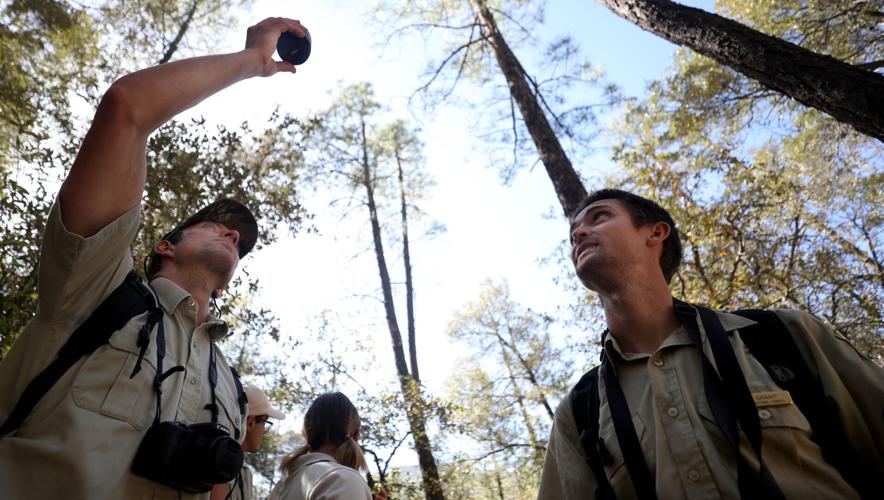
“At about sundown, the owl’s day is starting,” said Alex Grant, lead zone biologist for the Coronado. “We hike about half a mile, stop and start calling.”
Grant can imitate the male owl’s four-note call with his voice; the teams also have a mechanical caller and an iPhone app. They will wait 10 minutes. The owl, which is quite social and territorial, will respond if it hears a call.
Alex Grant, lead zone biologist for the Coronado, gives the call of the Mexican spotted owl during a survey technician training demonstration in the Santa Catalina Mountains. Video Kelly Presnell / Arizona Daily Star
If an owl calls, it’s noted and the team hikes another 1.5 miles — a rule-of-thumb average researchers have noted between owl territories. If no call is heard, they move half a mile and call again.
“We generally will hike 6 miles in an evening,” Grant said. They use headlamps but do not aim them at the solitary bird. For distant areas they sometimes backpack in. “We often hear the owls foraging at night after we are in our tents.”
Following Fish and Wildlife Service recovery guidelines, the teams will revisit the area three more times — at least a week apart — to make sure owls are occupying the area or have vacated it. This method is used to sample known Protected Activity Centers (PACs) — 600-acre foraging areas around a 100-acre nesting/roosting area where owls have been found in past surveys.
There are 20 PACs on the Santa Catalina Ranger District (the Santa Catalinas and part of the Rincon mountains) and 160 PACs on the entire Coronado National Forest.
“We keep visits to a minimum because it stresses the owl. They think, ‘someone is in my territory!” Grant said. “Owls are very noise sensitive” and may leave their nests if disturbed.
That’s why “management activities” — hazard tree removal or trail work involving chainsaws, prescribed burning or road construction — are not done in the Catalinas in known owl habitat during breeding and fledging (when young owls grow feathers and learn to fly) season, March through August. Prohibitions are set by the Fish and Wildlife Service Mexican spotted owl recovery plan.
Cabin owners (through a 108-year-old national forest program called “recreation residences”) on the mountain “are disappointed to find out they can’t put a new deck in during the summer,” because of spotted owl protections, said Neil Dutt, wildlife biologist for the Santa Catalina district. “However, we have found people are pretty receptive about protecting the owl. I am getting more questions about, ‘what can we do to help the owl?’ “
Driving, hiking, picnicking and other recreation is not restricted per se on roads and trails in the Catalinas during owl season. “But we don’t encourage forging your own trail or loud groups hiking at night,” Grant added. Dogs, which could harass birds, must be on leash in the forest.
And please don’t go looking for nests, said Shaula Hedwall, the lead Mexican spotted owl biologist for Fish and Wildlife Service. “We get reports on people hiring guides to take them to see the birds, they end up harassing them and that causes stress.”
The owls generally occupy the same area all year, some move to lower elevations in the winter.

Mexican spotted owls pair for life, although if one member dies, the other will seek a new mate.
Get to know the Mexican spotted owl
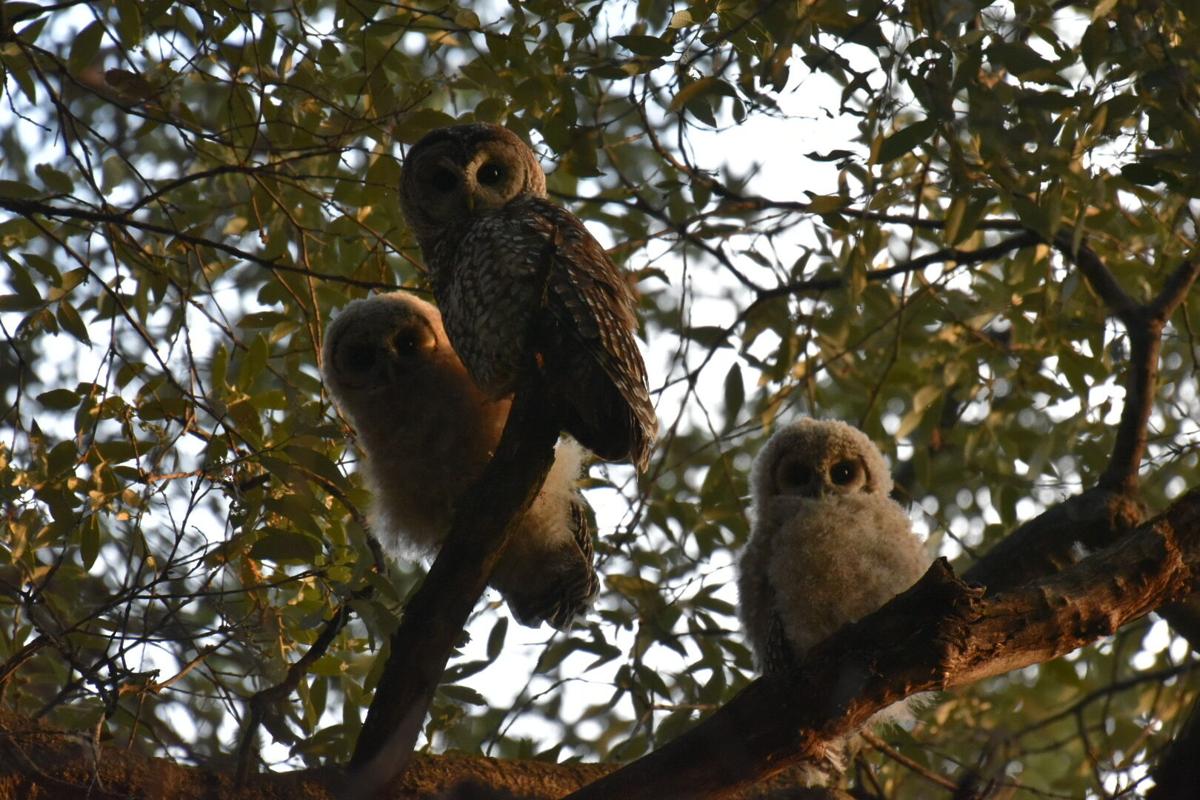
Courtship/breeding occurs in March and a female is usually on a nest by April. The female will lay one to three eggs and stay on a nest all month; the male brings food. Eggs hatch in early May and young owls fledge (grow feathers for flying) in June and July. Parents feed them into the fall when the young owls leave and seek a new nest site. Not every owl pair breeds every year.
The owls pair for life, although if one member dies the other will seek a new mate. They generally use the same nests year after year. Owls don’t build nests but use ones previously built by squirrels and other birds as well as “witches’ brooms” — prolific side-growth of tree branches in cluster caused by mistletoe, mites or other fungal, viral or environmental damage. Owls nest in mixed-conifer and pine-oak forests, and rocky canyons.
The Mexican spotted owl is one of three spotted owl subspecies along with the northern spotted owl (famous for reduced timber-cutting reductions in the northwest to protect its old-growth habitat) and the California spotted owl. The Mexican spotted owl is one of largest owls in North America, between 16 to 19 inches tall with a wingspan of 42 to 45 inches. Females are larger and heavier than males.
Mexican spotted owls are brown with irregular brown and white spots on their abdomen, back and head; they blend well into the foliage. Owls’ night-hunting equipment includes good hearing, dark-circled eyes for seeing in the dark and feathers that allow a silent approach. The owls hunt rodents, lizards and small birds. They perch on a branch and swoop down on prey with sharp talons that kill quickly.
Owls need habitat for their prey like logs and snags. They also need cover from their predators: great horned owls and red-tailed hawks. They favor riparian canyons with pine and layers of cover like oak or the increasingly rare old growth mixed-conifer at high elevations.

Matt Lachiusa, left, and Alex Grant of the Coronado National Forest use a Bluetooth speaker to broadcast the call of a Mexican spotted owl while demonstrating survey technician training in the Santa Catalina Mountains on April 19.
An indicator species
Large fires like Horsehoe 2 (2011) in the Chiricahuas, Frye Fire (2017) in the Pinaleños (Mount Graham) and the Bighorn Fire (2020) in the Catalinas destroyed much old-growth forest. Some owls have moved to lower elevations out of burned areas, Grant said. “Overall, they are resilient, holding on where they can.”
The technicians also check out new potential habitat identified by remote sensing technologies and also by familiarity with owl nesting preferences.
“If we see a narrow canyon with steep walls, it’s a good prospect,” Grant said. “However, getting into the area may be difficult.”
The forest has three new seasonal technicians and one from last season. They had many hours of training from Fish and Wildlife Service. Currently, they are honing field skills and Grant is assessing their outdoors capacity. For example, if some are skilled at rock climbing, they can access more areas.
Besides the forest-wide crew, two contractors are working in the Santa Catalinas. The Coronado district which administers Mount Graham (Pinaleños) has a wildlife biologist and two technicians. The area also hosts the Mount Graham red squirrel, a subspecies found only on Mount Graham and listed as endangered since 1987. With an endangered squirrel and a threatened owl, “they have their hands full and we also help them out,” Grant said. This year, a contractor couple will also cover the remote Galiuro Mountains.
Although the owl has a large geographic range, it’s habitat is narrow. It’s usually the top predator, Grant said. “That’s why the Mexican spotted owl is important. It’s a critical component of this habitat.”
When a predator is removed, its prey base often expands rapidly, either overrunning an area or starving.
“If the owl isn’t there to manage that amount of prey, they can affect other resources,” Grant said. The owl is also an indicator species for a healthy old growth system.
Although you shouldn’t seek out owl nests, if you’re hiking at twilight, Grant said, be quiet and listen, you may hear an owl calling. “We have seen owls along trail systems, out foraging.”
How many owls are there in the Catalinas? The technicians aren’t doing a precise count of the the owls. A complete owl census has never been done and would be too expensive and not that useful to managers. They need to know how and whether their actions impact owl habitat and population. The ultimate goal is recovering populations so they no longer need special protections.
“Individual owl surveys in the PACs inform management, so occupancy and breeding status are what is important at (that) scale,” Fish and Wildlife Service biologist Hedwall said. Fish and Wildlife Service will scale data from the PACs up to larger areas. Occupancy and trend of owls and habitat through time is how the agency evaluates Mexican spotted owl population health.
“It will take several years to begin determining the trend of the owl and its habitat,” Hedwall added.
Videos: Southern Arizona wildlife caught on camera
Playtime: Wildlife returns to backyard for some wrestling and fun
UpdatedNature strikes again in the backyard of Tucsonan Tracie Robbins. Seen here is a coyote stopping for a drink and a recap of bobcat kittens playing with each other over the last year. Robbins shares the various videos she captures on Twitter.
Rare ocelot caught on trail camera in Southern Arizona
UpdatedArizona's only known ocelot has been seen in the Huachucas since 2012. Vail resident Jason Miller captured this footage with a motion-activated trail camera on July 4.
Bobcat kittens play on patio furniture at Tucson home
UpdatedLocal bobcat kittens are at it again, this time playing on patio furniture as their mom watches. This video from July 20 is the latest shared by Tracie Robbins, a resident of Tucson's east side whose home is often visited by this furry family.
Javelina cools off in Tucson yard
UpdatedAs Tucson's heatwave rages on, reader Lawrence Winters shared this video of a javelina taking a dip in a water bucket to cool off.
Bobcat returns to Tucson home after a year with new kittens in tow
UpdatedTracie Robbins is no stranger to bobcat visitors. Last summer, a young bobcat family often played on the putting green in the back yard of her home in southeast Tucson. Exactly a year after her first sighting, the mother bobcat has returned with her newest litter in a video shared by Robbins on June 11, 2023.
Black bear spotted northeast of Tucson
UpdatedThe Arizona Game and Fish Department shared a video of the bear estimated to be two to three years old as it rummaged through garbage. Video courtesy of AZGFD.
Star reader catches glimpse of Javelina after-party at local resort
UpdatedA Star reader shared this video of seven javelinas he saw while at a Tucson resort Saturday, March 25.
Watch as Tucson's nighttime wildlife romps around
UpdatedA backyard wildlife camera captures funny antics by a javelina, raccoon and coyote. Video courtesy of Laura Bruner.
Tucson wildlife: A peccary pumpkin party
UpdatedJavelinas chow down on leftover Halloween pumpkins in a Tucson backyard.
Releasing bobcats for research
UpdatedWhen the cage door opens, collared cats don't wait around.
Research project continues tracking Tucson's urban bobcats
UpdatedResearchers endure casualties, criticism to learn about real wildcats.
Golf course coyotes howl at sunset in northwest Tucson
UpdatedReporter Henry Brean filmed this coyote chorus at Crooked Tree Golf Course on Dec. 27, 2022.
Downtown Tucson got a rare visit from a wild coatimundi.
UpdatedWatch Now: A coati caught at a historic mansion downtown is released back into the desert outside Tucson.
Just an ordinary bike ride ... following a bear
UpdatedTom Nielsen was out for a bike ride just south of the Oro Valley hospital and west of the marketplace when he managed to get this video. He tells the rest of the story. Video courtesy of Tom Nielsen.
Bobcats play in Tucson backyard
UpdatedTucson wildlife: Two bobcats were caught on camera playing with each other in the backyard of a Tucson home on the southeast side over the last few days.
The furry felines are frequent visitors to the backyard and you can see their latest antics shared on Twitter, courtesy Tracie Robbins.
Watch now: Bear sightings reported around Pima County
UpdatedSince Monday, bear sightings have been reported in Oro Valley, Tucson, Green Valley, Sahuarita and Hereford, the Arizona Game and Fish Department said. To report a bear sighting, the AZGFD says to call 623-236-7201. Video courtesy of AZGFD.
Watch now: Bobcats playing on an Oro Valley Golf Course
UpdatedSheryl Hester went out to take a sunset photo, but found these young bobcats playing on a golf course. She couldn't resist snapping away. Photos by Sheryl Hester
Watch now: Mountain Lion strolls outside home in Tucson Foothills
UpdatedA video showing a mountain lion outside a home in the foothills of the Tucson Mountains on Sunday evening was shared by Arizona Game and Fish Department Tuesday morning. "Such sightings of the wide-ranging species are routine in outlying areas of Tucson," AZGFD wrote.
You can help Arizona Game and Fish officials monitor the movement and behavior patterns of mountain lions in Tucson by reporting sightings to the department's 24-hour hotline at 623-236-7201. Video courtesy Arizona Game and Fish, Carmen and Jack VanDyke.
Watch Now: Trail cameras catch mountain lions at Tucson home.
UpdatedFour mountain lions have been recorded so far this year at a house in the Tucson Mountains.
Watch Now: Bobcat Sadie and a friend drink from a backyard fountain.
UpdatedA bobcat, named Sadie by researchers, drinks from a backyard fountain in Tucson in July, about two months before she was shot dead.
Watch now: Family of bears takes a stroll in southeastern Arizona
UpdatedSky Island Alliance recorded a family of bears strolling through the western foothills of the Huachuca Mountains southwest of Sierra Vista on one of its Border Wildlife Study cameras.
Watch Now: Mountain lion roaming in the Coronado National Memorial
UpdatedSky Island Alliance sees a mountain lion in the Coronado National Memorial on their Border Wildlife Study cameras. The Border Wildlife Study began in March 2020 around the time border wall construction began in the Huachuca Mountains and access roads were carved out in the Patagonia Mountains. Sky Islands Alliance set up 58 cameras along 30 miles of the U.S.-Mexico border, on both sides of the border. To find out more about the study go to skyislandalliance.org/our-work/wildlife-program/borderwildlife. Video courtesy of Sky Island Alliance
Watch now: Ding, dong! Bobcat filmed by front door camera in Tucson
UpdatedThis furry visitor was caught on a Ring doorbell camera outside of a home in the Colonia Solana neighborhood near Reid Park on Thursday, Aug. 25. Video courtesy of Nina Trasoff.
Watch now: Bear captured in Sierra Vista neighborhood, released
UpdatedA nearly 300-pound male bear was released back into the wild after being seen and filmed near Buffalo Solider Trail in Sierra Vista on Saturday morning. The bear climbed a residential wall and was captured near the Winterhaven neighborhood, according to Arizona Game and Fish. Video courtesy of Arizona Game and Fish Department Tucson.
Watch now: A cool cat takes a cool nap in the Foothills
UpdatedA bobcat prepares for a snooze under a bushy palm. The homeowner says he likes to scratch the gravel away so he can lay on the damp, cool, freshly watered dirt. On the hottest days, he's there for more than six hours. Video courtesy of Stephen Parquet, Catalina Foothills.
Watch now: Young bear seen in NW Tucson captured and released
UpdatedA young bear captured Saturday evening by Arizona Game & Fish officers in Tucson was released Sunday in good condition at a remote location. It was ear-tagged for future identification. The female, age 1-2, was sighted more than two dozens times since Wednesday be residents Northwest of Tucson. It was captured and tranquilized at Ina Road and La Canada Drive. Video courtesy of Arizona Game & Fish Department 2022
Watch now: Bear spotted rummaging through trash can in Oro Valley
UpdatedThe bear was seen Thursday morning near North Oracle Road and East Linda Vista Blvd., according to the Arizona Game and Fish Department. AZGFD advised residents in the area that items such as trash, outdoor pet food and bird feeders attract bears and sightings should be called into 623-236-7201. Video courtesy of AZGFD.
Watch now: Bobcat's breakfast near Oro Valley
UpdatedWatch as this bobcat stalks his prey and then catches it. Let this remind you not to leave small pets outside unattended. Video by Sandra McCauley.
Watch now: Breakfast with the deer on Tumamoc
UpdatedIt's not rare to see deer along the road at Tumamoc Hill, but the experience of seeing them in their natural habitat never gets old.
Watch now: Bobcat kitten plays with mother behind Tucson residence
UpdatedA bobcat kitten plays with its mother in the backyard of a Tucson residence throughout the month of July. These videos were captured and shared daily on Twitter as the kitten grew. Video courtesy of Tracie Robbins.
Watch now: Rescued porcupine released back into wild
UpdatedA porcupine was just released back into the wild near Parker Canyon Lake after being severely burned in a wildfire there and rescued in March. The porcupine was treated at Civano Animal Hospital in Tucson following the fire before further recovering at a conservation center in Scottsdale. Video courtesy of Arizona Game and Fish Department.
Watch now: Bobcat kittens play in a dry fountain
UpdatedThese bobcat kittens are having fun in a dry fountain in a backyard northwest of Tucson. Video by Steve Denning.
Watch now: Bobcat stops by Tucson waterhole for an overnight drink
UpdatedThis thirsty bobcat was filmed drinking from a well in a Catalina Foothills resident's back yard Saturday, July 9. "Fred" the bobcat is a regular visitor to this waterhole. Video courtesy of Yessica Wheeler.
Watch Now: Collared bobcat raises kittens in Tucson neighborhood
UpdatedResearchers and residents get a look at how an urban bobcat raises her young.
Watch now: Javelina family takes an evening stroll in midtown Tucson
UpdatedThis family of javelina was seen in a midtown Tucson neighborhood around sunset as the two adults and two furry youngsters strolled down a sidewalk. The Arizona Game and Fish Department recently urged the public to not attempt to rescue baby mammals, such as javelina, that may appear abandoned because the animals are typically left alone while the mother forages for food and water. Video by Dominika Heusinkveld.
Bobcat plays with its kitten in Tucson backyard
UpdatedTucson wildlife: A bobcat and its baby were caught on camera multiple times playing together in a backyard on Tucson's southeast side this weekend. These desert cats were seen on June 11 and 12, between 5 and 6 a.m., by Tucson resident Tracie Robbins, who shared the videos on Twitter.
"We may not see a bobcat for months, and then sometimes we’ll have visitors for several days in a row," Robbins said. She said she noticed a basket of golf balls tipped over when she woke up and took that as a sign that the cats routinely stop by to visit and play on the putting green outside. Video courtesy of Tracie Robbins.
Watch now: Mountain lion seen up-close on camera outside Tucson home
Updated"Elusive and rarely seen, they are more common in southeast Arizona than most residents think," the Arizona Game and Fish Department shared on Twitter. The mountain lion, filmed by Jerry Rowlette, was seen outside of a home in the foothills of the Tucson Mountains in May.
Residents who see a mountain lion can call 623-236-7201 to help AZGFD monitor their movement and behavior.
Watch now: Bobcats in love in the Tucson area
UpdatedTurn your sound on and listen to what may be a mating call from a bobcat. The bobcats were seen near the Catalina Foothills. Video by Kent.
Watch Now: Family of deer eating breakfast on Tumamoc Hill
UpdatedArizona Daily Star reporter, Cathalena Burch, and I are frequent walkers of Tumamoc Hill, located on the west side of Tucson. For the past several years we would come upon this family of deer eating and running across the walkway. On a recent morning they were not shy to hikers watching them and taking photos. Produced by: Mamta Popat, Arizona Daily Star
Watch now: A hummingbird plays in the sprinkler
UpdatedJust like the kids, hummingbirds must like cooling off with the sprinkler on hot Tucson days. Video courtesy of Jennifer Perez
Watch now: Breakfast time for the Quail family in the Tucson area
UpdatedIt's breakfast time for this Gambel's quail family northwest of Tucson. Mom and Dad (with the black belly) herd their 12 chicks as they eat seeds dropped by "landlord" Julian P. Donahue, who took this video.
Watch now: Frequent visitor to northwest Tucson home munches on meal worms
UpdatedTodd Martin calls his visitor Lenny the Lizard. He is fed meal worms when he visits. Lenny's companion, Elizardbeth, is a bit shy and hasn't approached for food. Video by Todd Martin.
Watch now: Playful lizards visit a Tucson back yard
UpdatedWendy O'Rourke calls these two Bob (the larger one) and Babette. They played around on the top of the wall for a while and are frequent visitors to Wendy's Tucson home. Bob has been known to steal a blueberry from those Wendy sets out for the birds. Video courtesy of Wendy O'Rourke.
Watch now: Startled mountain lion at Loews Ventana Canyon
UpdatedA young mountain lion thinks twice about entering Loews Ventana Canyon early Monday. Its age and startle response suggest that it was just learning its way around and not dangerous. Mountain lions are common in the Sabino Canyon area, but incidents are few. If seen call 623-236-7201. Video courtesy of Arizona Game and Fish Department.
Watch now: A true lounge lizard in Tucson
UpdatedMark Cormier says this is the resident Gila Monster at his home and offered this tidbit: A group of these lizards is called a lounge. This may be where the term lounge lizard comes from. Video by Mark Cormier.
Watch now: A spotted skunk threatens the worst at Saguaro National Park
UpdatedThis spotted skunk was captured on video doing a handstand at Saguaro National Park. That's often the last warning before you learn what "stinker" really means. Video courtesy of the National Park Service.
Watch now: Javelina mama and babies
UpdatedMama Javelina feeds her babies in a Catalina Foothills yard. Video by Jennifer Perez
Watch now: Mountain lion outside a home in the Tucson Mountain foothills
UpdatedA mountain lion outside a home in the Tucson Mountain foothills at night. Such sightings are routine in outlying areas, and require no management action by Arizona Game and Fish. Help them monitor their movement & behavior by calling 623-236-7201 if seen. Trail cam video by Jerry Rowlette.
Watch now: Family of bobcats spotted in Foothills back yard
UpdatedThree bobcats were filmed Jan. 2 passing through the back yard of a home in the Catalina Foothills just before sunset.
Jennifer Perez, who recorded the video of the feline trio and shared it on social media, said she often sees wildlife enter her yard from a deep wash located behind it. One bobcat shown can be heard softly growling around 30 seconds into the video. Video courtesy of Jennifer Perez.
Watch now: Backpacker’s intense standoff with mountain lion near Tucson
UpdatedWARNING: This video contains strong language. While at a Saguaro National Park campground, hiker Tiffany Foster warded off a cougar in a tree near her tent.
Foster, who filmed and posted the encounter on YouTube, was able to contact her husband via a two-way satellite messenger and escape the Grass Shack camping site north of Vail once the mountain lion retreated.
The National Park Service alerted hikers the following day to avoid Grass Shack Campground, located in the Rincon Mountains along the Arizona National Scenic Trail, and closed the area from Dec. 3 and Dec. 12 due to mountain lion activity.
The full uncensored video can be found here. Video courtesy of Tiffany Foster.
Watch now: Javelina rescued from trash can in Foothills neighborhood
UpdatedJavelinas are often seen near the La Casita Townhomes development in the Catalina Foothills. In-ground trash cans in the area seem to attract wildlife as they scavenge for food, but they also can trap the animals if they fall in.
Watch now: Owl takes a bath in trough on Tucson's northwest side
UpdatedThe female great horned owl is seen taking a quick dip in a watering hole in the yard of a Tucson resident who shared the video online last week.
Another male owl, thought to be this one's mate, has also routinely visited the trough, said Cindy Kelton, who filmed the video. Kelton has been filming desert animals as they stop by her backyard trough since 2014, including coyotes, javelina, roadrunners, and hawks. Video courtesy of Cindy Kelton.
Watch now: Coyote pups play in front yard near Tucson Estates
UpdatedThis year has been an active one for critters around Tucson. These coyote pups were spotted late this spring on Tucson's southwest side before the monsoon rains started. Video courtesy Cindy Broughton.
Broughton, who posted the video online in August, said a new litter of coyotes takes shelter in a drain pipe near her home every year before outgrowing it and moving to a nearby wash.
Bighorn sheep scatter in Catalina Mountains during aerial survey
UpdatedBighorn sheep scramble away from the helicopter during a recent aerial population survey in the Catalina Mountains. Video courtesy of Arizona Game and Fish Department.
Watch now: Bighorn sheep enjoy post-monsoon greenery near Tucson
UpdatedAn estimated 75 bighorn sheep are in the Santa Catalina Mountains after the Tucson area's monsoon livened up local habitats, according to a Wednesday tweet from the Arizona Game and Fish Department. Video courtesy Ben Brochu.
This summer's heavy rainfall has brought new plant growth and helped restore areas that were burned during the Bighorn Fire that raged in the Catalinas last year.
Watch now: Bear has a rub-a-dub in watering hole near Tucson
UpdatedA black bear caught on a wildlife camera in the Catalina Mountains stopped by a watering hole near Tucson for a quick drink and a bath July 14.
Video courtesy Greg Joder @_eco.nut_ on Instagram.

