



As national media has focused on the U.S. border agents confronting a high volume of migrant arrivals between ports of entry, Arizona stakeholders are calling for more resources for officers working within the nation’s busy and understaffed ports.
Immigrant-rights advocates also say building greater capacity to receive asylum seekers at the ports of entry — instead of inadvertently channeling them to remote locations in between — would reduce the burden facing border agents in the field.
Nogales, Arizona’s ports of entry process more than $30 billion worth of imports and exports between Arizona and Mexico each year, said Jaime Chamberlain, president and CEO of Nogales-based Chamberlain Distributing. The family-run business has imported fruits and vegetables from northern Mexico for more than 50 years.
“My business runs on the effectiveness and efficiency of the ports of entry,” said Chamberlain, who is also board chairman for the Greater Nogales and Santa Cruz County Port Authority.
Yet the highly trained port officers have been shuttled away from their areas of expertise, to assist border agents in the field with tasks like driving asylum seekers to processing stations, he said. In addition to undermining efficiency at the ports, that affects morale and officer retention rates, he said.

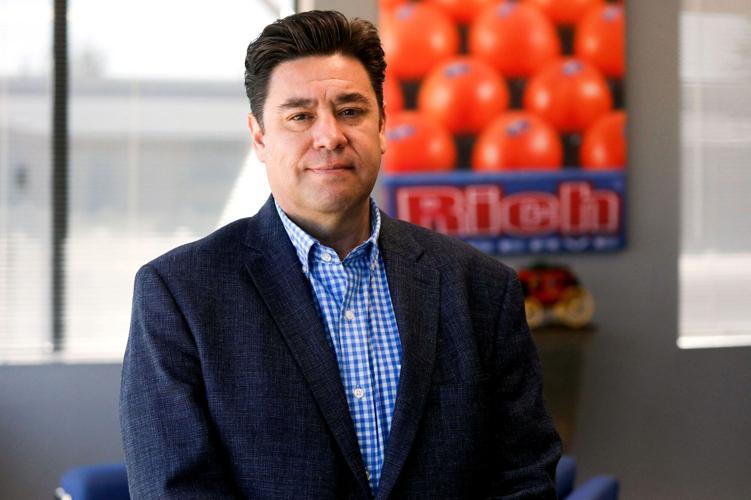
Jaime Chamberlain, the president of Chamberlain Distributing Inc. and Chairman of greater Nogales and Santa Cruz Port Authority, on Jan. 18.
“We are going to not only lose people now, but we’re going to lose people in the future and have a very difficult time in hiring,” he said.
U.S. Customs and Border Protection’s latest staffing models say 4,000 more CBP officers are needed to meet today’s workforce needs, said Anand Muni, national executive vice president for the National Treasury Employees Union, which represents CBP officers as well as employees of 34 other federal agencies.
The U.S. Department of Homeland Security appropriations for fiscal year 2024 include funding for 1,795 more Border Patrol agents, but only 150 additional CBP officers at the ports of entry, according to the union.
Officers have been stretched thin, strained physically and emotionally, and some have been demoralized by getting transferred away from their families and their area of expertise in order to help at the southern border, the union says.
Since 2022, CBP officers across the country have dealt with 11 instances of temporary deployments to help at the southwest border, Muni said.
“They’re taking 300 to 400 officers at a time and moving them around to the southern border,” he said. “You’re disrupting that many lives constantly, every 60 days.”
As the national budget debates play out, immigrant rights activists worry that conservative legislators’ focus on more restrictions to the U.S. asylum system will only exacerbate chaos between ports of entry.
When asylum seekers can’t access the ports of entry, they’re more likely to arrive in hard-to-reach places, far from processing infrastructure, said Pedro De Velasco, director of education and advocacy for Kino Border Initiative. The binational nonprofit offers food, shelter, legal assistance, psychological support and other services to migrants at its resource center in Nogales, Sonora.
For migrants, crossing the border between ports of entry now means paying criminal groups who control the smuggling routes south of the border, and who often drop migrants in remote areas along the Arizona-Mexico border, he said. That results in massive logistical challenges for border agents who’d rather be focusing on finding migrants seeking to evade detection.
“Nobody wants people crossing through remote areas: the U.S. government doesn’t want it, the NGOs (non-governmental organizations) don’t want it,” he said. “It’s only a benefit to organized crime (groups), who are exploiting people’s desperation.”
De Velasco recounted that, during a meeting last summer, border agents called it "'an operational nightmare’ to move people from the middle of nowhere, to a place where they can process them,” he said. “So it’s like, okay, if you want people to enter at the ports of entry, you have to increase capacity there.”
Blue shirts vs. green shirts
U.S. Customs and Border Protection is the umbrella agency over both Border Patrol and the Office of Field Operations. The latter oversees the CBP officers that man the ports of entry.
In contrast to the green-shirted border agents who work between ports of entry, the typically blue-shirted CBP officers work at land, air and sea ports across the country. Their duties include drug and weapons interdiction, inspection of agricultural imports, anti-terrorism work and regular immigration processing.

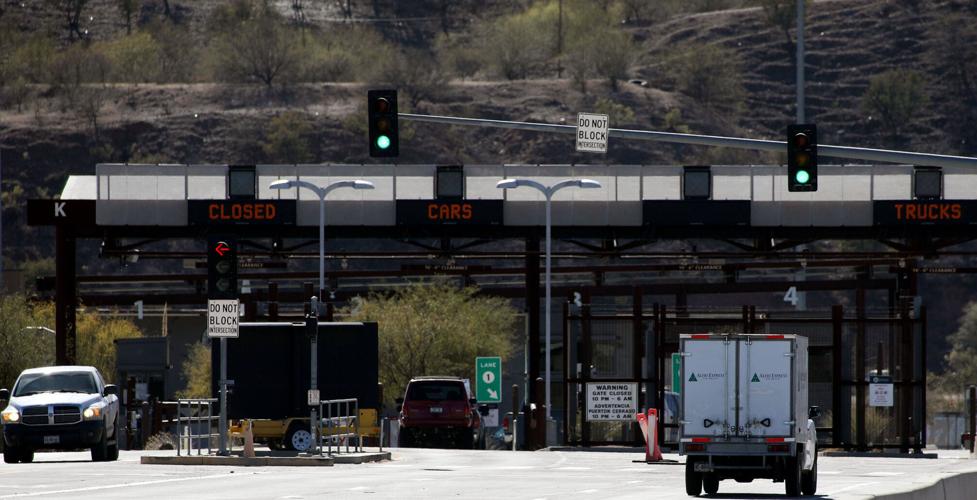
The Mariposa Port of Entry in Nogales, Arizona.
And now, southern land port officers face a new task of handling appointments made through the CBP One application, which the Biden administration touts as the only legitimate way for most migrants to enter the U.S. to apply for asylum. But advocates say the app has far too few appointments available to meet the high demand, leaving asylum seekers waiting six months or more for an appointment, often in dangerous conditions in Mexico.
Increased staffing at the ports will be necessary to meet the higher workload imposed by CBP One appointments and to hopefully pave the way for a significant increase in the number of appointments offered, according to a January report from the Washington, D.C.-based Migration Policy Institute.
The report’s authors interviewed port officers and border agents along the U.S.-Mexico border as they developed eight recommendations for how to meet today’s migration challenges on the border, said report co-author Colleen Putzel-Kavanaugh.
In speaking with CBP officers, she said she was “in awe” of the sheer amount of responsibilities handled at the ports.
“It’s really a remarkable feat,” she said. Scaling up the CBP One application’s accessibility will require investments, she said.
“They’ve tried to adapt the CBP One appointments into the infrastructure that already exists,” she said. “But some of that means that they are taking areas they may have used for something else and repurposing it to process CBP One applications. That begs the question, could this be increased and what would it take to do that in terms of infrastructure and in terms of workforce?”
Arizona delegation on board
Port officers are frustrated by the looming possibility of a government shutdown, which would likely necessitate work without pay, said union rep Muni, who was a CBP officer at the port of San Francisco from 2008 until last year.
A 35-day government shutdown that ended in January 2019 meant officers going without paychecks for weeks, he said.
“If they (legislators) care about the border so much, if they care about the officers so much, give us the resources we need and stop using us as political pawns,” he said.
Arizona’s governors and congressional delegations, past and present, understand the importance of Arizona’s ports of entry to the state and national economy, said Lance Jungmeyer, president of the Nogales-based industry group Fresh Produce Association of the Americas.
“In Arizona, the border is viewed as a resource and an asset, something to be pragmatic about,” he said. “In other states, particularly in Texas, you have a governor there who tries to use the problems that are happening to bring even more negative attention or disruption to the border. That results in businesses wondering whether that can be a reliable place to do business.”
Arizona Sen. Kyrsten Sinema led negotiations that resulted in the bipartisan infrastructure law, passed in 2021, which provided $500 million to modernize ports of entry in Arizona, including at San Luis.

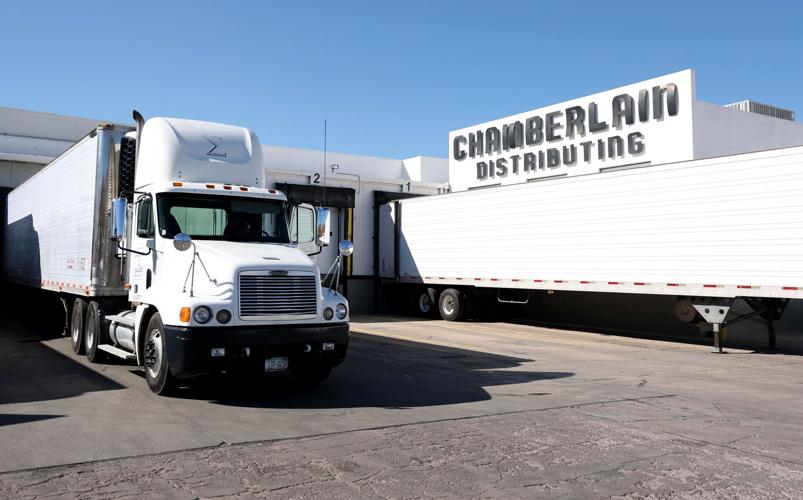
LEFT: A semi-truck parks in the dock to be loaded with cargo at Chamberlain Distributing, 2731 N. Donna Ave., in Nogales, Ariz., on Jan. 18. RIGHT: The inspection station at the Mariposa Port of Entry, 210 N. Mariposa Road, in Nogales Ariz., on Jan. 18. The port of entry is the primary U.S. port for Mexican fruits and vegetables.
She’s now helping lead the ongoing Senate negotiations for a “comprehensive border security package,” which is currently tied to the national budget negotiations.
Sinema said she couldn’t give specifics, but on Thursday she told the Arizona Daily Star that legislators are “very close” to a deal.
“Work I’m doing on the border package will allow us to prioritize the flow of individuals into the country seeking asylum, so that folks who are coming (with legitimate claims) are more likely to get asylum and those who are economic migrants will not have incentive to apply,” she said.
Immigration and border law is “Byzantine and complex,” she said. “Negotiations have been painstakingly cautious and careful, because we want to get it right.”
Otherwise, she said, “we’ll have decades of litigation, without actually solving the problem.”
In mid-January Arizona Sen. Mark Kelly co-sponsored legislation to fund more CBP officers and border agents, as well as the purchase of “non-intrusive inspection systems,” which give detailed scanned images of the interior of vehicles and cargo containers at the border, his office said. The bill would also create a program to focus on seizing U.S. firearms smuggled into Mexico for use by criminal gangs there.
“Border Patrol and Port Officers have been stretched far too thin as they do the difficult job of keeping our country safe every single day,” Kelly said in a press release. “This bill would give federal law enforcement the additional personnel and technology needed to keep our ports of entry fully staffed, stem the flow of illegal drugs, and secure the border.”
Drug seizures are far more likely to occur at ports of entry than out in the field: About 90% of drugs seized nationally by CBP are discovered at the ports of entry — often in cargo containers or passenger vehicles — rather than by border agents between ports of entry, according to CBP.
Earlier this month a 19-year-old U.S. citizen was arrested at the Douglas, Arizona port of entry for attempting to smuggle 123 pounds of fentanyl — about 492,000 pills — into the U.S., concealed in a compartment in the bed of his pickup truck.
Still, CBP is only able to scan 3.7% of the 11 million cargo containers that enter the U.S. annually, according to a 2021 report in the American Journal of Transportation.
Taking resources from ports
In September, CBP began shifting some officers temporarily away from the ports of entry to help with processing large numbers of migrant arrivals between ports, extending wait times for travelers crossing into Nogales, Arizona, said the city’s mayor, Jorge Maldonado.
But the need for more resources at the Nogales ports pre-dates those staff reassignments, Maldonado said.
“We’ve been asking for more (CBP officers) for the last 10 years,” he said. “Our port at Mariposa has got 12 gates and at the most, they open eight. DeConcini has six gates, but most of the time only four are open.”
Then in early December, CBP closed the Lukeville-Sonoyta port of entry for four weeks, with devastating impacts on local economies on either side of the border, and a steep drop in tourism for businesses in Rocky Point, Sonora, which Arizona tourists typically access through the Lukeville port.
The closure at Lukeville, and other ports in Texas and California, prompted an outcry from border community members.
After the Lukeville closure, a group of stakeholders in Arizona, including Maldonado and Chamberlain, developed a list of six recommendations for port of entry operations, which they submitted to Arizona’s local, state and national elected officials.
Their recommendations include: only deploying CBP personnel to support Border Patrol operations if the federal government declares a national emergency; renewing a program that gives financial and educational incentives for officers who choose to work at Arizona’s ports of entry; and providing needed resources for CBP to properly monitor technology used at the ports of entry.
Local recruiting, and quicker hiring practices, were also among the recommendations, said Matias Rosales, chairman of the Greater Yuma Port Authority board, who also signed on to the recommendations.
Rosales said when he first moved to Yuma County from California, he applied to be a CBP officer but the background check took two years. By the time he was offered the job, Rosales’ wife was pregnant and he had moved on professionally, and so had to turn down the position.
“There has to be a way to safely vet the person, but to do this in a timely fashion,” he said.
Yuma County has two ports of entry: a pedestrian port, “San Luis 1,” which is currently open while undergoing a complete modernization project, and the commercial port known as “San Luis 2.”
The latter is one of the major commercial ports in Arizona for agriculture, and the port is now capturing more trade business coming from Baja California, where the Mexican port city of Ensenada is seeing a high increase in manufacturing imports, he said. Proper staffing is crucial to the port’s ability to remain competitive with California’s ports, he said.
Even shifting a small number of port officers to the field has a dramatic impact on wait times for commercial and pedestrian traffic, he said.
“If our port director asked to move six officers to help (border agents) in processing centers in Yuma, that right there shuts down two lanes of entry,” he said. “That makes a big difference in waiting 1.5 hour to cross, to making that a four-hour wait.”
Particularly for produce distributors, time is of the essence when it comes to international shipping, said Jungmeyer, who’s also board chairman for the Border Trade Alliance.
Predictability in shipment timing is crucial, and a half-day delay at the port of entry can cause a chain reaction of missed shipments, lost income or lost work-hours for warehouse employees, who might get sent home if trucks aren’t there to unload, he said.
Loss of that predictability “creates a burden on the company responsible for delivering this on time and really steps into their profit margins, and harms their ability to be in business,” he said.
With the election coming up, and political pressure to take some action on the border, Jungmeyer said he’s worried poorly considered legislation could be the result.
“Sometimes when there’s pressure for quick action, the wrong choice is made that has negative unforetold consequences,” he said. “That’s why we want to work closely with the federal government now, to make sure all the resources are there to conduct legitimate trade and travel, while humanely and effectively working with the migrant crisis going on.”
Get your morning recap of today's local news and read the full stories here: tucne.ws/morning

