


DOUGLAS, Ariz. — Arizona Democratic Sen. Ruben Gallego praised investments in Arizona’s busy ports of entry, and decried what he called Republicans’ moves toward cutting critical health services to finance tax cuts, during a whirlwind visit to Cochise County on Tuesday.
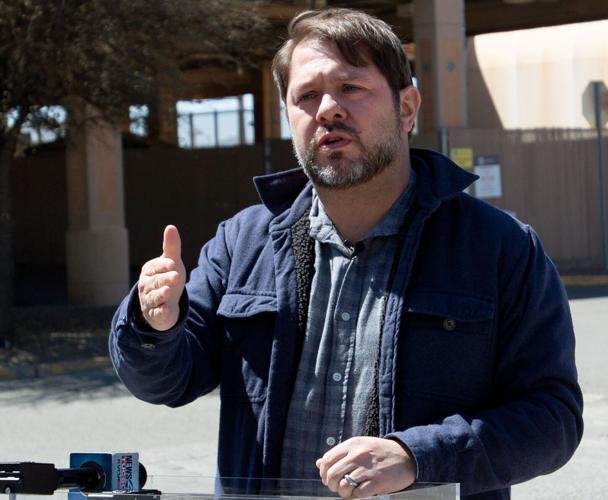
Investments in ports of entry “pay for themselves” through increased trade and job creation, Gallego said, speaking to media in front of the Douglas port of entry, which he said is the nexus of $1 billion in international trade each year.
The Trump administration’s on-and-off again tariffs against Canada and Mexico, as well as 25% tariffs on steel and aluminum imports, have launched an “arbitrary” trade war that only serves to undermine the U.S. economy, especially in border regions like Southern Arizona, Gallego said.
“I want to make sure these East Coast politicians or northern politicians understand: You can have strong border policies, with strong trade between two countries that have worked together for generations, and you don’t have to end up putting us in a bad situation economically,” Gallego said.
Last year, Cochise County received $216 million to construct a new commercial port further west of the Raul H. Castro port, and $184 million for the rehabilitation of the existing port. The projects — funded through the Bipartisan Infrastructure Law — are expected to bring an estimated $10.8 million to $20 million per year in additional revenue to the region, according to Cochise County.

U.S. Sen. Ruben Gallego, D-Arizona, holds a press conference in front of the Raul H. Castro Port of Entry in Douglas on Tuesday.
“I would love nothing more, going into the future, than to have more expansions, so we can make sure that every parcel that comes through here is checked, that everyone who comes through is checked,” Gallego said. “I hope people will continue to push for investments at the border. We all benefit as a state, as a country, with a strong Douglas and a strong Southern Arizona economy.”
Responding to the possibility that Douglas could lose federal investments in the port projects, amid the Trump administration’s Department of Government Efficiency cuts, Gallego said that would be “the dumbest thing the United States federal government could do is to cut this type of investment.”
“The more imports that we can bring in here means more jobs for Southern Arizona,” he said.
Douglas Mayor José Grijalva has said 70% of the city’s sales tax comes from visitors from Agua Prieta, the Mexican town just across the border. In January the Douglas City Council voted 3-2 to declare a state of emergency, fearing a dramatic decline in revenue from sales taxes, tourism and other commerce areas, and requesting “compensatory assistance from the federal government.”
Health care fears at town hall
Later Tuesday, Gallego took questions from the public at a town hall held at a Chiricahua Community Health Center clinic location in Douglas. The community health center here serves 35,000 patients annually, about half of them on Medicaid, said Dr. Jonathan Melk, CEO of the federally qualified center. The center serves all of Cochise County at 11 sites, plus mobile medical and dental sites, he said.
Medicaid is a federal-state program to provide health care to low-income Americans. One-third of Cochise County’s residents are on Arizona’s Medicaid program, known as AHCCCS, or Arizona Health Care Cost Containment System, Melk said.
“Pulling off primary care in a very complex system on the U.S.-Mexico border is not easy to do,” he said. “We turn nobody away based on ability to pay. ... If we were to dramatically reduce Medicaid (payments), that would probably impact our overall ability to provide services to everyone,” including the centers’ patients who have commercial insurance, including Border Patrol agents, port officers and teachers.
U.S. House Republicans approved a budget resolution in late February which directs the House Energy and Commerce Committee to cut the deficit by at least $880 billion over the next 10 years. At the same time, Republicans are looking to finance $4.5 trillion in tax cuts, the Associated Press reported.
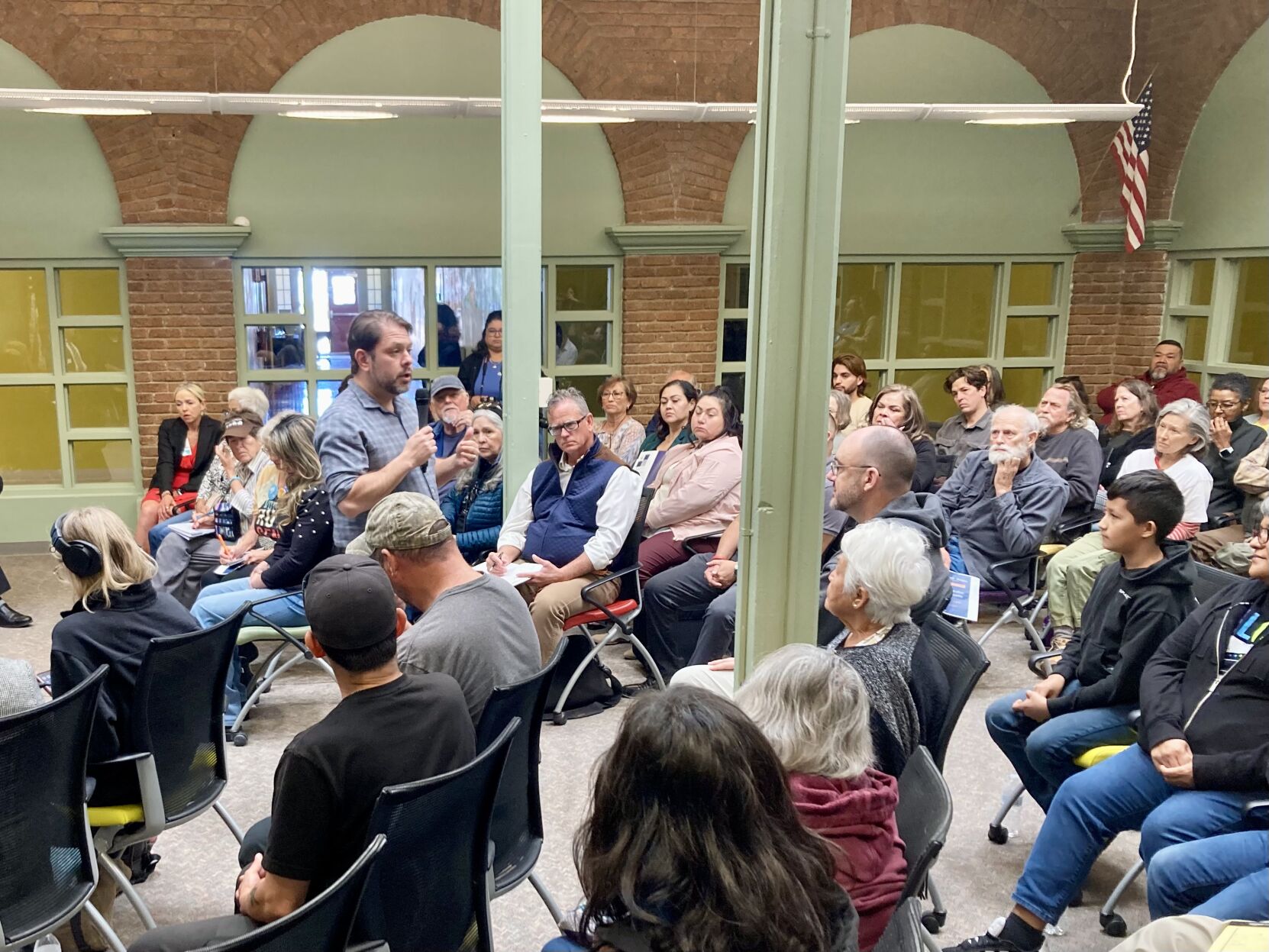
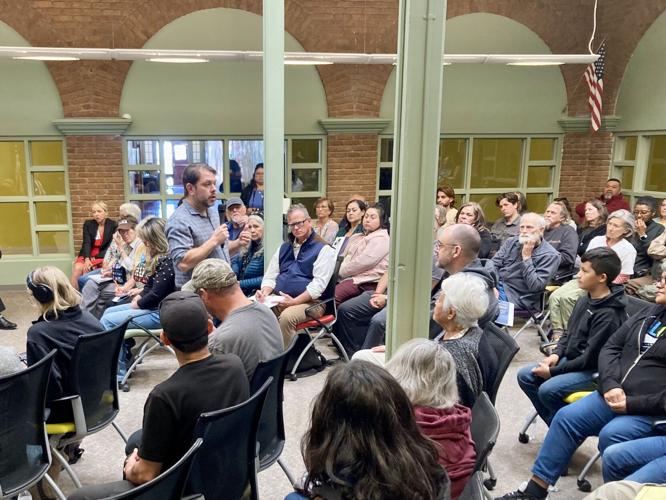
Sen. Ruben Gallego speaks at a town hall meeting in Douglas, Arizona, at a Chiricahua Community Health Center clinic location on Tuesday.
While some Republicans have denied plans to cut Medicaid, they’ve also ruled out cuts to Medicare. But if Medicare is off the table, significant savings could only be achieved by cuts to Medicaid, which accounts for more than 90% of the remaining funding streams that fall under the Energy and Commerce Committee’s jurisdiction, according to an analysis by the Congressional Budget Office.
Town hall attendee Michael Henderson, 45, said he’s been increasingly worried about potential cuts to AHCCCS. He said he has a chronic condition that affects his pancreas and requires him to take an enzyme medication to be able to digest food. Without AHCCCS, the cost would be $1,500 a month, he said.
“If I lose that, I’m gonna be in rough shape. I won’t be able to eat,” he said. “I’m just concerned about the state of the country. That’s why I came, because I can’t just talk about it online. I need to get involved.”
Speaking to attendees, Gallego spoke of his childhood, growing up in a poor family and putting off medical care as long as possible. It’s a familiar scenario for many, he said, which ultimately ends up driving up costs as preventable health problems worsen.
Gallego acknowledged that governments have to make tough financial decisions.
“There are some areas where there is fraud, waste and abuse, and you should actively be looking for that,” he said. “But what’s happening right now at the federal government is this administration wants to find enough room, in terms of savings by cutting Medicaid, in order for them to give more tax cuts. ... It’s not because we need to; it’s because they want to.”
Especially in rural areas, even small cuts to programs like Medicaid can have ripple effects in terms of difficulty hiring medical staff, and maintaining service levels, he said. And private insurance premiums will go up, if hospitals have to raise prices to compensate for reduced income from public insurers like Medicaid, he said.
“If Medicaid gets cut, the very delicate system that connects everybody can go down. It is hard enough to recruit technicians, doctors, nurses, specialists, to rural Arizona,” Gallego said. “If your job gets harder and harder, and you see better options somewhere else, people are going to start leaving. ... And they are hard to replace.”
Afterwards, Gallego attended a town hall-style meeting with veterans in Sierra Vista where he planned to highlight his resistance to the Trump administration’s extensive cuts to VA employees, which threaten critical services for veterans, his office said. The Trump administration has cut 2,400 VA employees already and plans to lay off 80,000 more, the AP reported earlier this month.
Gallego cosponsored a resolution demanding the reinstatement of those employees, but it was blocked by Republicans, his office said. He was also among the Democrats on the Senate Veterans’ Affairs Committee who sent a letter to VA Secretary Doug Collins seeking answers about the mass layoffs.
“It defies logic and reason that the agency could cut an additional 83,000 employees, beyond the 2,400 or more that you have already terminated, without healthcare and benefits being interrupted,” the letter said.

