





NOGALES, Ariz. — The threat of 25% tariffs still looming, Nogales seed distributor Sabrina Hallman says the farms she works with in Mexico are struggling to figure out how much seed to order for their upcoming growing season, anticipating that rising food prices will lower consumer demand.
“This is my booking season right now — today, yesterday, tomorrow,” Hallman, president and CEO of Sierra Seed Company, said on Friday. “Tariffs on April 2 aren’t helping me at all.”
Southern Arizona produce importers and distributors, as well as agricultural-input suppliers like Hallman, are trying to figure out how to weather the next few weeks and beyond, once the Trump administration’s 25% tariffs on Mexican imports take effect again on April 2 — for the second time this year.
The long-threatened 25% tariffs on Canadian and Mexican products went into effect on Tuesday, but President Donald Trump later agreed to a one-month pause for goods covered under the trade agreement implemented in Trump’s first term, the U.S.-Mexico-Canada Agreement.
The temporary relief — which importers say covers all agricultural products from Mexico — followed a Wednesday phone conversation with Mexican President Claudia Sheinbaum, and a stock market tumble.
“I did this as an accommodation, and out of respect for, President Sheinbaum,” Trump wrote on Truth Social.
Yet the tariffs were in effect for three days this week, distributors said Friday. Many who work in cross-border trade say any relief over the delay is outweighed by the brutal uncertainty they’re still facing.
“It’s absolutely awful, anxiety-ridden. You can’t future plan. You can’t even next-week plan,” Hallman said during a Friday roundtable discussion, held at the Fresh Produce Association of Americas’ office in Nogales. “That 25% puts us out of business.”

Gov. Katie Hobbs, at a roundtable discussion Friday in Nogales with the Fresh Produce Association of the Americas, said, "For our economy to be successful, for businesses to be successful ... there has to be predictability. And this back and forth on the tariffs is just creating chaos, and Arizonans are paying the cost of that."
At the roundtable discussion, Southern Arizona business owners voiced their worries to Gov. Katie Hobbs, during the Democratic governor’s Friday afternoon listening tour at three stops in Nogales. Hobbs said she wanted to hear how tariffs have disrupted businesses in Southern Arizona and how the state can help.
“We’re going to do everything we can to communicate those concerns to the administration and help share the message that we heard here today, and hear from folks in what ways we can be the most helpful to try to mitigate some of this impact,” Hobbs told reporters after the discussion.
Hobbs said she’d pass on business owners’ concerns to the Trump administration and Arizona’s congressional delegation, as well as to the Arizona-Mexico Commission in a meeting scheduled for Monday.
Also on Friday, U.S. Rep. Juan Ciscomani, a Tucson Republican, led a group of freshmen Republicans on an Arizona border tour, meeting with U.S. Department of Homeland Security and Department of Defense officials, a press release said. They also took a tour of the Nogales port of entry and heard from local stakeholders, including produce distributors and customs brokers.
Ciscomani said he’d share their tariff concerns with the Office of the U.S. Trade Representative, which advises the president on trade issues, importers told the Arizona Daily Star.
Trump said the tariffs are a response to Mexico and Canada’s failure to do more to stop the smuggling of drugs and humans across U.S. borders. Hobbs said linking those two issues is counterproductive.
“I think we have to work together on cooperation on the border and stopping the criminal activity that’s hurting, frankly, both of our countries,” Hobbs said. “But I think the tariff discussion really should be separate. For our economy to be successful, for businesses to be successful ... there has to be predictability. And this back and forth on the tariffs is just creating chaos, and Arizonans are paying the cost of that.”
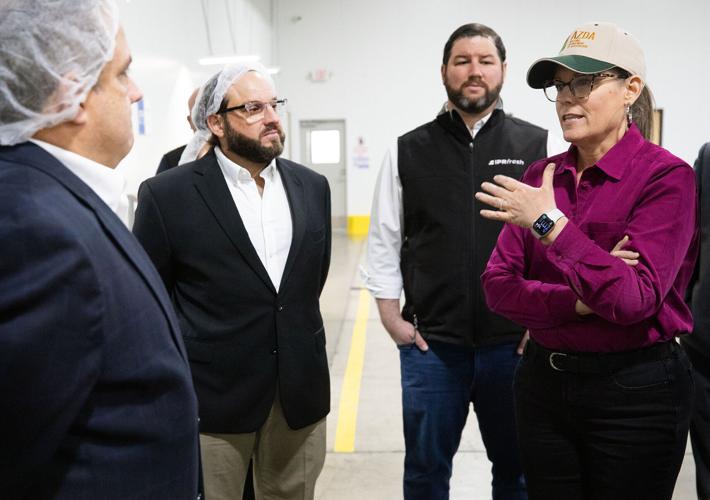
Hobbs also toured the chilly produce warehouse at IPR Fresh, a fresh produce importer and distributor in Nogales. IPR Fresh owner José Luis Obregón said he had to boost his sale prices by 25% while the tariffs were in effect, to compensate for his increased costs.
“It’s really hard to make business decisions when you don’t know what’s going to happen tomorrow, or next month, or next year,” Obregón said after talking with Hobbs. “If we know what the rules are gonna be, then we’d adapt to it, we’d make it work.”

Gov. Katie Hobbs, far right, talks Friday with José Luis Obregón, president of IPR Fresh, far left, about how the tariff threats by the Trump administration affect his business in Nogales, Arizona. "It's really hard to make business decisions when you don't know what's going to happen tomorrow, or next month, or next year," Obregón said.
The agriculture import-and-export industry plays a massive role in Arizona’s economy and is the largest employer in Santa Cruz County.
Presenting data from a recent University of Arizona study he co-authored, agricultural economist George Frisvold said higher input costs, like those stemming from tariffs, could have ripple effects throughout the industry, including on the exports side.
Arizona processed food manufacturers and agricultural input suppliers operate on tight profit margins: If their costs go up by only 8%, they would lose all their profits if they didn’t pass on higher prices to their customers: farmers, retailers, wholesalers and restaurants. But raising prices to stay in business worsens food price inflation, he said.
In Arizona, agricultural import and export activities contribute more than $3 billion in sales to the state economy and support more than 12,000 jobs, Frisvold said.

George Frisvold, University of Arizona agricultural economist. In Arizona, agricultural import and export activities contribute more than $3 billion in sales to the state economy and support more than 12,000 jobs, he said.
The “prevailing sentiment” among customs attorneys is that importers will owe the additional 25% tariffs on imports made during the three days the tariffs were in effect, though some were hoping otherwise, said Guillermo Valencia, a Nogales-based U.S. Customs broker.
His company, Valencia International, works with importers to ensure they meet the bond requirements that insure their duty payments, and to determine how much they owe U.S. Customs and Border Protection.
Valencia said his customers are struggling to finance the higher bond requirements they’re now facing from CBP, in anticipation of new tariffs.
“It’s definitely uncharted territory, and who knows where we’re gonna be next month,” he said at the roundtable discussion.
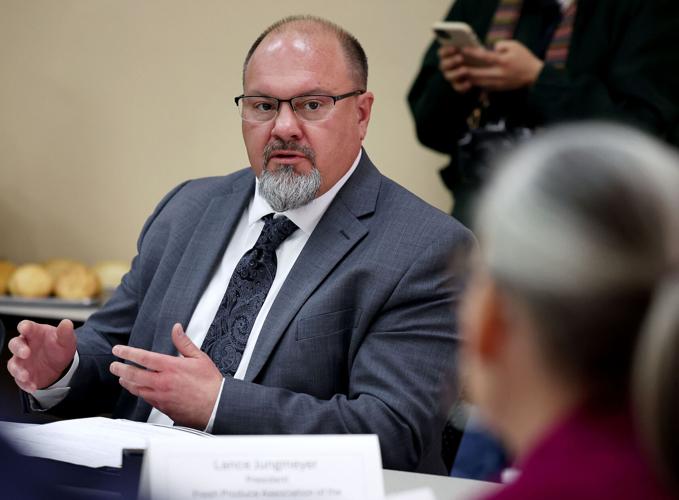
Importers have 10 days to pay tariffs, starting from the day an import is received. But they usually don’t get paid by their customers who buy those imports for 30 to 45 days, said Lance Jungmeyer, president of the Fresh Produce Association of the Americas, a Nogales trade group representing 120 companies along the Southwest border that import and distribute Mexican produce.

Lance Jungmeyer, president of the Fresh Produce Association of the Americas, talks to Gov. Katie Hobbs during a roundtable Friday in Nogales, Arizona with other business leaders about the Trump administration's tariff threats. Importers have 10 days to pay tariffs, starting from the day an import is received. But they usually don't get paid by their customers who buy those imports for 30 to 45 days, Jungmeyer said.
Those higher tax obligations will create significant cash-flow challenges that smaller businesses will struggle to survive, he said.
Jungmeyer told the Star he’s already heard of retailers switching their produce sources to Central American countries, instead of Mexico, to avoid the tariffs.
“Everyone has been having to reevaluate all their partnerships, supply chain,” he said on Thursday. “It’s already had an effect.”
At the southern border, imports of manufactured goods, like automobiles, slowed significantly for the few days the tariffs were in effect, said Jaime Chamberlain, president and CEO of Nogales-based Chamberlain Distributing. The family-run business has imported fruits and vegetables from northern Mexico for more than 50 years.
Ford has an auto-assembly plant in the Sonoran capital of Hermosillo, said Chamberlain, past chairman of the Board of Directors of the Greater Nogales Santa Cruz County Port Authority.
“Ford did not send any of their cars from Hermosillo by rail or by truck for two days,” he said.
But fresh produce importers don’t have that flexibility to pause or delay receiving perishable goods that need to be refrigerated and sold quickly, he said.
At his growers’ farms in Mexico, there’s only a day or two’s worth of refrigerated space available to hold crops that would otherwise be lost, Chamberlain said.
On Friday, Chamberlain said he asked the Governor’s Office and Ciscomani to help press the Trump administration for a permanent tariff exemption for agriculture imports, which ensure year-round supply of fresh produce that couldn’t be achieved otherwise.
“Our Mexican-grown products are part of the total supply chain for the rest of America,” he said. “There’s probably been an adversarial attitude for over 100 years between domestically grown products and imported products. We have to get rid of that and change the narrative.”

