




New rooftop-solar customers of Tucson Electric Power will get 10% lower credits for excess energy they export to the grid, under a reset of such credits approved Thursday by the Arizona Corporation Commission.
But the utility panel voted to put off until October discussion of changes to the solar export credits, after hearing an earful from solar-industry advocates who said further cuts would reverse years of precedent and devastate the industry, and from advocates of deeper cuts who said the solar credits are unfairly subsidized by other customers.
TEP’s solar export credit rate — known as the Resource Comparison Proxy or RCP rate — will drop to 6.33 cents per kilowatt hour starting Oct. 1, down from a rate of 7.03 per kWh that has applied to new solar installations since Oct. 1 of last year.
The new RCP rate applies to TEP customers who apply to interconnect their solar systems on or after Oct. 1 and remain in effect for those customers for 10 years.
Rooftop solar customers of TEP sister utility UniSource Energy Services and Arizona Public Service Co. also will get similar 10% cuts in credits for excess power they send to the grid, under similar rate-setting decisions by the ACC at the same open meeting.
At the request of TEP and the ACC staff, the utility panel approved the maximum 10% annual decrease in the solar energy export credits — and they could have gone even lower under an unsuccessful proposal by one commissioner.
ACC Chairman Jim O’Connor voted with Republican colleagues Lea Marquez Peterson and Kevin Thompson and Democrat Ana Tovar to approve the proposed solar export rates.
Deeper cuts avoided
Commissioner Nick Myers voted against the 10% rate cuts, after withdrawing amendments that would have dropped the export rate more than 10%, to as little as 3 cents per kWh.
Those amendments, filed by Myers this week, drew fire from solar-industry advocates who said further cuts would unfairly violate the 10% annual cap on export-rate decreases adopted in 2017.
That cap was approved after years of consideration and hearings as part the so-called “Value of Solar” case, a landmark 2017 overhaul of the state’s solar rules that ended so-called net metering, or full retail-rate credits for excess energy exports.
Court Rich, an attorney representing the Arizona Solar Energy Industries Association (AriSEIA), said cutting the solar export rates beyond the cap approved for the utilities for the past six years would be unfair and potentially unlawful.
“Good government doesn’t change the rules in the middle of the game, good government doesn’t tell all these folks and the thousands of people who work in the solar industry that have been relying on a stable system that ‘you know what, this year we’re just going to do something different’ — that’s not what good government is,” said Rich, also representing the national Solar Energy Industries Association, electric-car and home-battery maker Tesla and the home solar company Sunrun.
“And it’s illegal, from a legal standpoint we’re talking about due process,” Rich added, noting that stakeholders had little time to analyze and respond to Myers’ amendments.
O’Connor said he believes the current commission is free to change the solar export rules.
But after the commission went into a closed executive session to get legal advice on the matter, O’Connor said he supported approving the 10% export-rate decreases and discussing at its October open meeting whether to reopen the Value of Solar case to re-examine the solar-export rules.
“The commission, whomever was working here in 2017, they’re gone and it’s now us,” he said.
“So, we need to be brought up to speed, take fresh eyes, a fresh look and balance all the moving parts in this rather complex arena,” O’Connor said, inviting public members to file written comments.
Subsidy debate
Myers said he would withdraw his amendments with the expectation of further discussion of reforming the solar export rate.
“Customers are paying more for power than it’s worth, and they’re locked into that payment for an entire decade, and additionally I’m not a fan of subsidizing industries on the backs of ratepayers,” he said.
Marquez Peterson, who lives in Tucson and is the only ACC member from outside Maricopa County, said she was willing to vote for the 10% rate step-downs but it’s important to have a deeper discussion of the solar export rate issue.
“I think it’s the right step for regulatory certainty, I do hear from so many in the solar industry, installers and others, about how important that is,” she said.
Tovar said the 2017 solar policy and its limits on export-rate decreases represented a compromise that is relied upon by solar companies that employ some 8,000 workers across the state and customers who have planned their solar systems based on the ACC rules.
“All of this could be in jeopardy, if we change the terms now,” she said.
Solar slowdown?
During a public-comment period Thursday, solar advocates including representatives of several solar installation companies urged the commission to reject Myers’ call for deeper cuts to the RCP rate.
Autumn Johnson, executive director of the AriSEIA, said higher interest rates are making it hard for rooftop solar systems to work financially for many consumers, citing concerns that 2023 may see overall installations drop.
“That does make it harder for those projects to pencil out, in addition obviously to the (RCP) step-down,” Johnson said.
Aiyana Koch-Martinez, a team coordinator with Tucson-based solar installer Technicians for Sustainability, urged the commission to reject the deeper solar-credit cuts proposed by Myers.
“If you’ve run a business, I think we can all agree it’s not a good practice to change the rules in the middle of the game, especially the rules that were created by all of the stakeholders coming together in good faith to create a balanced approach,” Koch-Martinez said.
But Merissa Hamilton, a Mesa-based Republican activist, urged deeper cut to solar credits, claiming solar companies are supporting “green slavery” by buying materials like cobalt from Africa.
“It is also immoral for ratepayers to have to subsidize, pay higher rates to the homeowners who have solar,” Hamilton said.
Myers said solar installations that are growing rapidly show that maintaining higher solar export rates is unneeded.
He cited figures showing the number of TEP residential customers with rooftop solar nearly doubled from just over 21,000 in 2018 to nearly 40,000 or about 9.8% of more than 400,000 home accounts in 2022.
“If an industry that is 15 or 20 years old cannot survive without a subsidy, how bad of a business model is that?” Myers said.
Credit step-down
TEP’s RCP started at around the retail rate of about 11.5 cents per kWh in 2018 and has dropped 10% annually since, except the ACC voted to keep the rate unchanged at about 10.4 cents in October 2020 during the height of the COVID-19 pandemic.
Under the ACC’s decision, the RCP rate for new solar customers of UniSource, which serves Mohave and Santa Cruz counties, will drop to about 7.6 cents per kWh from 8.4 cents now.
The RCP for APS customers will drop to 7.6 cents from 8.5 cents per kWh.
The RCP rates are based on a rolling, historical five-year weighted average cost of grid-scale solar photovoltaic facilities the utility owns or purchase power from, and “avoided costs” for power transmission, distribution and line losses.
Solar advocates said the export rate should be based on the avoided cost at the price the utilities pay for wholesale power, which averaged more than 10 cents per kWh last year.
In its application, TEP said that based on confidential data shared with regulators — but not made publicly available — the actual RCP rate should be just over 3 cents per kilowatt hour, so it asked for the maximum 10% decrease.
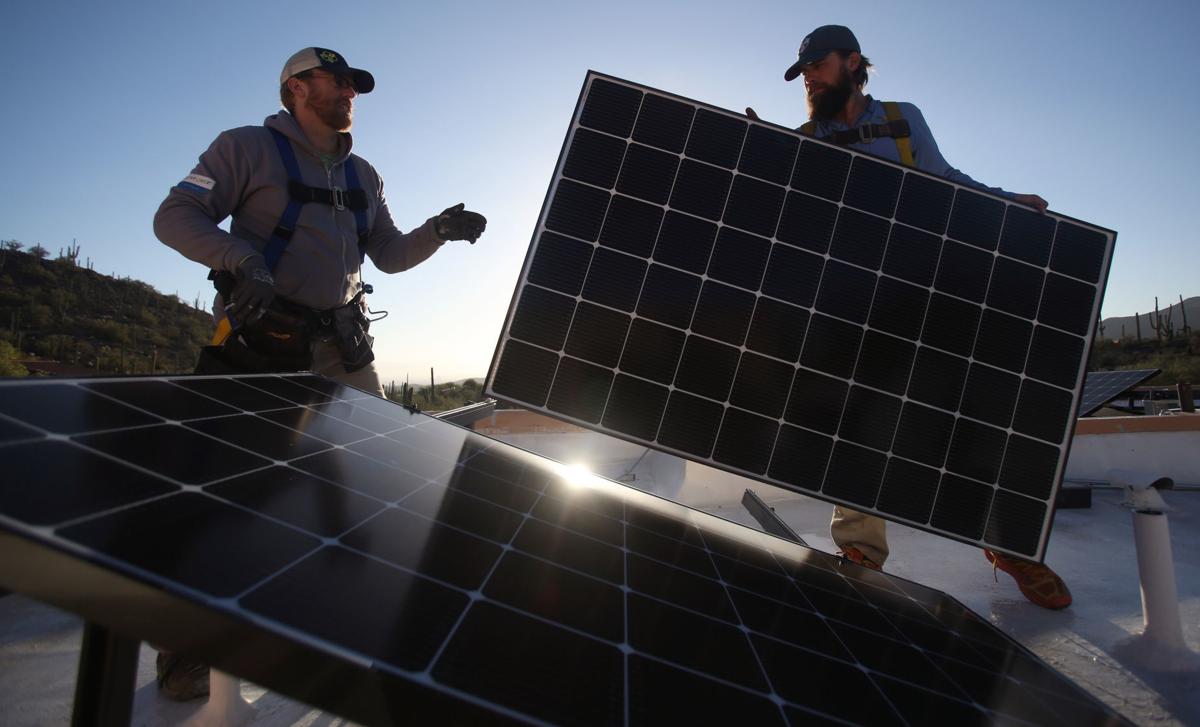
Workers from the Tucson-based company, Technicians For Sustainability, install a solar panel system on a customer's home on March 18, 2021. Video by: Mamta Popat/Arizona Daily Star

