


A federal judge Wednesday refused to set aside the conviction of Joseph Bongiovanni, saying he is not permitted to speculate as to why the jury reached its verdict against the retired Drug Enforcement Administration special agent.
Complete coverage: The case of ex-DEA agent Joseph Bongiovanni
Jurors in October found Bongiovanni guilty on seven of the 11 counts he faced in U.S. District Court, making him the first DEA agent in Western New York convicted of corruption.
But in the retrial, jurors acquitted Bongiovanni of one count that specifically accused him of accepting bribes from the Ron Serio and Michael Masecchia drug-trafficking organization.
"We are disappointed with the court's ruling," said defense attorney Robert Singer, who with attorney Parker MacKay represented Bongiovanni. "The ruling fails to address the core of our argument that the government charged this case as a conspiracy involving bribes and failed to prove that twice."
Prosecutors contended the drug organization paid more than $250,000 to Bongiovanni, under a deal arranged by his longtime friend Louis Selva, for protection between 2010 and 2017 as the organization sold 10,000 pounds of marijuana and 5 kilos of cocaine in Western New York until Serio’s arrest.
What’s more, even though jurors convicted Bongiovanni of narcotics conspiracy, they found that the weight of marijuana that was “reasonably foreseeable” for Bongiovanni to know about was less than 110 pounds.

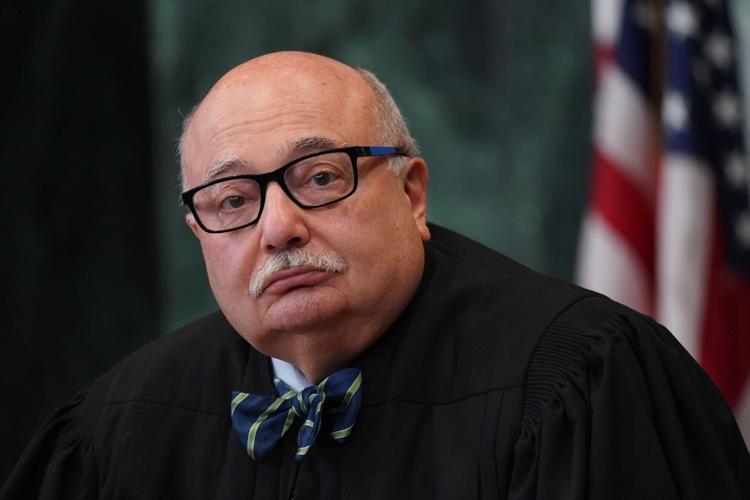
U.S. District Judge Lawrence Vilardo.
Had jurors believed Bongiovanni played a role in the thousands of pounds of marijuana that Serio distributed across Western New York, they would have found that a much greater weight was proven in the conspiracy, MacKay and Singer have said.
So Bongiovanni’s lawyers argued the jury’s finding that less than 110 pounds of marijuana was foreseeable to him indicates that the jury found Bongiovanni guilty only of conspiring to protect his longtime friend, Selva, who had a basement marijuana grow in his basement, but not of conspiring to protect the much larger drug organization.
“But to reach that conclusion, this court must speculate as to what was in the jurors’ minds,” U.S. District Judge Lawrence Vilardo said in his ruling.
That’s something the 2nd U.S. Circuit Court of Appeals has explicitly prohibited, Vilardo noted.
“Indeed, even when verdicts are clearly inconsistent, the court is not to try to guess which of the inconsistent verdicts is the one the jury really meant,” Vilardo wrote.
Prosecutors from the U.S. Attorney’s Office in Buffalo contended the first count against Bongiovanni charged a conspiracy with two separate objectives: to defraud the United States and the Drug Enforcement Administration and also commit bribery.
The government had to prove only one of those objectives.
“The jury could convict Bongiovanni on Count 1 if it found that he defrauded the United States and the DEA without receiving money in exchange for his efforts,” Vilardo said. “And in fact, there was ample evidence suggesting that Bongiovanni did just that.”
The only definitive conclusion Vilardo said he could draw from the jury’s verdict on Count 3 – conspiracy to possess with intent to distribute controlled substances – is that the government did not prove that Bongiovanni could reasonably foresee that the conspiracy involved more than 110 pounds of marijuana.

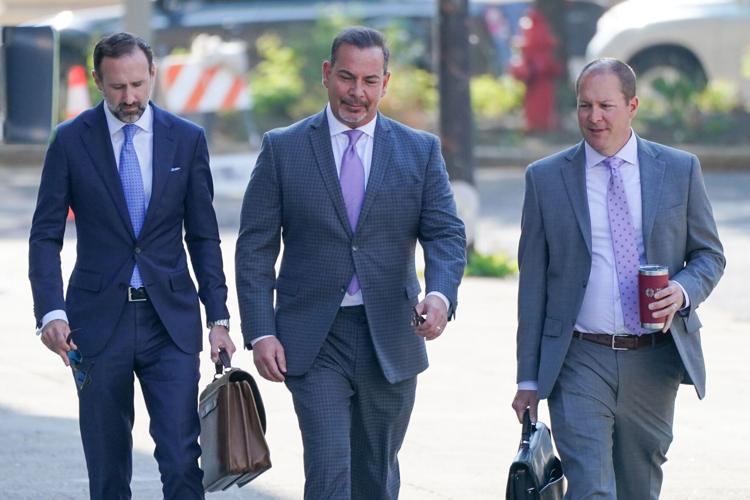
Former DEA agent Joseph Bongiovanni, middle, arrives for a hearing on June 21, 2023, at the Robert H. Jackson U.S. Courthouse with attorneys Parker MacKay, left, and Robert Singer.
“To infer that the jury also concluded that Bongiovanni did not conspire with Masecchia is mere speculation,” Vilardo said. “Moreover, there was ample evidence that Bongiovanni used his position as a DEA agent to cover for Masecchia even if Bongiovanni received no bribes and even if he did not know the full scope of the drug conspiracy.”
Bongiovanni’s attorneys said the evidence, at best, could establish only that Bongiovanni knew of Selva’s simple possession of the small amount of marijuana.
“Once again, Bongiovanni asks this court to read too much into the jury’s verdict,” Vilardo wrote.
The judge said he could glean from the jury’s verdict that the government failed to prove that more than 100 pounds of marijuana was reasonably foreseeable to Bongiovanni as part of the conspiracy.
“But that does not, as Bongiovanni claims, permit the inference that the jury found only that he protected Selva’s small grow operation or that the government’s proof on Bongiovanni’s involvement in the Serio DTO conspiracy was lacking. Again, this court is not permitted to speculate as to why the jury reached its verdict.”
Bongiovanni’s lawyers have objected to the U.S. Probation Office’s presentence investigation report, making some of the arguments for a lesser offense level as they did trying to convince Vilardo to set aside the verdict. Vilardo said he will issue a separate decision addressing those presentence report objections.
At his retrial, jurors convicted Bongiovanni, 60, of four counts related to the Serio drug-trafficking organization: conspiracy to defraud the United States; conspiracy to distribute controlled substances; and two counts of obstruction of justice.
His three other convictions are related to Pharaoh’s Gentlemen’s Club owner Peter Gerace Jr.: two counts of obstruction of justice and one count of false statement to a U.S. agency. These convictions were over internal DEA memos he wrote and for what he told investigators about his past contact with the Cheektowaga strip club owner.
Bongiovanni was found not guilty of one count of conspiracy to defraud the United States; one count of conspiracy to distribute controlled substances; and one count of obstruction of justice – all charges that named Gerace.
At Bongiovanni’s first trial, a jury deadlocked on most of the counts but convicted him of two charges over a DEA case file kept in his home after his retirement.
Bongiovanni’s sentencing was scheduled for July 15, but that was converted to a status conference. A new sentencing date has not been set.

