





University of Arizona faculty and students express mixed views after Democratic Gov. Katie Hobbs signed a bill that will prohibit encampments on university or community college campuses.
“It’s disappointing that Governor Hobbs has let the Legislature outlaw an effective and traditional form of peaceful campus protest by criminalizing it as trespass,” said UA Chair of the Faculty Leila Hudson.
“The university already has policies regulating campus use, structures, and camping, so criminalizing protest encampments can be seen as emphatically stifling a traditional modality of nonviolent civil disobedience with the threat of disproportionate penalties and exposure to police violence,” Hudson said.
On May 7, Hobbs signed HB2880 into law, to prohibit “establishing or occupying an encampment on a university or community college campus“ and mandating procedures universities and community colleges must follow in case an encampment occurs.
Rep. Alma Hernandez, a Tucson Democrat who sponsored the bill, said it will protect the integrity of public universities by ensuring safety. “Upholding the right to free speech and peaceful protest” is a priority, she added.
“However, encampments have never been protected by the First Amendment and have no legal right on our campuses,” Hernandez said. “In the wake of the October 7th events, we witnessed how encampments disrupted the educational experience and created tension within our university communities. ... This legislation is a balanced step that upholds First Amendment rights while affirming that our campuses are places for education, not disruption.”
Last year, university campuses across the country, including in Arizona, were sites of pro-Palestinian encampments during Israel’s ongoing war against Hamas in Gaza that began with the Oct. 7, 2023 Hamas attacks on Israel. Numerous universities have faced targeted attention from the Trump administration since January, including being investigated for allegedly encouraging anti-Semitism on their campuses. Some international students who participated in protests have been targeted for deportation.
At the UA, a pro-Palestinian protest and encampment in the spring of last year ended with UA police and other law enforcement agencies breaking up the camp with rubber bullets and pepper balls after some protesters threw objects at officers.
Edan Levy, describing himself as a Jewish Israeli-American student at the UA, said he was directly impacted by last year’s “anti-Israel encampments” and he strongly supported the bipartisan passage of HB2880. He said the legislation “strikes a critical balance between upholding the fundamental right to free speech and empowering universities to address conduct that crosses into harassment and intimidation.”
“These encampments became platforms for targeted harassment and hostility towards Jewish students. My friends and I were spat on, called slurs, and told to ‘go back to Poland’ by individuals participating in the encampment,” Levy said. “I firmly believe in freedom of speech and freedom of assembly. However, people do not have the right to establish lairs of hatred used to launch attacks against Jewish students and endanger the safety of all students on campus.”
Vanessa Perry, a UA professor, said the new law will give college administrators and others “even more” opportunity to conflate pro-Palestinian sentiments with anti-Semitism.
Recalling the UA protests and encampments last spring, Perry said she “cannot even fathom the disproportionate show of force this law will invite.”
“This bill is deliberate censorship of pro-Palestinian voices,” she said.
The procedures the new law will require institutions to follow include: immediately directing individuals involved to “dismantle the encampment and vacate the campus;” advising them that anyone who fails to comply and leave is “guilty of criminal trespass;” initiating legal action to have them removed from campus if they don’t leave; and initiating disciplinary action against students who refuse to leave or to comply with the institution’s code of conduct.
Max Thomas, a UA student who took part in the pro-Palestinian protests last year, said the government is choosing to focus on prosecuting protesters of what he calls genocide in Gaza, instead of on genocide itself.
“This bill undoubtedly infringes on students’ rights to speech and assembly. And for what?” Thomas asked. “I truly can’t wrap my head around the reality that the political response to anti-genocide protest is to weaponize the state against students.”
Hudson, the UA faculty chair, wrote to the Arizona Daily Star that, “The local encampments protesting the Israeli destruction of Gaza (and U.S. institutional complicity in it) follow in the tradition of peaceful civil disobedience of Dr. Martin Luther King Jr. and have been sites of interfaith community, education, and civil discourse. ...
“They have been the targets, not the source, of violence,” said Hudson, an associate professor in the School of Middle Eastern and North African Studies.
Samuel Gottfried, a UA student, said he doesn’t believe the legislation limits free speech at all and that instead, it helps students express opinions in ways that don’t prevent other students from having access to buildings or resources.
“Nor will it allow those who want to express their opinions to intimidate or incite violence against any individual or group of people,” Gottfried said. “I want to thank the Arizona Legislature and Governor Katie Hobbs for signing this law into effect, and I hope that this helps set the groundwork for more civil discourse on our campuses as opposed to the ugly incidents of the last year and a half.“
Nolan Cabrera, a UA professor, said if the encampments were supporting Israel, this bill never would have passed.
“Historically, universities have frequently stifled unpopular speech,” he said, pointing as an example to steps taken to repress anti-Vietnam War protests. “The current actions are a modern day version of this tension.”
Photos: Police break up second pro-Palestinian encampment on University of Arizona campus
Pro-Palestine protests
Updated
Demonstrators retreat along University Boulevard in a cloud of teargas and taking hits from pepper balls as several area law enforcement agencies use chemical ammunition to clear an encampment of pro-Palestinian demonstrators off the University of Arizona campus, May 10, 2024, Tucson, Az.
Pro-Palestine protests
Updated
Demonstrators use homemade shields to fend off some of the pepper balls fired at them by law enforcement as pro-Palestinian protestors are pushed off the University of Arizona campus and west on University Boulevard, May 10, 2024, Tucson, Az.
Pro-Palestine protests
Updated
A demonstrator carries a street barricade, one of several protestors took to buttress the walls of their encampment of pro-Palestinian protestors on the University of Arizona campus, May 9, 2024, Tucson, Az.
Pro-Palestine protests
Updated
Law enforcement officers toss and kick away obstacles on Park Avenue left by retreating demonstrators as several area law enforcement clear an encampment of pro-Palestinian demonstrators off the University of Arizona campus, May 9, 2024, Tucson, Az.
Pro-Palestine protests
Updated
A line of demonstrators form a line to confront the area law enforcement agencies marching towards them near the intersection of Park Avenue and University Boulevard, May 10, 2024, Tucson, Az.
Pro-Palestine protests
Updated
Demonstrators retreats in a cloud of tear gas as several area law enforcement agencies clear an encampment of pro-Palestinian demonstrators off the University of Arizona campus, May 10, 2024, Tucson, Az.
Pro-Palestine protests
Updated
Arizona Department of Public Safety officers stop and don gas masks and riot helmets as they prepare to clear an encampment of pro-Palestinian demonstrators off the University of Arizona campus, May 9, 2024, Tucson, Az.
Pro-Palestine protests
Updated
A law enforcement officer pulls the pin on a tear gas canister while clearing an encampment of pro-Palestinian demonstrators off the University of Arizona campus, May 10, 2024, Tucson, Az.
Pro-Palestine protests
Updated
An officer fires a chemical ammunition round into a cluster of demonstrators while clearing an encampment of pro-Palestinian demonstrators off the University of Arizona campus, May 10, 2024, Tucson, Az.
Pro-Palestine protests
Updated
A line of several area law enforcement agencies stands at the intersection of University Boulevard and Park Avenue after ejecting a small group of pro-Palestinian demonstrators off the University of Arizona campus, May 10, 2024, Tucson, Az.
Pro-Palestine protests
Updated
A demonstrator claps to music in an encampment of pro-Palestinian demonstrators on the University of Arizona campus, May 9, 2024, Tucson, Az.
Pro-Palestine protests
Updated
Demonstrators hold a sign for traffic along Park Avenue outside an encampment of pro-Palestinian protestors on the University of Arizona campus, May 9, 2024, Tucson, Az.
Pro-Palestine protests
Updated
A demonstrator hauls in a pair of barricades appropriated to help reinforce the walls of an encampment of pro-Palestinian demonstrators on the University of Arizona campus, May 9, 2024, Tucson, Az.
Pro-Palestine protests
Updated
A demonstrator shines a laser into the faces of photographers watching an encampment of pro-Palestinian demonstrators on the University of Arizona campus, May 9, 2024, Tucson, Az.
Pro-Palestine protests
Updated
Officers from several area law enforcement agencies form a line and advance on an encampment of pro-Palestinian demonstrators on the University of Arizona campus, May 9, 2024, Tucson, Az.
Pro-Palestine protests
Updated
A demonstrator watches one line of law enforcement advance on the encampment of pro-Palestinian protestors at the University of Arizona, May 9, 2024, Tucson, Az.
Pro-Palestine protests
Updated
Demonstrators form a line as they prepare to face off with hundreds of law enforcement officers pushing them out of their encampment at the University of Arizona, May 9, 2024, Tucson, Az.
Pro-Palestine protests
Updated
Demonstrators lock arms after retreating out of their encampment as law enforcement officers push them down Park Avenue and off the University of Arizona campus, May 10, 2024, Tucson, Az.
Pro-Palestine protests
Updated
A demonstrator yells towards the law enforcement officers clearing an encampment of pro-Palestinian protestors at the University of Arizona, May 10, 2024, Tucson, Az.
Pro-Palestine protests
Updated
An organizer speaks to an encampment of pro-Palestinian demonstrators preparing to face off with law enforcement on the University of Arizona campus, May 9, 2024, Tucson, Az.
Pro-Palestine protests
Updated
A couple walks past graffiti on the wall of a Main Gate Square business after law enforcement forced a knot of pro-Palestinian demonstrators off the University of Arizona, May 10, 2024, Tucson, Az.
Pro-Palestinian protest
Updated
Two pro-Palestinian protesters organized set up a barrier to an encampment on the University of Arizona campus in Tucson, Ariz. on May 9, 2024. Police broke up the camp hours later.
Pro-Palestinian protest
Updated
A woman takes photos of pro-Palestinian protesters as they march on the University of Arizona campus and set up an encampment in Tucson, Ariz. on May 9, 2024.
Pro-Palestinian protest
Updated
Pro-Palestinian protesters organized push back on University of Arizona police as staff tried to set up flood lights on an encampment on the University of Arizona campus in Tucson, Ariz. on May 9, 2024. Police broke up the camp hours later.
Pro-Palestinian protest
Updated
Pro-Palestinian protesters set up tents for an encampment at the olive grove on the University of Arizona campus in Tucson, Ariz. on May 9, 2024. Police broke up the camp hours later.
Pro-Palestinian protest
Updated
Pro-Palestinian protesters organized by Students Against Apartheid march down University Blvd. to the University of Arizona campus in Tucson, Ariz. on May 9, 2024. Protesters set up another encampment which police broke up hours later.
Pro-Palestinian protest
Updated
A single pro-Palestinian protester walks down University Blvd. towards other marchers as they make their way to the University of Arizona campus in Tucson, Ariz. on May 9, 2024. The protesters set up another encampment, but it was broken up by police hours later.
Pro-Palestinian protest
Updated
Pro-Palestinian protesters organized by Students Against Apartheid gather in Catalina Park then marched to the University of Arizona campus and set up an encampment in Tucson, Ariz. on May 9, 2024.
Pro-Palestinian protest
Updated
Pro-Palestinian protesters stand along a wall at the olive grove on the University of Arizona campus and set up an encampment in Tucson, Ariz. on May 9, 2024. Police broke up the camp hours later.
Pro-Palestinian protest
Updated
An organizer speaks to pro-Palestinian protesters gathered at the olive grove on the University of Arizona campus in Tucson, Ariz. on May 9, 2024.
Pro-Palestinian protest
Updated
Pro-Palestinian protesters bring in supplies to set up an encampment at the olive grove on the University of Arizona campus in Tucson, Ariz. on May 9, 2024. Police broke up the camp hours later.
Pro-Palestinian protest
Updated
A University of Arizona police officer yells out to pro-Palestinian protesters that they will be arrested for trespassing as they set up an encampment at the olive grove on campus in Tucson, Ariz. on May 9, 2024.
Pro-Palestinian protest
Updated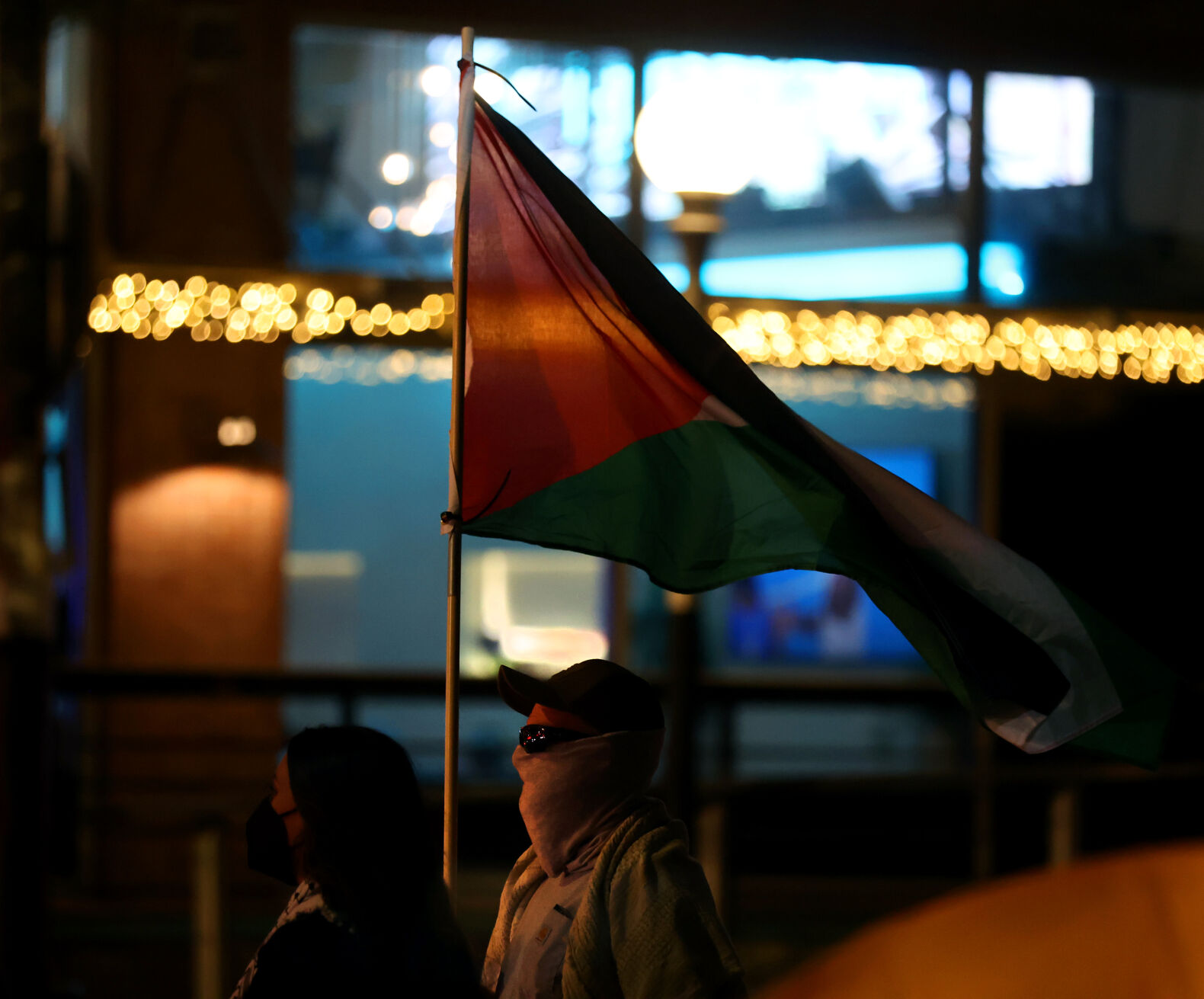
A pro-Palestinian protester stands along Park Ave. near the olive grove at the University of Arizona campus in Tucson, Ariz. on May 9, 2024.
Pro-Palestinian protest
Updated
Pro-Palestinian protesters organized by Students Against Apartheid gathered in Catalina Park then marched to the University of Arizona campus and set up an encampment in Tucson, Ariz. on May 9, 2024.
Pro-Palestinian protest
Updated
Pro-Palestinian protesters set up an encampment at the olive grove on the University of Arizona campus in Tucson, Ariz. on May 9, 2024. Police broke up the camp hours later.

