

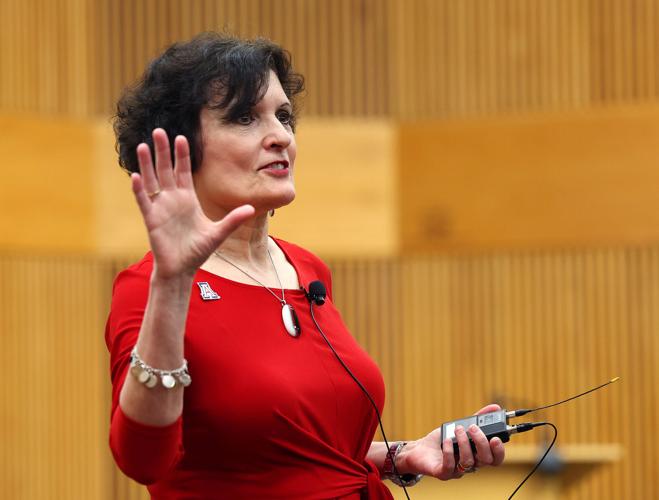
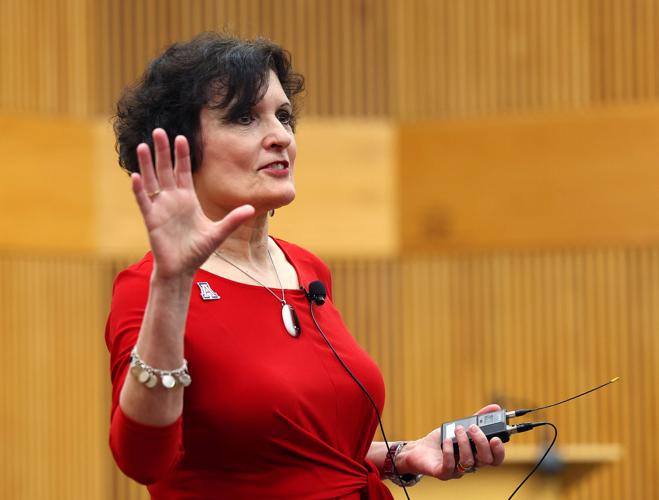

It is important for universities to avoid being reactionary in this challenging time and implement “inclusive excellence” for all students, Patricia Prelock, the fourth and final University of Arizona provost candidate said during an on-campus forum Monday.
“It’s not an easy time when there’s so much uncertainty and confusion, so I think just honoring that – that’s real,” Prelock said during a discussion of DEIA and campus cultural and resource centers amid the Trump administration’s many executive orders and notices demanding universities shut down diversity and inclusion practices or risk losing federal funds.
“If you look at the strategic imperatives that President (Suresh) Garimella has set up, the expectation should be success — academic success, access and affordability for all students. That’s the answer — for all students,” Prelock, a provost currently serving as interim president at the University of Vermont following Garimella’s departure, told about 40 people at the forum and over 300 faculty and staff attendees online. “… Your values are inclusion, determination, adaptation, exploration, all of those things. So, we would lean into our values at the University of Arizona and lean into how we (are) providing a most excellent education for everyone.”
After the open session, Prelock told the Star it was crucial to make it clear the UA’s cultural centers were open for all students and not just the diverse communities they were created to serve. And while difficult, it is important to not be “reactionary” since DEIA did not just serve diverse communities but everyone on campus.
In reaction to Trump administration orders and a Department of Education letter to universities deeming all race-conscious admissions, programming, hiring, and more to be illegal, UA President Garimella put out a notice Feb. 18 stating an inventory of all DEIA-related programs, jobs and activities at the UA would occur. The same week, the university took down two of its DEIA-related websites and removed the words “committed to diversity and inclusion” from its land-acknowledgement statement.
Later, a DEIA collective at the UA reported the administration plans to centralize the seven cultural centers and possibly implement “mass layoffs.” In response, faculty, students and staff linked to the cultural centers have conducted protests on campus. The most recent one involved approximately 100 protesters marching to Old Main to hand-deliver a pro-DEIA petition to Garimella. At the march, Prelock’s statements went hand-in-hand with Jamaica DelMar’s, the director of African American Student Affairs, who said each of UA’s seven cultural centers were open to all students seeking a safe space.
Prelock cited “experience across disciplines,” “tackling higher education challenges,” and “commitment to educate and innovate” as the reasons for her interest in the UA post. She also discussed strategies for shared governance, enrollment management and pushing for excellence and innovation in teaching.
Prelock said she is proud of the shared governance at UVM, where she meets with campus leadership monthly and attends all of the senate meetings. When she became interim president of UVM, Prelock said she initiated weekly briefings with all her leadership due to Trump’s executive orders, just to hear what they had to say, communicate with them better and to be supportive. She also started sending weekly messages to the university community and has a website with up-to-date information.
Regarding enrollment management, Prelock, a first-generation university graduate who has been at UVM for 28 years, said the school had to be strategic about attracting out-of-state students, who form 75% to 80% of the student body, and figure out how to place recruiters across the 50 states. Highlighting UA’s strengths — the performing arts, the space program, the health sciences program, athletics, and more — and engaging students in pre-orientation experiences will help get them excited about coming to the school, she said.
Prelock reiterated her intention to build relationships, calling herself a “relational leader,” and as an administrator who still teaches in the classroom, she said her superpower was to “really engage students.” As an educator still, she said she understands the importance of teachers who are “thoughtful, smart, innovative” and appreciates all levels of faculty including non-tenure-track, clinical, research and senior faculty.
Prelock, the final candidate in the UA’s provost search, was preceded in campus visits by Eric Barker, Jenna Rickus and William Bernhard — the first two of which are in leadership at Purdue University, another institution Garimella has been at before moving on to UVM.
The provost search committee would be going through the four candidates’ open session feedback forms this week. The feedback will then be consolidated and sent to Garimella, who will make the final decision, said David Hahn, co-chair of the committee with Cindy Rankin.

