


Beachfront property on Bennu?
That’s one tantalizing possibility raised by the first deep dive into samples brought back from the asteroid by the University of Arizona-led OSIRIS-REx space mission.
So far, scientists studying the rocks and dust from Bennu have identified ample amounts of carbon, nitrogen and organic compounds, all essential components for life.
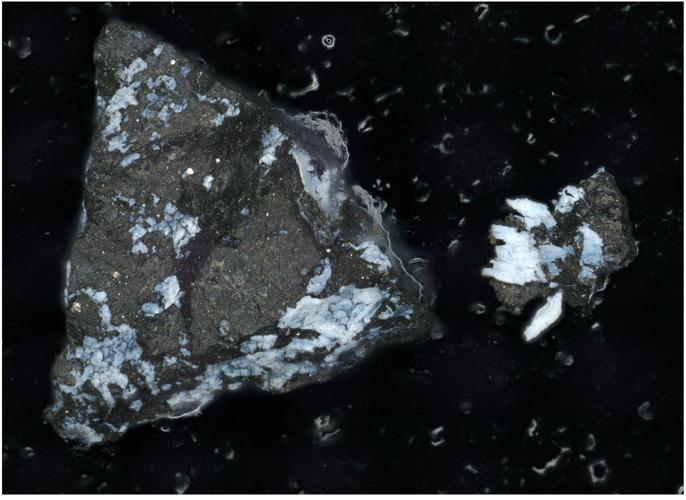
They also found a surprise that did not show up in the remote sensing data collected by the robotic spacecraft during its visit to the asteroid: magnesium sodium phosphate, a water-soluble compound that suggests the space rock could be the remnants of a tiny ocean planet from billions of years ago.
“The presence and state of phosphates, along with other elements and compounds on Bennu, suggest a watery past for the asteroid,” said U of A Regents Professor Dante Lauretta, principal investigator for OSIRIS-REx. “Bennu potentially could have once been part of a wetter world. Although, this hypothesis requires further investigation.”

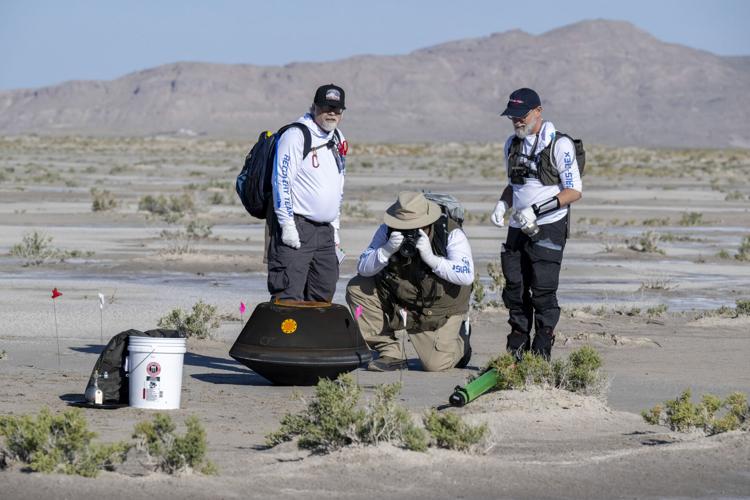
University of Arizona OSIRIS-REx Principal Investigator Dante Lauretta, right, helps recover the spacecraft's return capsule filled with samples from the asteroid Bennu after it landed at the Department of Defense's Utah Test and Training Range on Sept. 24, 2023.
The first findings from the OSIRIS-REx sample analysis team were published Wednesday in the journal Meteoritics & Planetary Science, with Lauretta as lead author.
The paper, which lists nearly 150 other contributors, also serves as an introduction for the Bennu sample catalog, an online portal where scientists can access data about the material and request tiny bits of it from NASA’s Johnson Space Center in Houston to fuel their own research.
OSIRIS-REx was launched in 2016 and briefly touched the surface of Bennu on Oct. 20, 2020, after almost two years of orbiting and observing the asteroid.
The $1.1 billion space probe returned to Earth last year to release a capsule filled with more than 121 grams of asteroid debris that landed safely on a military test range in the desert west of Salt Lake City on Sept. 24.
Many more scientific papers are expected in the coming years, as the sample analysis team and other researchers around the globe are granted access to the pebbly payload from OSIRIS-REx. Scientists could spend decades, if not generations, studying the material, which dates back more than 4.5 billion years and could hold clues about the formation of the solar system and the origin of life.
“The Bennu samples are tantalizingly beautiful extraterrestrial rocks,” said Harold Connolly, co-lead author of the new paper and a visiting research scientist from Rowan University in New Jersey. “Each week, analysis by the OSIRIS-REx Sample Analysis Team provides new and sometimes surprising findings that are helping place important constraints on the origin and evolution of Earthlike planets.”

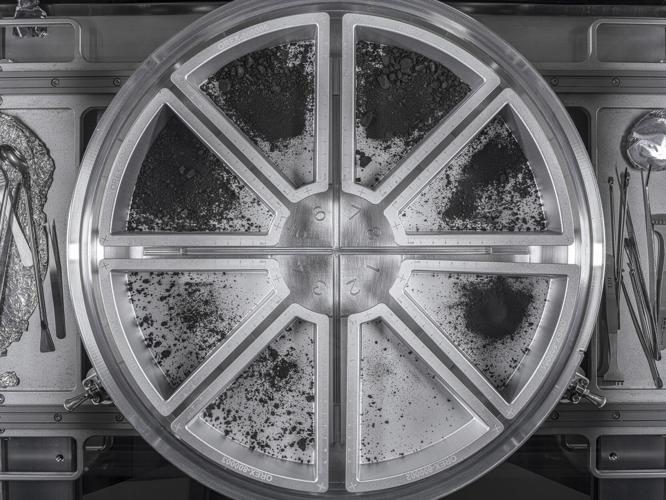
Eight sample trays contain material brought back to Earth from the asteroid Bennu by the University of Arizona-led OSIRIS-REx space mission.
Mark Marley, director of the U of A’s world renowned Lunar and Planetary Laboratory, called the publication of the first paper describing the asteroid sample “an exciting milepost” on the road to future discoveries.
“For now, we can only imagine the stories of the origins of our planet and the life upon it still to be told by the Bennu grains already in our laboratories,” Marley said.
The Tucson-born asteroid mission begins its pursuit of its next target.

