




Scientists have identified life’s key ingredients and signs of the stew needed to mix them in asteroid samples brought back to Earth by a University of Arizona-led space mission.
The rocks and dust safely delivered by NASA’s OSIRIS-REx spacecraft in 2023 contain 14 of the 20 amino acids that life on Earth uses to make proteins, according to the first in-depth study of the material.
Researchers also discovered salt crystals left behind on the asteroid Bennu billions of years ago by the slow evaporation of briny water in which organic compounds could interact and combine.

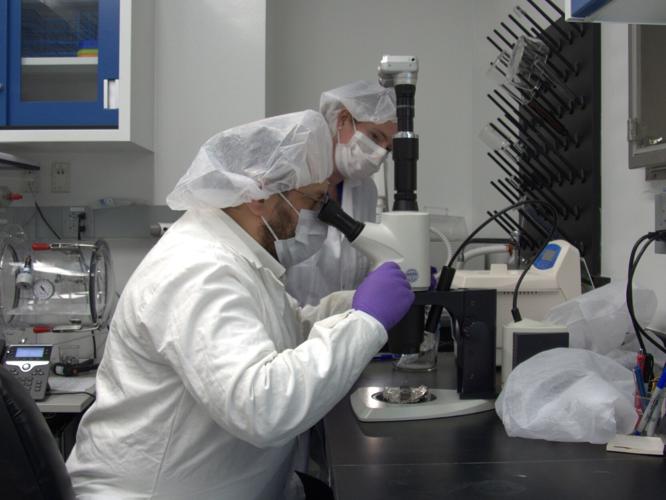
Jason Dworkin, project scientist for OSIRIS-REx at NASA’s Goddard Space Flight Center in Greenbelt, Maryland, uses a microscope to view a sample from the asteroid Bennu in the center’s astrobiology lab in November 2023.
The findings, announced by NASA and detailed in two new scientific papers published Wednesday, seem to bolster the odds that life could have formed on other planets and moons.
“These samples from Bennu are an incredible discovery, showing that the building blocks of life were widespread across the early solar system,” said U of A Regents Professor Dante Lauretta, who leads the OSIRIS-REx mission as its principal investigator.
Lauretta is a co-author on the two studies just published in the journals Nature and Nature Astronomy.
The paper in Nature describes the work of 66 scientists from four continents, who studied the geology of the asteroid samples and found evidence of an ancient environment well-suited to kickstart the chemistry of life.
“We’re seeing minerals in Bennu samples that we have never seen before in a meteorite or any extraterrestrial sample,” said co-lead author Tim McCoy, curator of meteorites at the Smithsonian Institution’s National Museum of Natural History in Washington, D.C.
That includes a complete set of salt crystals left over from an evaporation process that could have lasted thousands of years and provided the necessary stew for producing the complex compounds life depends on.

These needle-shaped salt minerals, artificially colored here in purple, were identified in samples from the asteroid Bennu, where they were deposited as a result of brine evaporation from the asteroid’s parent body.
‘We’re not just confirming what we thought we already knew about the asteroid. We are finding out something completely novel, which is part of the fun of being a scientist,” said Sara Russell, the study’s other co-lead and a cosmic mineralogist at the Natural History Museum in London.
Other surprises are detailed in the Nature Astronomy paper, which details the amino acids and other organic compounds teased from the Bennu samples.
Though no evidence of life was found, researchers did identify all five nucleobases that life on Earth uses to store and transmit genetic instructions in more complex biomolecules like DNA and RNA.
The asteroid material also yielded an unexpected amount of ammonia — close to 100 times more of it than the natural levels found in soils on Earth. Ammonia is an important building block for amino acids, which are in turn an important building block for the proteins that power nearly every biological function.

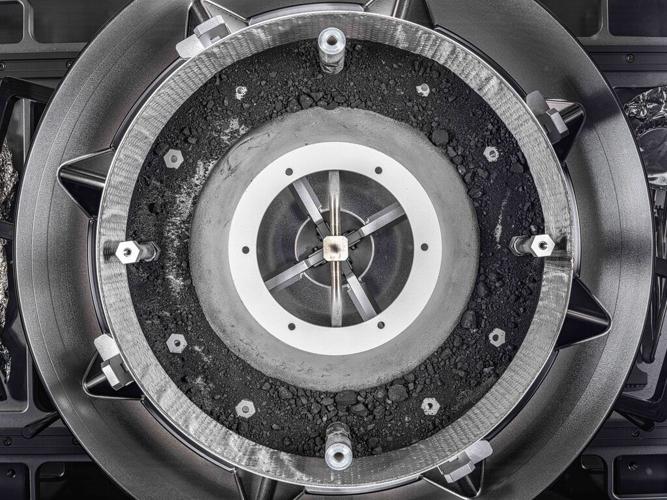
Charcoal-colored debris from the asteroid Bennu waits to be collected from the sampling canister of the University of Arizona-led OSIRIS-REx space mission in 2023. The rocks and dust have begun to offer clues about conditions in the early solar system more than 4 billion years ago.
NASA’s head of science, Nicky Fox, said the findings from Bennu support the idea that asteroids formed far from the sun were an important source of both water and the chemical building blocks of life for the young Earth.
“This is really a groundbreaking scientific discovery,” said Fox, who serves as associate administrator for the science mission directorate at the space agency’s headquarters in Washington, D.C.
These revelations could not have been made without the material brought back by OSIRIS-REx, said Danny Glavin, a senior sample scientist at NASA’s Goddard Space Flight Center in Greenbelt, Maryland, and co-lead author of the Nature Astronomy paper.
The clues they are searching for are so tiny and fragile, it’s like looking for a needle in a field full of haystacks, Glavin said. “And from orbit, all you can see is the field.”
“That’s why some of these new discoveries would not be possible without a sample-return mission, meticulous contamination-control measures, and careful curation and storage of this precious material from Bennu,” he said.

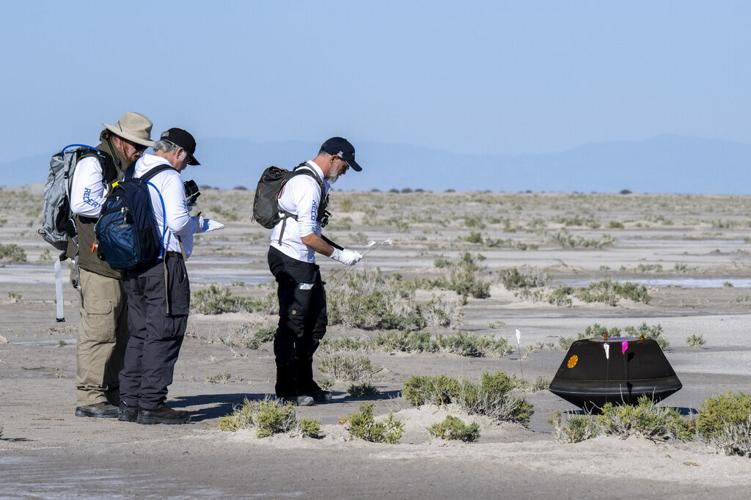
The University of Arizona’s Dante Lauretta, right, and Francis McCubbin, left, and Scott Sandford, both of NASA, collect data next to the OSIRIS-REx sample return capsule after it landed in Utah on Sept. 24, 2023.
Other U of A co-authors on the two papers include Jessica Barnes, Harold Connolly, Dani DellaGiustina, Pierre Haenecour, Dolores Hill, Tom Zega and Zoe Zeszut, all of whom have been studying samples from Bennu at the university’s Kuiper-Arizona Laboratory for Astromaterials Analysis.
Graduate students Maizey Benner, Kana Ishimaru, Nicole Kerrison, Iunn Ong, Beau Prince and Lucas Smith also took part in the work at the advanced lab that was specially built for OSIRIS-REx in the basement of the Kuiper Space Sciences Building on the U of A Mall.
The asteroid sampling mission was first conceived at the university more than 20 years ago. NASA gave the project a greenlight in 2011 as part of its New Frontiers program.
Short for the Origins, Spectral Interpretation, Resource Identification and Security Regolith Explorer, OSIRIS-REx was launched in 2016 and briefly touched down on Bennu on Oct. 20, 2020, to collect samples from the near-Earth asteroid.
After a journey of more than 4 billion miles, the van-sized space probe dropped off its capsule full of asteroid debris as it swung past Earth on Sept. 24, 2023.
The spacecraft is now on an extended journey — also led by the U of A — to rendezvous with a second asteroid known as Apophis, shortly after it narrowly misses the Earth in 2029.
Though the entire haul from the almost $1.2 billion space mission could easily fit in a disposable 8-ounce coffee cup, it still represents the largest asteroid sample ever collected and the most material to be brought back from space since the Apollo moon landings.
The grand total of 121.6 grams of rocks and dust from Bennu — more than double NASA’s mission objective — is expected to fuel decades worth of research, thanks to high-tech scientific instruments that allow each speck of debris to be sliced down to the atomic level and studied hundreds of times.
The first two in-depth studies published Wednesday are based on just 0.06% of the material brought back by OSIRIS-REx, according to Jason Dworkin, mission scientist at NASA Goddard and co-lead author on the Nature Astronomy paper.
“This is only the beginning,” he said.
After all, some of the most tantalizing questions about our solar system have yet to be answered: Are we alone? And if so, why?
“Bennu had all the stuff but didn’t make life,” Dworkin said. “Why was Earth so special?”

