


Getting more counselors and social workers into Southern Arizona elementary and middle schools this year has helped students deal with the learning and mental health challenges created by the pandemic, educators say.
District officials in the Tucson area report that some younger children returning to schools after a year of remote learning showed a regression in social skills, for example.
Other students have exhibited lower maturity levels than before and difficulties in expressing their emotions in healthy ways, officials say.
Arizona Superintendent of Public Instruction Kathy Hoffman took actions this year to pay for hundreds of school counselors and social workers across the state.
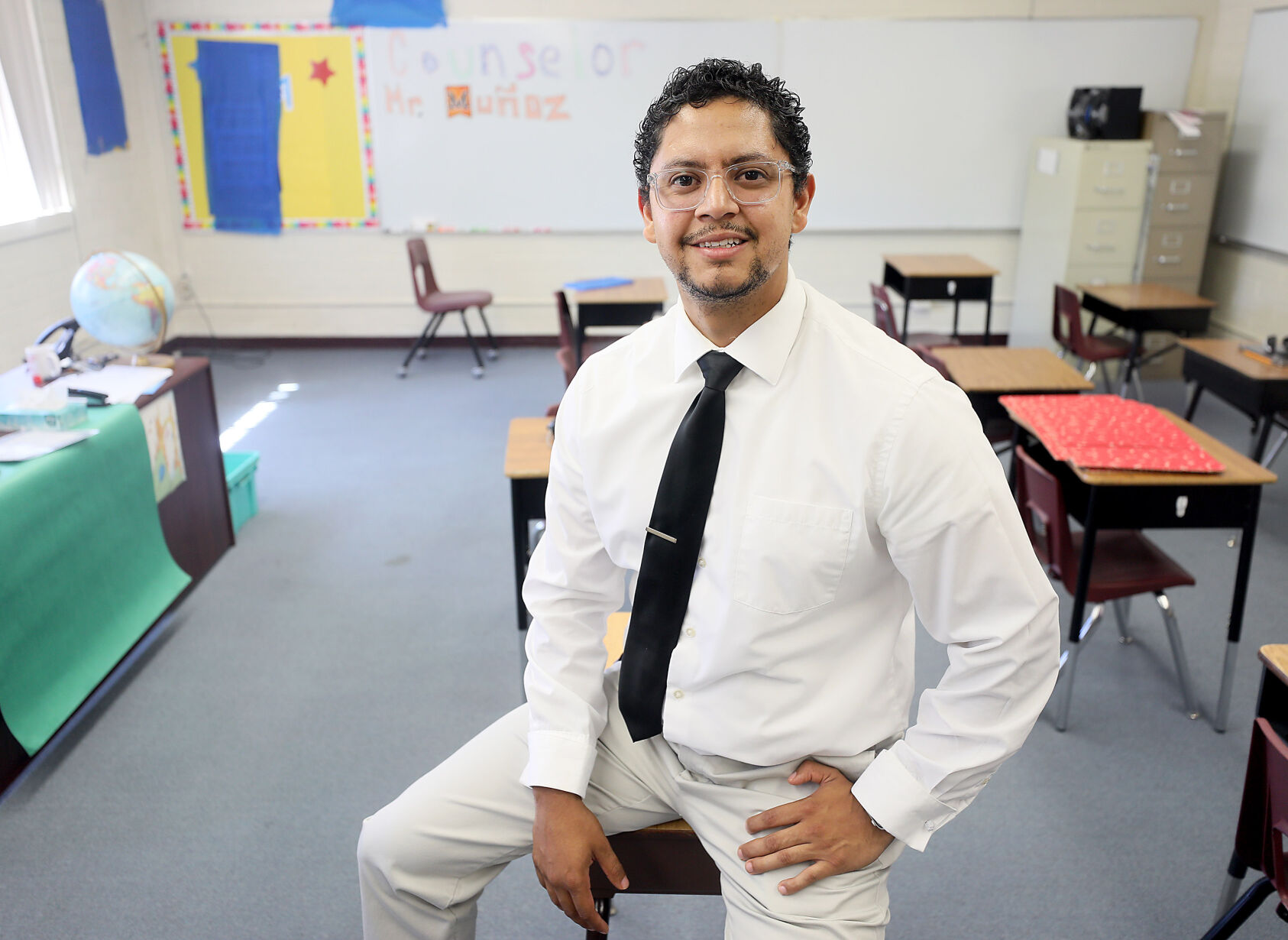
Gabriel Munoz is among them. When he moved to Nogales from Texas earlier this year for his fianceé’s federal job, he didn’t have to wonder what he would do for work.
“I did hear that there was a big growth in counseling needs, not just in Nogales but across the state,” said Munoz.
After graduating with his master’s degree in school counseling and interning in Texas, Munoz thought it was a happy coincidence that the perfect job was ready and waiting for his arrival.
But given the nationwide focus on mental health during the pandemic — especially the wellness of children and teens — he says that in a way, it was also no surprise.
Munoz is one of three new counselors who serve Nogales Unified School District’s six elementary schools, the first counselors in those schools in many years. He said his objective is to help not just students, but everyone involved in their learning process.
“This is awesome for me to be an advocate for something I really have passion for. I’m here to eliminate all the barriers students have,” he said. “I believe there’s barriers we have that stop us from learning and being successful, not only for students, but also for teachers, administrators and parents.”
Trusting local communities
Since Hoffman took office in 2019, the Arizona Board of Education, which regulates the public school system, has continuously revised its counselor certification requirements, a move that district officials in rural areas called a game-changer.
“One of the barriers that continues for rural schools is that if you have an educator who would be a great fit but don’t have a master’s degree in a mental-health-related field, there are more obstacles for a rural educator to pursue a degree,” Hoffman said.
Nogales Superintendent Fernando Parra explained: “Based on the requirements in previous years, it was difficult for us to hire anyone.”
Last year, the state Education Department provided funds, “but we weren’t able to fill the positions,” Parra said. “We reached out to Superintendent Hoffman and said ‘these are extremely needed positions but if we don’t have flexibility on loosening the requirements, it’s going to be difficult to fill.’ Making the adjustment, that really made a difference for us to be able to hire.”
The change is that counselors whose positions were funded with Coronavirus Aid, Relief, and Economic Security (CARES) Act pandemic relief money are able to apply for state certification with master’s degrees in areas of study that aren’t tied to mental health.
Under the state’s School Safety Program, by contrast, candidates for school counseling positions are required to have a master’s degree in a mental-health-related field, due to the state law tied to the plan.
The School Safety Program is a state-funded grant aimed at promoting safe and effective learning environments by paying for social workers, counselors, school resource officers and juvenile probation officers on campuses.
The change during the pandemic has helped to fill vacant positions, particularly in remote and rural areas, which struggled to find and attract applicants with such a specific skill set. Counselors hired under both types of funding are state-certified and hold advanced degrees.
Congress “is trusting local communities to know where (federal relief) dollars needed to go,” Hoffman said.
Critical to academic success
In other Southern Arizona schools, meanwhile, counseling and social worker positions had been wait-listed for more than a year because of a lack of funding.
In April, Hoffman allocated $23.1 million of federal pandemic relief money to two years of funding for 140 school social workers and counselors.
Included on that waitlist were 10 elementary schools within the Vail Unified School District in the Tucson area.
“We now have one counselor at each of our 33 schools,” said district lead counselor Amanda Cook. “This really allows them to get to know the students, staff and administration.”
In addition to the $23.1 million, a portion of federal Elementary and Secondary School Emergency Relief funds was earmarked for 41 schools — including the Nogales elementary schools — that previously had to forfeit funding for a school counselor or social worker because they weren’t able to fill the positions.
April’s infusion in funding was meant to supplement the School Safety Program.
“Even before the pandemic, Arizona faced a severe shortage of mental health professionals in schools,” Hoffman said, adding that a 2019 $20 million expansion in funding didn’t meet the demand. “Far more schools applied than we were able to provide for.”
The $23.1 in funding from the CARES Act and the American Rescue Plan Act allowed the state to fully fund the program, including the waitlist.
She noted that these new positions have an expiration date, however.
“I’ll be calling on the Legislature in the future when they expire to maintain these positions and use state funds and continue growing the program,” Hoffman said. “There are still schools in need. Just because we’ve been able to use federal funds now, there’s still a huge demand in every school.”
She called the school counselors and social workers “critical for students’ success.”
Back to basics
Vail Unified’s lead counselor Cook said elementary school teachers have reported a lack or a regression of social skills for kids returning to school after remote learning during the pandemic.
“At school you learn to interact and share. When they took that away, they didn’t get that year of learning,” Cook said. “That truly came with a gap of knowledge in that area.”
Cook said basic foundational skills building is the role of elementary school counselors, while middle school counselors focus more on peer and group interaction skills.
The pandemic highlighted the role and importance of school counselors and the need for them in all K-12 school settings, not just high schools, Cook said.
Vail’s Mesquite Elementary School made headlines in September when a parent and two other men came onto campus and, according to police, threatened to zip-tie the principal over COVID-19 policies.
While the news quickly spread in the community, it didn’t have a notable effect on students in the school, Cook said, but the counselor was available if needed.
“Kids are pretty resilient. As long as the adults that are in their lives are modeling the appropriate behavior, they’re able to mimic and follow along,” she said. “We need that all over the place.”
In Tucson Unified School District, where 140 counselors are on staff, nearly all vacant positions have been filled thanks to the influx in funding, said Rebecca Carrier, the district’s counseling coordinator.
One area of hiring focus is at the district’s Virtual Academy, the online learning option for children who still aren’t back on campus.
TUSD had anticipated a lower enrollment, but with nearly 2,000 students enrolled at the academy at the end of the first quarter, the district is working to hire more counselors to serve remote students, Carrier said.
The increase in on-campus counselors has allowed more direct contact with individual students and small groups, and allowed counselors to spend more time on college, career and academic support.
Carrier said it’s important to emphasize social-emotional learning and mental health as it relates to academic outcomes.
“Prior to COVID, we were seeing a huge jump in youth mental health concerns. Suicide is the second leading cause of death for tweens and teens in the U.S. and Arizona,” Carrier said. “We were seeing huge increases prior to COVID. Currently, we’re still seeing that.”
Carrier said educators are also seeing students exhibiting lower maturity levels and difficulties expressing their emotions.
The counselors use a practice called social-emotional learning, which emphasizes self-awareness, self-management, responsible decision making, relationship skills and social awareness.
Carrier said there’s been solid data over the last decade showing the positive impact that social-emotional learning, also called SEL, has on academics, attendance and behavior.
Open expression is encouraged
Social-emotional learning is also being used in Nogales schools, with the district’s counselors working to build relationships with students and their families, said Superintendent Parra.
“It’s just amazing what a difference” that makes, he said.
Joining Munoz as an elementary school counselor in Nogales is Yasmin Lopez, who previously worked as a case manager at a behavioral health agency.
“I’ve had a passion to work with children since the beginning,” Lopez said. “I like to motivate others and bring out the best of them. I’ve always wanted to influence children and families.”
Lopez said she’s eager to help her students learn the healthy tools they’ll need not just in school, but in life in general.
Munoz said that one of his main goals is to break down the stigma he sees about talking about feelings and mental health.
“If we start them at an early age and talk about self-care and being able to express and understand themselves,” he said, “they’re more willing to eliminate that stigma in taking care of themselves.”


