



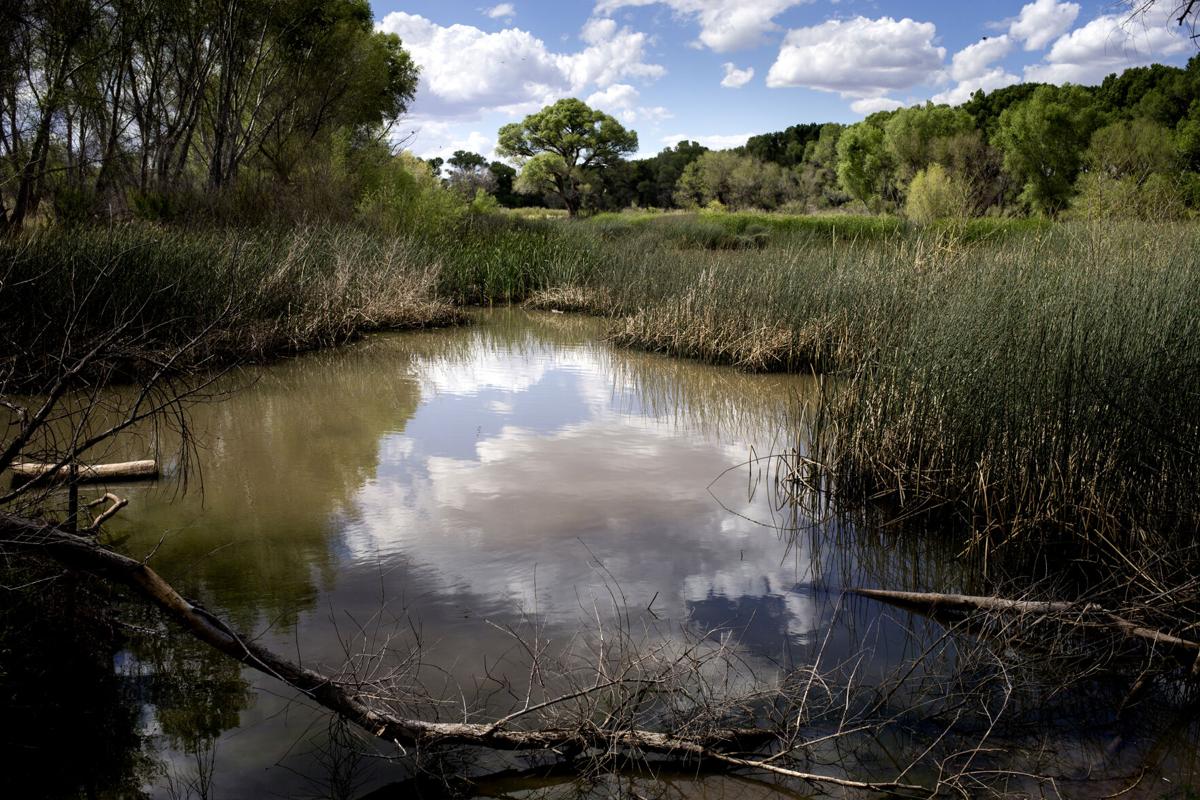
State officials for the first time this week provided an explanation for why they haven’t created a management area to protect the San Pedro River from groundwater pumping, despite evidence of continued groundwater declines there.
In a response to an environmentalist lawsuit filed in Maricopa County Superior Court seeking state action, attorneys for Gov. Katie Hobbs cited uncertainties about surface water rights in the Upper San Pedro River Basin and the fact that most groundwater use there is by federal entities that “are not necessarily subject to state regulation.”
Hobbs’ statement came in a request to dismiss the lawsuit asking that the state start proceedings to designate the basin as a state-run Active Management Area. The governor also asked separately to be removed from the case.
The Arizona Department of Water Resources also filed a motion this week seeking to dismiss the lawsuit. It didn’t cite specific substantive reasons for not creating an Active Management Area.
Its motion relied on legal arguments saying among other things that there’s no “mandatory duty” under state law for it to determine whether creation of an AMA is justified.
Hobbs’ motion made similar arguments, adding the governor “has no business in this lawsuit.” She said the only allegations made against her — that she appointed ADWR Director Tom Buschatzke and that she’s responsible for the agency’s actions and inactions — “do not come close to stating a claim for relief.”
Robin Silver, a Flagstaff activist who is one of the parties filing suit, said Hobbs’ comments justifying a lack of state action toward creating an AMA are not accurate and not relevant. Silver is a co-founder and board member of the Tucson-based Center for Biological Diversity, which is also a plaintiff in this lawsuit.
He, the center and a group calling itself the San Pedro Alliance petitioned ADWR last September to start proceedings to determine if an AMA should be declared. That would give the state power to curb groundwater pumping there although it would also draw heavy opposition from area residents and officials who oppose state regulation of rural pumping. State officials never formally responded to the petition, which prompted this lawsuit.
But Hobbs wrote in her motion, “ADWR’s Director (Tom Buschatzke) has exercised his discretion in refraining from declaring the Basin an AMA given the unsettled nature of surface water rights in the Basin and the fact that most of the groundwater use in the Basin will be for federal users that are not necessarily subject to state regulation.”
ADWR has launched other efforts in the San Pedro Basin, including developing a groundwater model to simulate how the area’s groundwater interacts with river water flows, supporting unspecified projects to “amerilorate” the basin’s groundwater declines and developing a water supply-demand study of the basin by December, Hobbs said.
Hobbs’ statement offered no additional detail to back up her explanation for ADWR’s decision not to create an AMA. ADWR officials declined to respond to questions from the Star seeking more details about their position on an AMA, with agency spokeswoman Shauna Evans saying, “We don’t comment on litigation.”
Silver said the river’s surface water rights are now legally settled, due to an August 2023 ruling by another Superior Court judge. The ruling by Judge Mark Brain in Maricopa County formally quantified legal water rights for the 37-mile-long San Pedro Riparian National Conservation Area, making it possible for the bureau or other parties to try to protect them from overpumping.
The water rights case is part of a much larger, state-run court proceeding seeking to adjudicate water rights among all users in the broader Gila River Basin.
The conservation area stretches from the Mexican border north to near the St. David Cienega south of Benson.
While the Gila River adjudication will probably last for years, Silver said the judge’s findings of fact in the case that underscored his water rights awards “are not arguable, not disputable.” In the past, the center has prevailed in court in other lawsuits when it cited findings of fact made by judges in other unresolved cases, he said.
As for the state’s argument that federal water users are the river’s biggest users, Silver said that’s not correct because the largest federal water user there, Fort Huachuca, doesn’t use nearly as much water on the post as do its employees and contractors use off the post.
‘It doesn’t matter in an AMA if most groundwater uses are federal uses. They still have to protect the groundwater there,” Silver said.

